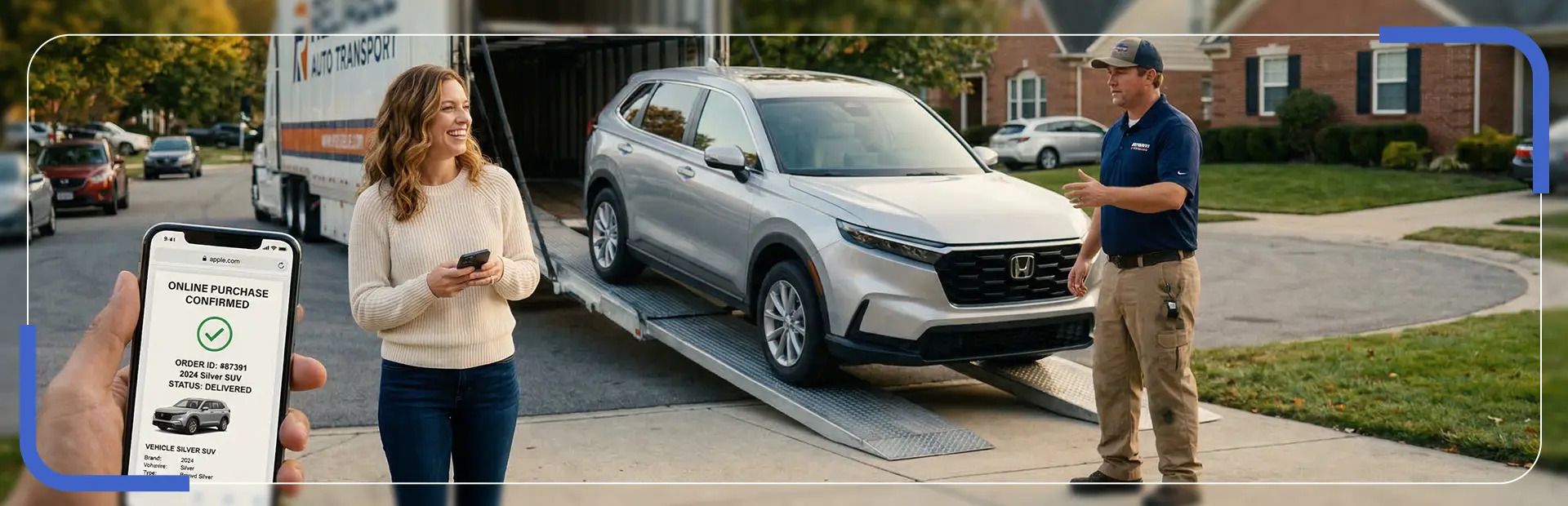
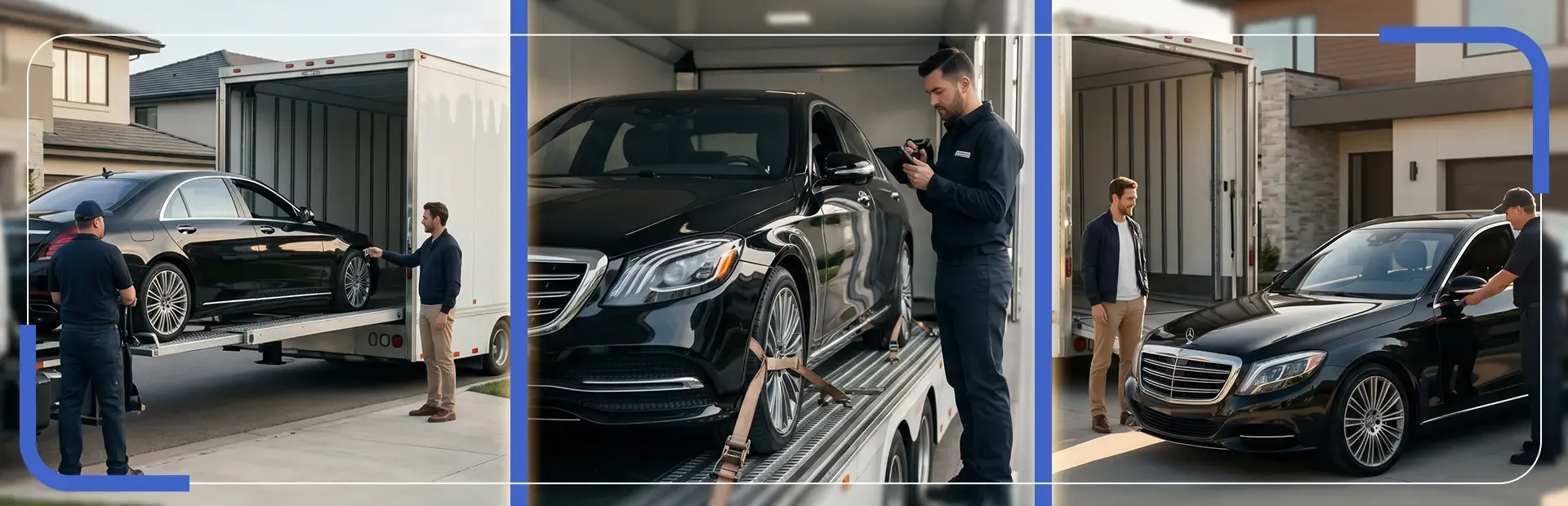
Classic car transport is a specialized shipping service designed to move collector, antique, and vintage vehicles safely, using enclosed carriers, verified insurance, and dedicated handling rather than the open trailers used for everyday vehicles. Unlike standard auto shipping, it treats your car as an asset, not just cargo. This guide covers every stage of the process: choosing a method, understanding cost, preparing your vehicle, and what to do at delivery.
Most damage claims in collector vehicle shipping trace back to one decision made before the car ever left the driveway: choosing the wrong carrier. Classic car transport is a specialized service with specific requirements, and the gap between a qualified provider and an unqualified one is not always visible in a quote. This guide closes that gap. Get a free, no-deposit quote from Safeeds today and have your classic vehicle matched with a verified enclosed carrier.
What Is Classic Car Transport and How Is It Different From Regular Auto Shipping?
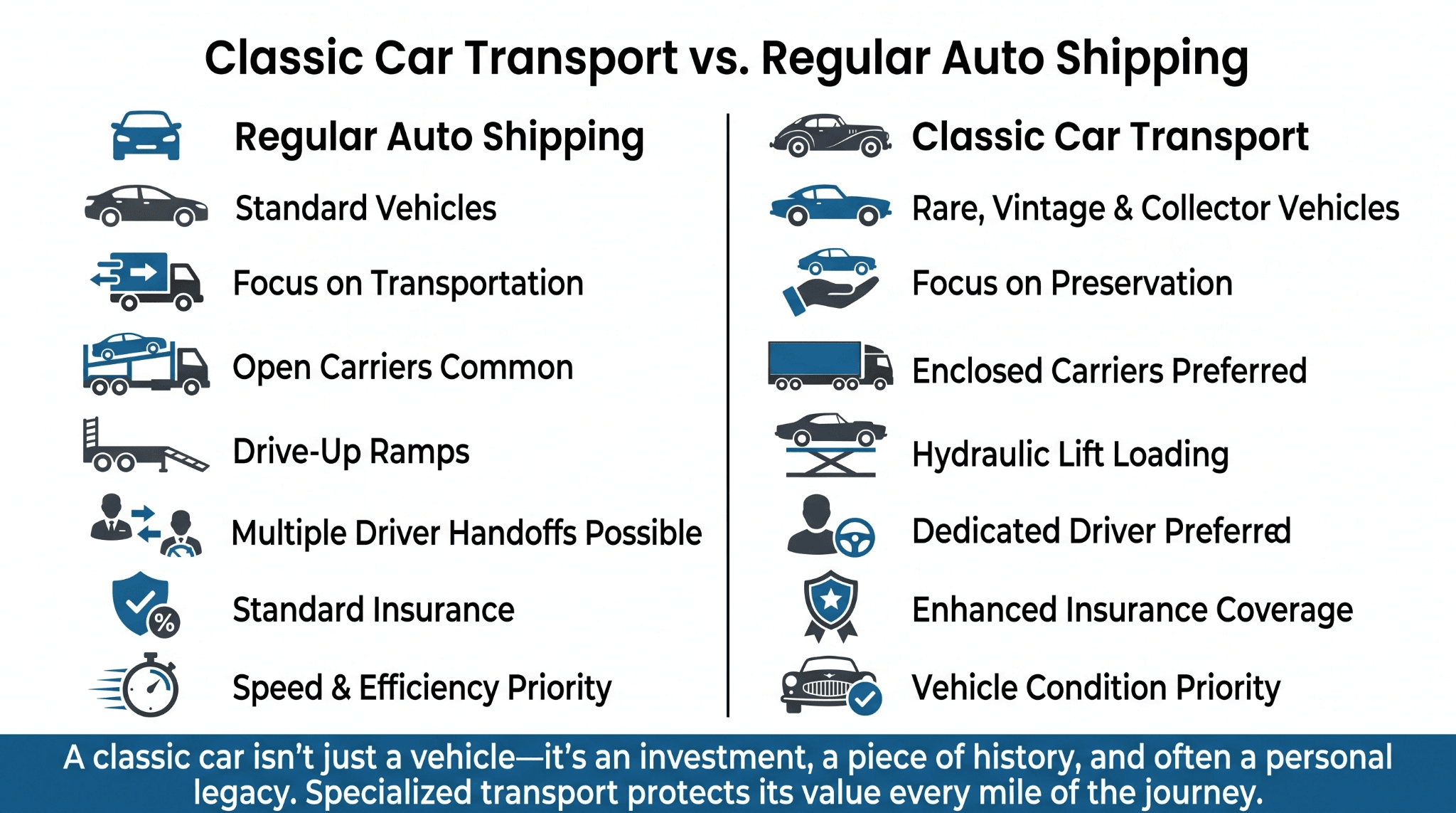
Standard auto shipping moves vehicles efficiently from point A to point B. Classic car transport does something different; it moves vehicles that cannot be easily replaced, repaired, or replicated.
The differences are operational. Specialized carriers use enclosed trailers, load cars with hydraulic lifts instead of drive-up ramps, and often assign one driver to the full route. Insurance requirements are higher. Vetting standards are stricter. Delivery expectations are set with the vehicle's condition, not just its arrival, as the primary goal.
For any vehicle that holds financial or sentimental value beyond its Blue Book price, these distinctions matter.
What vehicles qualify as classic, antique, or collector cars?
Age thresholds vary by state and insurer, but general definitions hold across the industry:
Category | Age Threshold | Key Characteristics |
Classic Car | 20–25+ years | Restored or original condition, limited daily use |
Antique Car | 45+ years | Pre-emissions era, historical value |
Collector Car | Any age | Rare, limited production, high market value |
Vintage Car | Pre-1930s | Museum-quality, historically significant |
Age alone does not determine how a vehicle should be transported. A 1995 Ferrari in mint condition warrants the same level of care as a 1969 Camaro. Rarity, condition, and replacement cost carry equal weight.
What Are the Main Classic Car Shipping Methods Available in 2026?
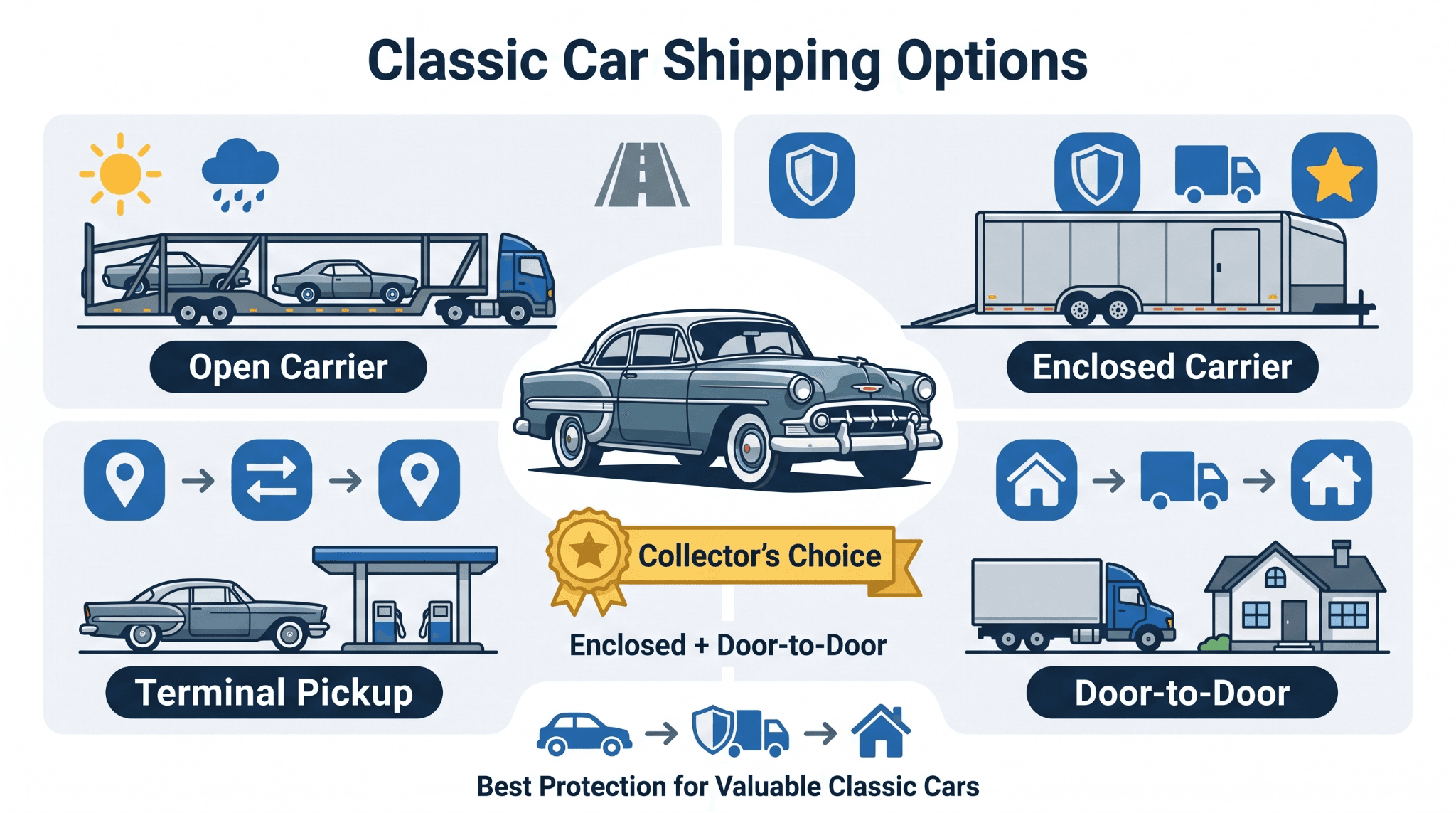
Two primary carrier types are available for vintage car transport: open and enclosed. A third variable, door-to-door versus terminal-to-terminal, further shapes the experience and cost.
Open carriers hold multiple vehicles on a two-level trailer exposed to weather and road debris. Enclosed carriers place vehicles in a fully covered trailer, protecting them from all external conditions. Terminal-to-terminal requires the owner to drop off and pick up at fixed locations; door-to-door sends the carrier directly to a specified address at both ends.
For most classic and antique vehicles, enclosed, combined with door-to-door, is the preferred combination.
When does enclosed transport make sense for vintage car transport?
Enclosed transport is the right call in these situations:
The vehicle has original, unrestored paint that cannot be replicated
The car is headed to or from an auction or collector show
The route crosses states with significant seasonal weather
The vehicle's market value exceeds $50,000
The car has rare or delicate exterior trim
In these cases, the enclosed carrier premium is not a luxury; it is a cost of protection. Enclosed transport typically costs 30–40% more than open transport, which, for a vehicle worth $80,000 or more, is a reasonable margin.
Is open transport ever appropriate for classic car shipping?
Yes, in specific circumstances. A classic car with a full repaint, a lower market value, or a short regional route may be a reasonable candidate for open classic car shipping. If the vehicle is fully insured for transit and road and weather conditions along the route are evaluated in advance, open transport can be both safe and cost-effective.
The key is making that choice deliberately, not by default.
How Much Does Collector Car Shipping Cost in 2026?
Collector car shipping cost is one of the most searched questions in this category, and the answer varies significantly. On average, classic car transport in the U.S. costs between $800 and $2,500, depending on distance, transport type, and vehicle specifics.
Cost Factor | Typical Impact |
Distance under 500 miles | Lower base rate |
Cross-country (1,000+ miles) | $1,200–$2,500 range |
Enclosed vs. open carrier | Enclosed adds 30–50% |
Inoperable vehicle | Adds $150–$300 |
Rural pickup/delivery | Increases due to limited carrier access |
Peak season (spring/summer) | Rates rise 10–20% |
Expedited scheduling (24–48 hrs) | Adds $200–$500 |
These are directional estimates. Actual quotes vary by carrier, route, and timing.
What factors push classic car transport costs higher?
Several variables consistently drive costs above the baseline:
Enclosed carrier selection on a long-distance route is the single largest cost driver
Rural pickup or delivery limits carrier availability and reduces price competition
Peak season booking between March and July reflects high demand across the full auto transport market
Inoperable vehicles require a winch or hydraulic loading equipment, narrowing the available carrier pool
Expedited scheduling compresses the standard booking window at a measurable premium
How can you reduce your collector car shipping cost without cutting corners?
Cost management in antique car transport does not require sacrificing quality. Practical steps:
Book 2–3 weeks in advance to access standard market rates
Allow a 3–5-day pickup window to expand carrier availability
Use terminal drop-off if a nearby location exists and the vehicle can be safely driven there
Collect at least three verified quotes before committing
Avoid peak spring and summer windows if the timeline allows, as demand drops in late fall and early winter
The lowest quote is rarely the best option for vintage car transport. A carrier offering significantly below-market pricing warrants scrutiny before booking.

How Do You Prepare a Classic Car for Transport?
Preparation directly affects vehicle safety in transit and the owner's ability to pursue a claim if something goes wrong. First-time shippers consistently underestimate this stage.
A well-prepared vehicle arrives with fewer incidents. When incidents do occur, a thorough pre-transport record makes resolution significantly faster. These steps apply whether the vehicle is crossing one state or the entire country.
What documentation do you need before classic car shipping?
Have the following ready before the carrier arrives:
Title or proof of ownership: Required by most reputable carriers
Current insurance certificate: Confirms active coverage at the time of pickup
Bill of lading: The official shipping contract; review it carefully before signing
Condition report: A written pre-transport record signed by both parties
Organizing these documents in advance eliminates delays and establishes a clear paper trail if a dispute arises.
How should you document the vehicle's condition before antique car transport?
A thorough photo record taken on the day of pickup is one of the most protective steps an owner can take:
Timestamped photos from all four sides, front and rear
Close-ups of any pre-existing scratches, chips, or rust
Interior shots showing upholstery, dashboard, and trim condition
A photo of the odometer at the time of pickup
Share this documentation with the carrier at pickup and retain a copy. If damage is identified at delivery, this record is the primary evidence in any insurance or claims process.
How Do You Choose a Reliable Classic Car Transport Company?
The auto transport industry includes thousands of brokers and carriers with widely varying levels of professionalism, insurance coverage, and experience with collector vehicles. Choosing correctly requires a vetting process, not just a price comparison.
According to the Federal Motor Carrier Safety Administration (FMCSA), all legitimate auto transport brokers and carriers must hold active operating authority and meet minimum insurance requirements. Verifying this takes under five minutes and eliminates a significant category of risk.
What questions should you ask a classic car shipping company before booking?
Use these as a baseline before committing:
Do you have specific experience transporting classic or collector vehicles?
What is the carrier's cargo insurance limit per vehicle?
Will the same driver handle the full route, or does the vehicle change hands?
What is your process if damage is identified at delivery?
Can you provide your FMCSA operating number and insurance certificate in writing?
Any company unwilling to answer these questions directly should be removed from consideration.
What red flags suggest a classic car transport broker is unreliable?
Watch for these warning signs:
No verifiable FMCSA registration or refusal to provide an MC number
Demands for full payment before a carrier is assigned
Insurance details provided verbally only, not in writing
Quotes 30–40% below every other estimate with no explanation
No written contract or bill of lading at the time of booking
These patterns frequently appear in double brokering arrangements, where a broker passes the shipment to a second, unvetted party without the owner's knowledge.
What Insurance Coverage Applies During Classic Car Transport?
Carrier cargo insurance covers damage that occurs while the vehicle is in the carrier's possession. According to FMCSA regulations, the standard minimum cargo insurance requirement is $100,000, though carriers transporting high-value vehicles are typically required by brokers to carry $250,000 or more. This coverage applies to the entire load, meaning it is not a per-vehicle guarantee, which is a critical distinction for anyone shipping a collector car with significant market value.
For a high-value classic, this distinction matters. A carrier transporting eight vehicles under a $100,000 policy may not fully cover a single collector vehicle worth $80,000 or more.
Does your existing classic car insurance cover transport?
Many standard and collector car insurance policies contain reduced coverage or full exclusions while the vehicle is in transit. Before booking any classic car shipping service, contact your insurer and ask two questions:
Is my vehicle covered while in the possession of a transport carrier?
What is the coverage limit and deductible during transit?
If coverage is absent or insufficient, supplemental transit protection is worth requesting.

What Do People Who Ship Classic Cars Wish They Had Known First?
Experience reveals details that the booking process does not. First-time classic car transport customers consistently report the same surprises, and the questions below reflect what collectors, first-time shippers, and vintage vehicle owners are actively asking before they book.
Is it safe to ship a classic car across the country?
Yes, when the right carrier is involved. Enclosed transport eliminates exposure to weather, road debris, and highway conditions entirely. At Safeeds, every classic car shipment is matched with a verified enclosed carrier with insurance confirmed before a carrier is assigned.
How long does classic car transport take?
Most domestic shipments take between 3 and 10 days. A carrier quoting 5–7 days for a cross-country route may take 9–10 due to weather or scheduling shifts. Treat quoted windows as estimates and build flexibility into the receiving timeline.
Does door-to-door mean the carrier comes directly to my address?
In most cases, yes, but not always to the curb. Large enclosed trailers cannot always navigate tight residential streets. The final handoff may occur at the nearest accessible point. Confirming pickup and delivery logistics with your carrier in advance prevents last-minute confusion.
Why are some classic car shipping quotes so much lower than others?
Significant price gaps are rarely explained by efficiency. Below-market estimates frequently escalate after booking through surcharges or carrier substitutions. Safeeds provides transparent, locked pricing before a carrier is assigned; the number you see at the start is the number you pay at delivery.
Will the same driver handle my vehicle the entire route?
Not always, and it matters. A vehicle that changes hands at a relay point introduces additional loading and handling risk. Always confirm the same-driver policy in writing before committing to any classic car transport provider.
What happens if my classic car is damaged during transport?
Reputable carriers document condition at pickup, carry verified cargo insurance, and have a defined claims process in place. At Safeeds, carrier insurance is validated as part of the matching process. A timestamped photo record from pickup remains the most important tool for resolving any claim quickly.
Your Classic Car Arrived: Here Is What to Do Next
The delivery moment is when documentation matters most. Before the driver leaves, inspect the vehicle in full daylight and compare its condition against the photos taken at pickup. Any new damage should be noted directly on the bill of lading, before signing, not after. Photograph any issues immediately with the timestamp enabled. Do not sign a clean bill of lading if damage is present, regardless of pressure from the driver. Contact the carrier's claims department within 24 hours if anything is identified.
When classic car shipping is handled correctly, with the right carrier, the right preparation, and the right documentation, most shipments arrive without incident. The owners who have the smoothest experiences are the ones who treated every stage of the process with the same care they bring to the vehicle itself. Request a free, no-deposit quote from Safeeds and get matched with a verified carrier that specializes in collector cars.