Most people don't realize that the date they choose to ship a vehicle can matter just as much as the company they choose to ship it with.
If you are planning to transport a vehicle, understanding the best time to ship your car is one of the most practical decisions you can make. The auto transport industry does not operate on a fixed pricing model. Car shipping cost, carrier availability, and delivery speed all fluctuate throughout the calendar year based on seasonal demand, regional migration patterns, and weather conditions.
This guide breaks down how each season affects the transport market, what factors drive pricing up or down, and which months consistently offer the most reliable service at the most competitive rates. Whether you are relocating across the country, purchasing a vehicle from out of state, or planning a seasonal move, the timing of your shipment affects both your budget and your experience. Request a free quote from Safeeds Transport Inc. and lock in your rate for 7 days, no hidden fees, no deposit required.
Why Timing Matters When You Ship a Car
Timing is one of the most underestimated variables in the auto transport process. Most customers focus on choosing a reputable company and selecting the right service type, but overlook how significantly the calendar affects what they pay and how quickly their vehicle arrives. The sections below explain the core mechanics behind that relationship.
How Seasonal Demand Shapes the Auto Transport Industry
The auto transport industry runs on a carrier-based model, where vehicles are loaded onto shared trucks and moved along established routes. Carrier availability and pricing are directly tied to how many people are shipping at any given time.
The following seasonal events consistently drive the highest demand spikes across the U.S. auto transport market:
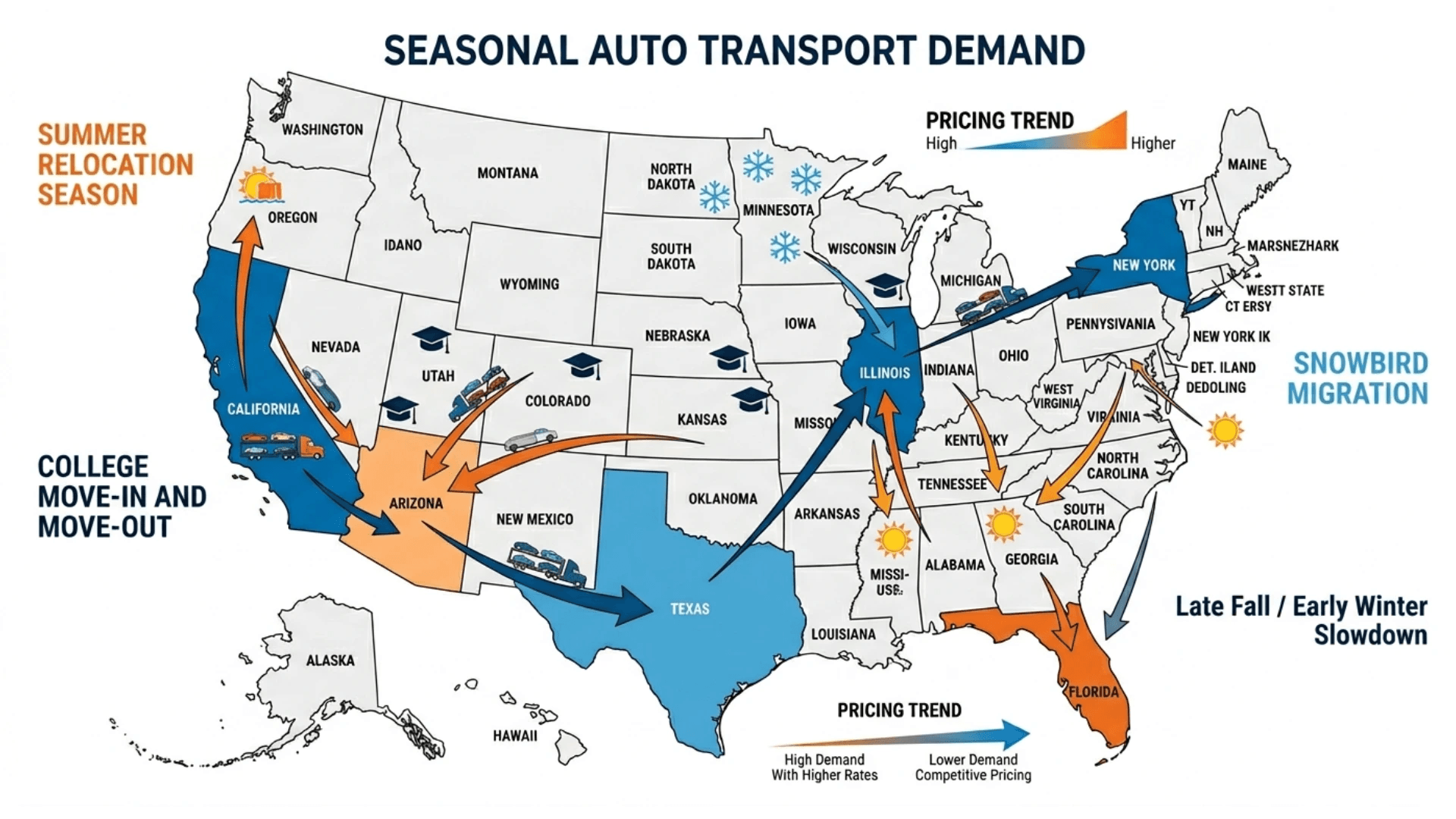
Summer relocation season: Families and individuals moving during school breaks generate the largest volume of shipment requests each year
College move-in and move-out dates: Students shipping vehicles to and from campuses create concentrated demand surges at the start and end of each semester
Snowbird migration: Retirees and seasonal residents moving vehicles between northern and southern states drive sharp pricing swings in both directions each fall and spring
Late fall and early winter: As migration and relocation activity slows, carrier capacity opens up, rates become more competitive, and booking confirmation windows shorten
The Connection Between Timing, Cost, and Delivery Speed
Car shipping cost and car shipping delivery time move in opposite directions depending on the season. Peak demand means higher prices and longer transit times; quieter months bring more competitive rates and greater scheduling flexibility. According to the Federal Motor Carrier Safety Administration (FMCSA), licensed carriers must maintain consistent safety standards year-round, but the market conditions around those carriers shift considerably with the calendar.
Why Planning Ahead Leads to Better Transport Options
Booking in advance gives customers access to a wider selection of carriers, more flexible pickup windows, and more competitive pricing. Last-minute bookings during peak season almost always result in fewer options, tighter timelines, and higher costs. For anyone seeking the best vehicle transport experience, early scheduling is not just advisable; it is a practical necessity during the busier months of the year.
Understanding Seasonal Changes' Impact on Auto Transport Rates
The price you pay to ship a car is not fixed; it responds directly to market conditions that shift with the seasons. Demand levels, carrier availability, and regional migration patterns all feed into the rate you are quoted on any given date. Understanding what drives those fluctuations makes it significantly easier to plan a shipment that fits both your timeline and your budget.
Peak Season and Why Prices Rise
The period from May through August represents the most active stretch in the auto transport calendar. Three overlapping trends drive this surge:
Summer relocation moves, as families and individuals take advantage of warmer weather and school breaks to change residences
College transitions, with students shipping vehicles to and from campuses at the end and start of each academic year
Snowbird migration, as retirees and seasonal residents begin positioning vehicles for summer stays in northern states
These converging demand sources reduce carrier availability across major routes and push pricing to its annual peak. Customers shipping during this window should expect to book further in advance and pay a premium compared to off-peak months. Tips for shipping a car during peak season always include booking at least four to six weeks ahead.
Off-Peak Shipping Opportunities
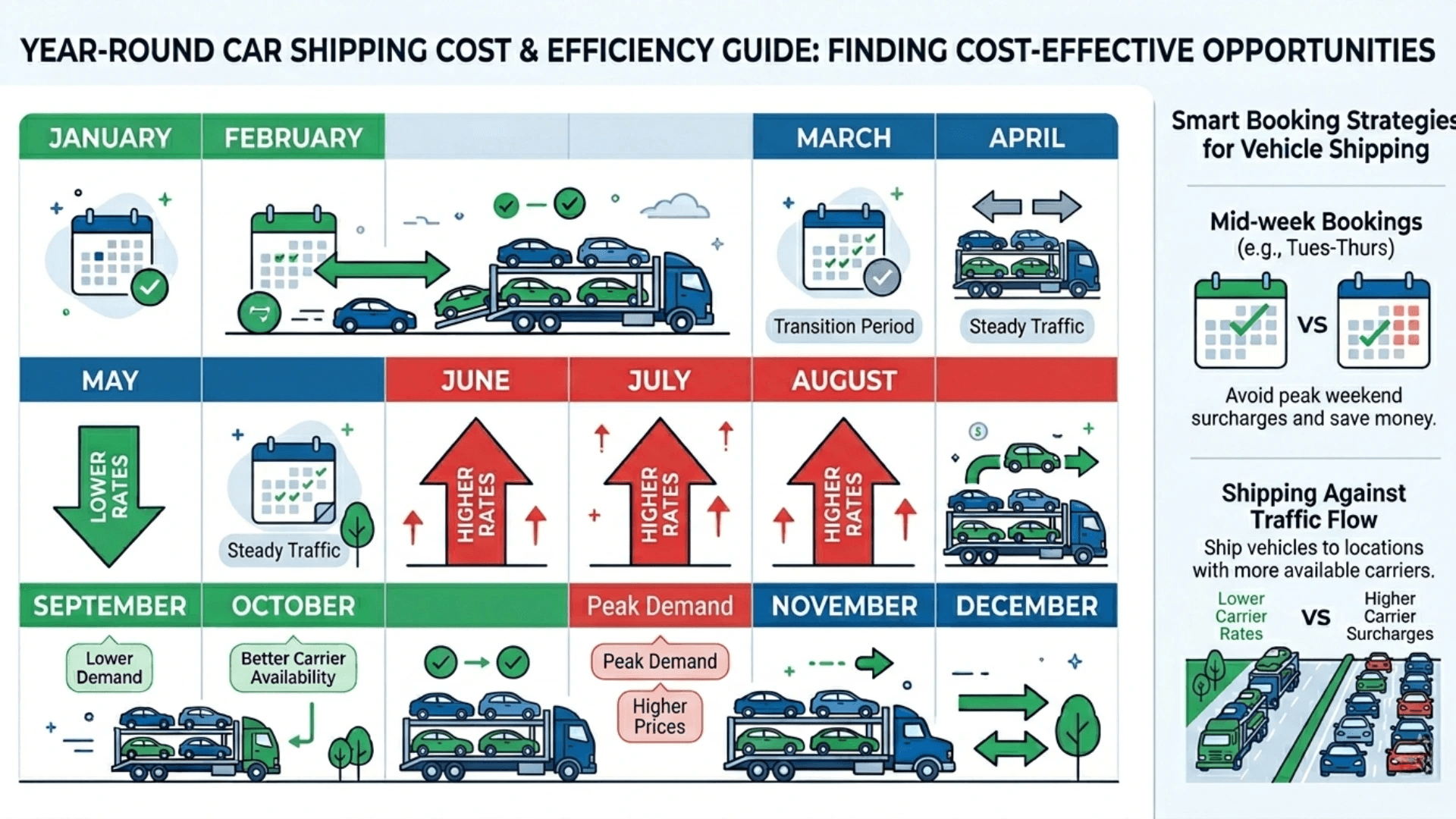
Early fall and the post-holiday stretch of January and February are consistently the most cost-effective periods to ship a vehicle. Carrier capacity is more available, broker competition increases, and lead times shorten. According to Transport Reviews, September and October in particular offer the strongest combination of pricing, availability, and weather for open carrier transport.
Car shipping's cheaper times of year share a common thread: they follow the two biggest demand peaks on the calendar:
September and October: Demand drops after the summer rush, carrier availability improves, and pricing reflects reduced competition
January and February: The post-holiday slowdown brings another window of lower rates as moving activity hits its annual low
Mid-week bookings: Outside peak season, midweek bookings often yield slightly better rates due to more flexible carrier scheduling
Shipping against traffic flow: Moving a vehicle opposite to the dominant seasonal direction frequently unlocks lower pricing on underutilized lanes
Regional Demand Patterns That Affect Pricing
Pricing is not uniform across all routes. Regional demand plays a significant role in what a customer pays for a specific shipment. For example, seasonal car shipping in Long Island experiences a notable uptick in the fall as residents arrange transport for vehicles heading to warmer states for the winter months. Routes heading southbound, toward Florida, Arizona, and Texas, become highly competitive and more expensive during November and December.
Similarly, northbound routes in the spring see increased pricing as snowbirds return and competing demand fills available carrier slots. Customers shipping against the primary flow of seasonal traffic often find better rates, as carriers are more willing to negotiate pricing on routes that are underutilized at that time of year.
The Best Time to Ship Your Car Throughout the Year
No single month works perfectly for every customer, but certain seasonal windows consistently outperform others in terms of pricing, carrier availability, and delivery reliability. The table below offers a side-by-side comparison of how each season stacks up across the factors that matter most, followed by a detailed breakdown of what to expect in each period.
Season | Demand Level | Cost Range | Carrier Availability | Weather Risk | Best For |
Spring | Moderate | Balanced | Good | Favorable | Flexible movers |
Summer | Peak | Highest | Limited | Hot / Clear | Planned relocations |
Fall | Low–Moderate | Competitive | High | Mild | Best overall value |
Winter | Low | Lowest | Variable | Harsh / Risky | Budget-conscious |
Spring Shipping: Balanced Pricing and Good Availability
Spring offers a reliable middle ground for most shippers.
Carrier availability improves after the winter slowdown
The weather becomes more favorable across most routes
Pricing hasn't yet climbed to summer levels
Late March–April brings a northbound surge from returning snowbirds
May picks up with end-of-semester student shipments
Book in early to mid-March for the best rates before demand builds
Summer Shipping: High Demand and Premium Costs
Summer is the busiest and most expensive shipping window of the year.
Peak-season costs run 20–30% higher than off-peak periods
Carrier availability on popular routes tightens quickly
Book as early as possible and offer flexible pickup windows
Consider terminal-to-terminal options to ease scheduling pressure
Early June is the sweet spot before the season hits full peak
Fall Shipping: One of the Smartest Booking Windows
Fall is consistently the best season for flexible shippers.
Lower demand and stronger carrier availability than in the summer
Mild weather across most routes
More competitive pricing throughout September and October
Early November sees a southbound surge as snowbird migration begins
Book in September or early October to lock in fall advantages
Winter Shipping: Lower Costs with Weather Risks
Winter brings the lowest prices of the year, with some trade-offs.
Best pricing along the southern and western corridors
Weather-related delays are common across northern and central states
Ice and storm systems can extend transit times and cause rescheduling
Enclosed auto transport is worth considering for protection against road salt, moisture, and temperature fluctuation.
How Seasonal Timing Affects Car Shipping Delivery Time
Delivery timelines in the auto transport industry are rarely fixed. They shift based on route distance, carrier availability, and the time of year a shipment is scheduled. Customers who understand how seasonal factors interact with transit times are better positioned to plan around potential delays and set realistic expectations from the start.
Average Car Shipping Time Estimate by Distance
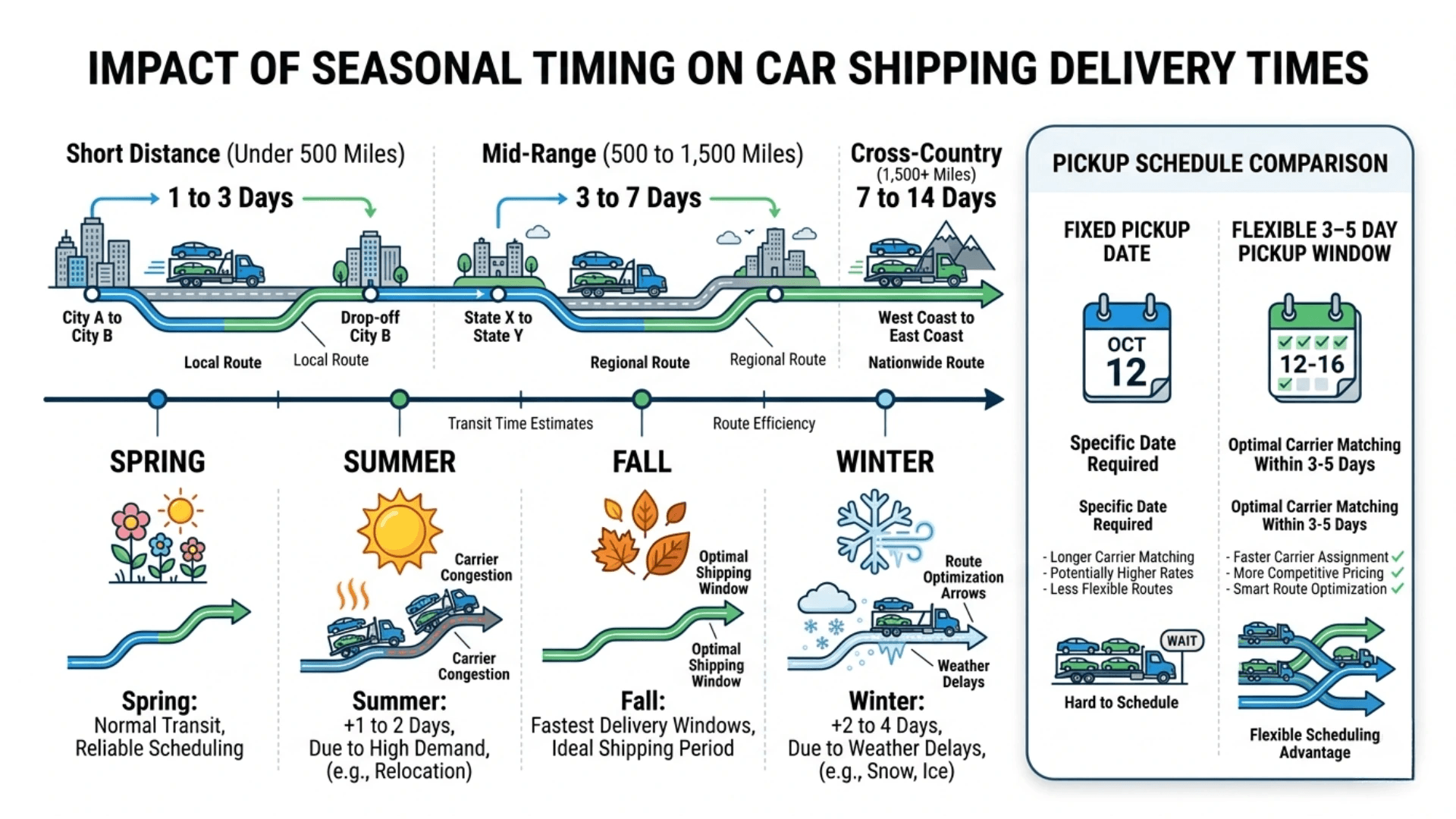
Transit time varies based on distance and route conditions. The following car shipping time estimate ranges apply under normal operating conditions:
Short-distance shipping (under 500 miles): 1 to 3 days
Mid-range shipping (500 to 1,500 miles): 3 to 7 days
Cross-country shipping (1,500+ miles): 7 to 14 days
These are standard estimates under normal conditions. Seasonal factors, particularly weather and demand levels, can extend these windows during peak and winter periods.
Why Seasonal Delays Happen
Seasonal delays typically come from three sources: weather conditions forcing carrier rerouting, congestion along high-demand corridors, and overbooking during peak windows. Winter storm systems across the Midwest or Northeast can add two to four days to estimated delivery, while summer congestion extends timelines as carriers manage heavier loads and more complex scheduling.
How Flexible Scheduling Improves Delivery Speed
Offering a three-to-five-day pickup window rather than a fixed date allows dispatch teams to match your vehicle with a carrier already passing through the area, reducing wait time and shortening the overall transit timeline. This is especially valuable during peak and holiday periods, where flexible requests consistently get filled ahead of rigid ones.
Choosing the Best Way to Ship a Car Cross Country
Method selection matters as much as timing when it comes to cross-country vehicle transport. The right combination of carrier type and service format depends on the vehicle being shipped, the route involved, and the time of year. Customers who match their method to their circumstances consistently report smoother experiences and fewer unexpected costs.
Open Carrier vs Enclosed Carrier
Your choice of carrier type affects both cost and the level of protection your vehicle receives. Here is how the two options compare:
Open Carrier | Enclosed Carrier | |
Cost | More affordable | 40–60% higher than open |
Best for | Standard passenger vehicles | Luxury, exotic, or collector vehicles |
Weather protection | Exposed to elements | Full protection from weather and debris |
Winter consideration | Adequate for mild routes | Recommended for northern/cross-country winter routes |
Availability | Widely available | Less common; book further in advance |
Door-to-Door vs Terminal-to-Terminal
Your choice of service format comes down to convenience versus cost. Here is how the two options stack up:
Door-to-Door | Terminal-to-Terminal | |
Cost | Slightly higher | More affordable |
Convenience | Pickup and delivery at your address | Requires drop-off and pickup at set locations |
Best for | Cross-country moves, unfamiliar destinations | Flexible schedules, nearby terminal access |
Popularity | Most common for long-distance shipments | Better suited for shorter or regional routes |
Matching Shipping Method to Season and Distance
The best vehicle transport method depends on a combination of the vehicle type, the distance of the shipment, and the time of year. A standard sedan being shipped from New York to Florida in October is well-served by open carrier transport during that favorable fall window. The same vehicle being shipped in January might benefit from enclosed transport to guard against winter road conditions, if the budget allows.
Cross-country distances also increase the exposure window for weather-related risk, making seasonal timing more consequential for longer routes than for short-haul shipments within the same region.

Planning Insights for a Smoother Shipment
Even with a solid understanding of seasonal trends, customers often have specific questions before committing to a booking. The following covers the most common points of uncertainty, from pricing expectations to preparation requirements, with straightforward answers that reflect how the auto transport process actually works.
How far in advance should I book my car shipment?
During peak season, May through August, book four to six weeks ahead. Carrier availability tightens quickly and last-minute requests typically mean higher pricing or longer waits. During fall and winter, one to two weeks is generally sufficient. That said, earlier booking always opens up better options regardless of the season, and with Safeeds Transport Inc., booking early also activates your 7-day price guarantee.
Will my car shipping cost change between when I book and when my vehicle is picked up?
With many brokers, pricing can shift between the quote and pickup stages, especially during high-demand periods. Safeeds Transport Inc. addresses this with a 7-day price lock. The rate confirmed at booking is the rate honored at pickup, with no hidden fees and no deposit required until a carrier has been secured.
What is the difference between open and enclosed transport, and which is right for my vehicle?
Open transport suits most standard passenger vehicles; it is cost-effective and widely available. Enclosed transport is the better choice for luxury, classic, or high-value vehicles, and is worth considering during winter months when road salt and moisture present real risks. If you are weighing the two options, Safeeds Transport's team can help you decide based on your vehicle type, route, and timing.
How do I know my vehicle is insured during transport?
Licensed carriers are federally required to carry cargo insurance covering vehicles in transit. Safeeds Transport Inc. verifies that every carrier in its network holds the required coverage before any shipment is assigned. For added peace of mind, Safeeds also offers AFTA GAP Protection, supplemental coverage that goes beyond what standard carrier insurance typically provides.
What should I do to prepare my vehicle before pickup?
Clean the vehicle so its condition can be accurately documented. Reduce the fuel level to around a quarter tank, remove all personal items from the interior, and verify tire pressure and battery health, especially for winter shipments. Photograph the vehicle from all angles before handoff, and review the Bill of Lading carefully at both pickup and delivery to ensure any pre-existing condition is properly recorded.
Making the Right Seasonal Shipping Decision
The timing of your shipment shapes nearly every aspect of the experience, from what you pay to how long you wait. Fall remains the strongest overall window for most customers, offering competitive pricing, solid carrier availability, and manageable weather. Spring is a reasonable alternative if you book before the snowbird return and the end-of-semester demand builds. Summer and the holiday period require the most lead time, and winter offers genuine savings if you are comfortable with the weather trade-off on northern and cross-country routes.
Regardless of when you ship, the fundamentals hold: book early, stay flexible on scheduling, and work with a transport partner that is upfront about pricing and process. Safeeds Transport Inc. offers free quotes with a 7-day price lock, no deposit requirements, and a nationwide network of licensed, insured carriers. Get your quote today and ship with confidence, whatever the season.