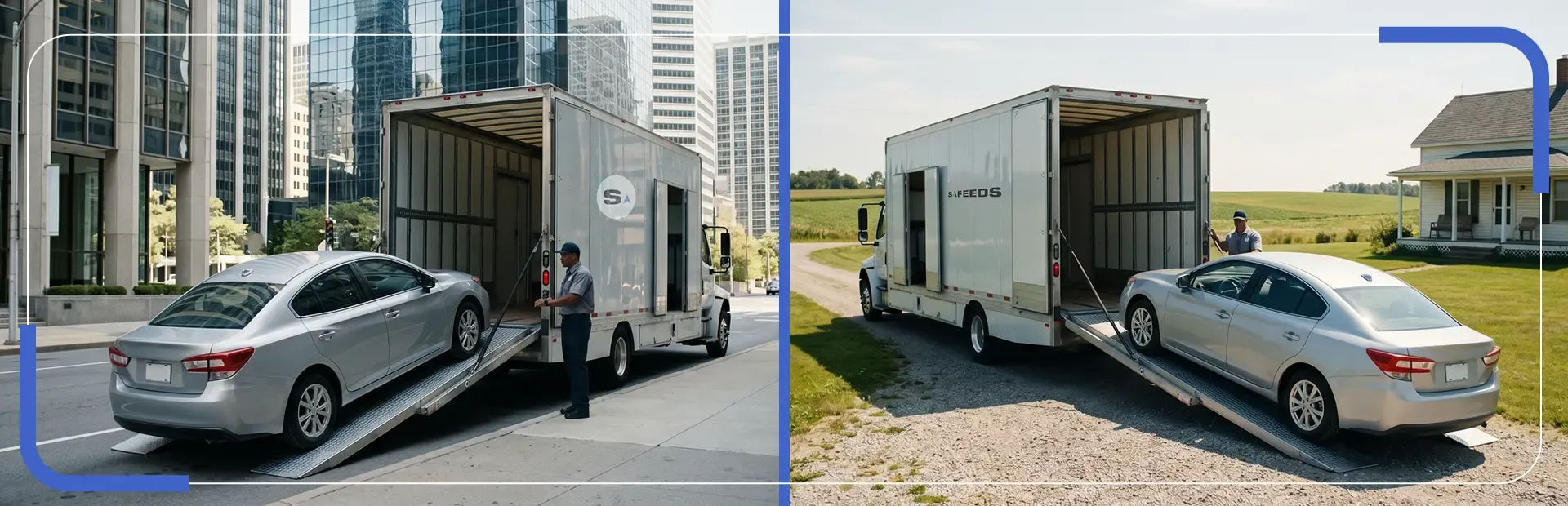
Moving a standard car across the country is complex enough; moving a heavy commercial vehicle across multiple states is an entirely different challenge. Heavy vehicle transport involves permit requirements, route restrictions, specialized equipment, and coordination across multiple regulatory jurisdictions, all of which must be planned before a single wheel turns.
Poor planning in this space does not just cause delays; it causes compliance violations, equipment damage, and significant cost overruns. Whether you are relocating construction machinery, a commercial truck, or an oversized fleet vehicle, the margin for error is narrow.
This guide covers six practical tips for executing a cross-country heavy vehicle move safely, efficiently, and within budget. Get a free quote from Safeeds Transport, experienced in heavy and oversized vehicle logistics across all U.S. routes.
Why Heavy Vehicle Transport Requires Specialized Planning
Standard auto shipping involves a licensed carrier, a flatbed or enclosed trailer, and a straightforward delivery window. Heavy vehicle transport operates in an entirely different category, one governed by federal weight limits, state-by-state permit requirements, and equipment specifications that vary by vehicle type and route.
The consequences of inadequate planning are tangible:
Permit violations resulting in fines or shipment holds
Route closures due to bridge weight limits or height restrictions
Equipment mismatch causing loading delays or vehicle damage
Missed delivery windows with downstream contractual consequences
Understanding these risks before booking is what separates a smooth cross-country move from a costly one.
Size, Weight, and Route Restrictions
Every state sets its own limits for oversized vehicle transport. Federal baseline standards allow a maximum vehicle width of 8.5 feet, height of 13.5 to 14 feet, and gross weight of 80,000 pounds on interstate highways. Vehicles exceeding these thresholds require special permits, and those permits are issued per state, per route.
A large transport vehicle crossing six states may require six separate permit applications, each with different processing times and conditions. Some states restrict oversized loads to daylight hours only. Others require pilot or escort vehicles. Route planning must account for all of these variables before the shipment is booked.
Equipment Requirements for Safe Delivery
Not all carriers are equipped for heavy equipment transport truck operations. The trailer type must match the vehicle's dimensions and weight distribution. Common equipment used in heavy transport includes:
Flatbed trailers: Standard for most heavy vehicles within legal limits
Lowboy trailers: Used for tall equipment that exceeds standard height clearances
Removable gooseneck (RGN) trailers: Required for vehicles that must be driven onto the trailer rather than loaded by crane
Multi-axle trailers: Necessary for extreme weight distribution across longer vehicles
Selecting a carrier without the right equipment for your specific heavy transport vehicle is one of the most common and avoidable causes of transport delays.
Tip #1: Choose a Heavy Vehicle Transporter with Proven Experience
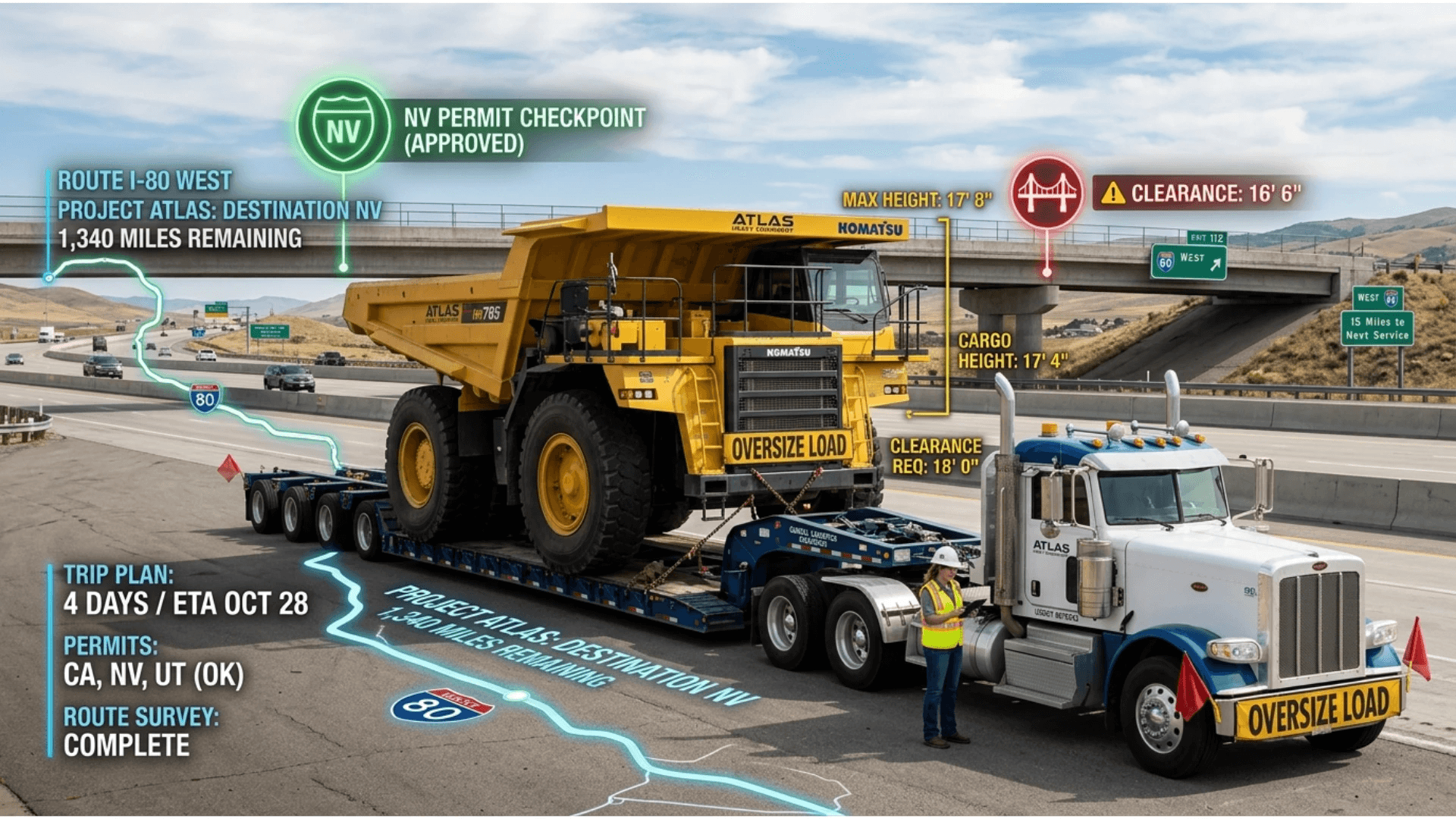
Experience is the most important factor when selecting a heavy vehicle transporter for a cross-country move. Oversized and heavy transport involves regulatory complexity that inexperienced operators consistently underestimate, and the consequences fall on the customer.
A transporter's track record across similar vehicle types and routes is a more reliable indicator of reliability than price alone.
Verify Licensing and Insurance
Before booking any truck transporter service, confirm the following with the carrier. According to the Federal Motor Carrier Safety Administration (FMCSA), all brokers and carriers operating in the U.S. must hold a valid MC number, maintain active operating authority, and carry cargo insurance sufficient for the vehicle being transported.
Additional items to verify:
Valid operating authority for the vehicle type and weight class being transported
Cargo insurance coverage sufficient for the full value of the vehicle
Surety bond confirming financial accountability in the event of a claim
Review Past Heavy Duty Truck Transport Projects
Ask prospective carriers for references or case examples from previous heavy duty truck transport projects. Specifically look for:
Experience on routes comparable to yours
Familiarity with permit requirements in the states your shipment will cross
History of on-time delivery on long-distance hauls
Ask About Specialized Fleet Capabilities
A qualified heavy vehicle transporter maintains a diversified fleet. Confirm they have access to the specific trailer type your vehicle requires and that their drivers hold the appropriate commercial licenses for oversized load operations.
Tip #2: Understand Route Planning Before Booking
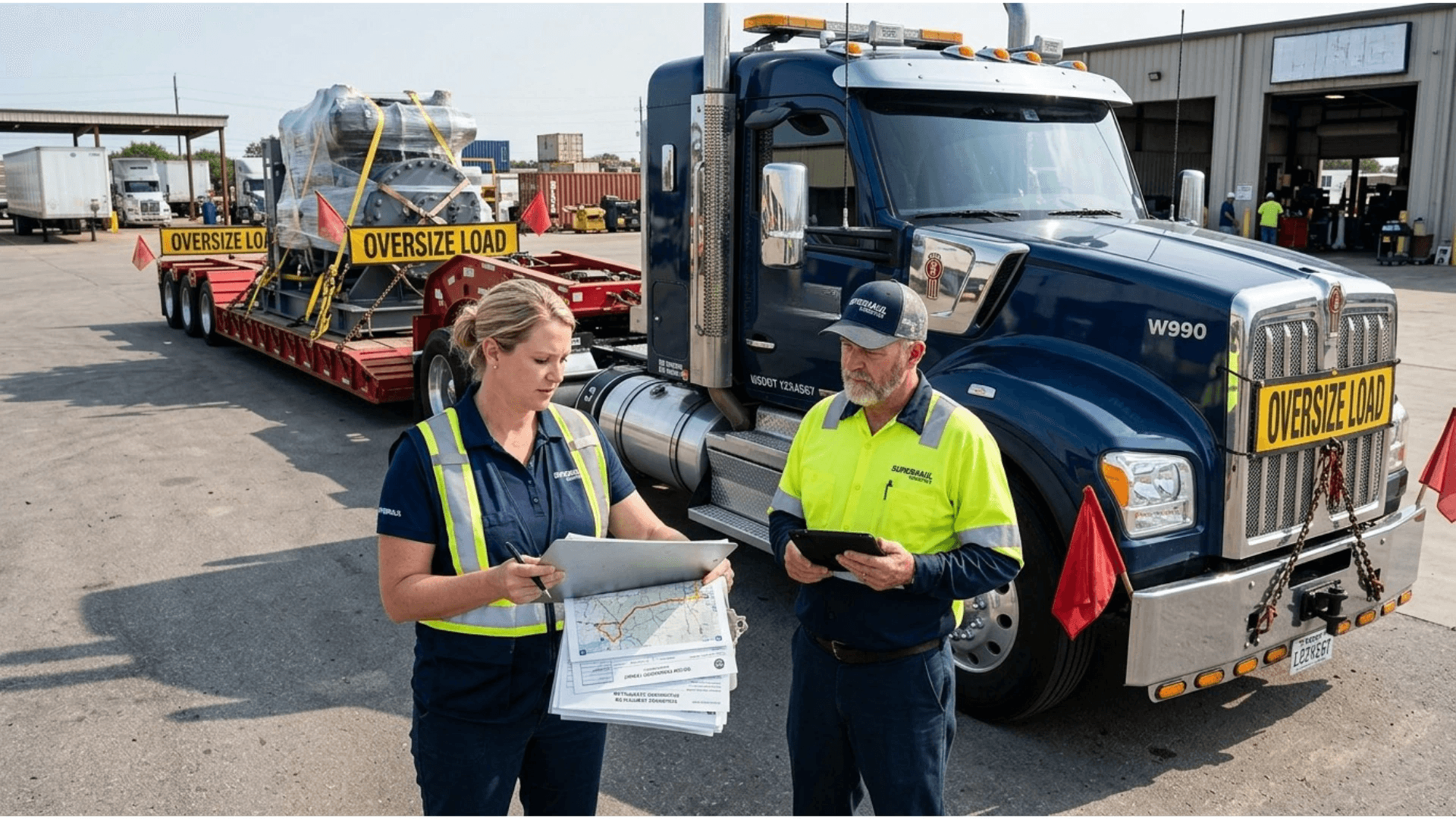
Route planning is not a logistical detail; it is a foundational requirement for any successful heavy truck transport operation. The Federal Highway Administration (FHWA) sets the baseline standards for oversize and overweight vehicle movement on U.S. highways, and each state builds its own permit requirements on top of those federal thresholds. The route determines permit requirements, transit time, delivery windows, and total cost.
A qualified carrier or broker will conduct route analysis before confirming any booking. Here is what that analysis must account for:
State-by-state permit restrictions: Each state has its own oversize load regulations, processing times, and approved travel windows
Bridge weight ratings: Not all highway bridges support the gross weight of large transportation vehicles; route planning identifies and avoids inadequate crossings
Height and width clearances: Overpasses, tunnels, and utility lines create clearance constraints that must be mapped in advance
Weather-related disruptions: Mountain passes, seasonal road closures, and extreme weather windows affect routing on long cross-country hauls
Construction and seasonal delays: Active construction zones on primary routes can significantly extend transit times
Escort and pilot vehicle requirements: Many states mandate lead or follow escort vehicles for heavy transport truck shipments exceeding specific dimensions
The table below outlines key oversize load thresholds that typically trigger permit and escort requirements across most U.S. states:
Dimension | Standard Legal Limit | Typical Permit Threshold | Escort Often Required |
|---|---|---|---|
Width | 8.5 feet | Over 8.5 feet | Over 14 feet |
Height | 13.5 – 14 feet | Over 14 feet | Over 16 feet |
Length | 48 – 53 feet | Over 53 feet | Over 75 feet |
Gross Weight | 80,000 lbs | Over 80,000 lbs | Over 120,000 lbs |
Thresholds vary by state. Always confirm current requirements with your carrier or broker before booking.
Delivery window expectations should also be established clearly before departure. Heavy truck transport on cross-country routes typically involves multi-day transit. Customers who expect next-day or two-day delivery on a coast-to-coast move are consistently disappointed, and that disappointment is avoidable with clear communication upfront.
Tip #3: Prepare Your Heavy Transport Vehicle Properly
Proper preparation before transport is one of the most direct ways to prevent delays, damage, and additional costs. Many customers underestimate this step, and carriers regularly encounter vehicles at pickup that are not ready for loading.
Taking the time to prepare your heavy transport vehicle correctly before the carrier arrives makes the entire process more efficient for everyone involved.
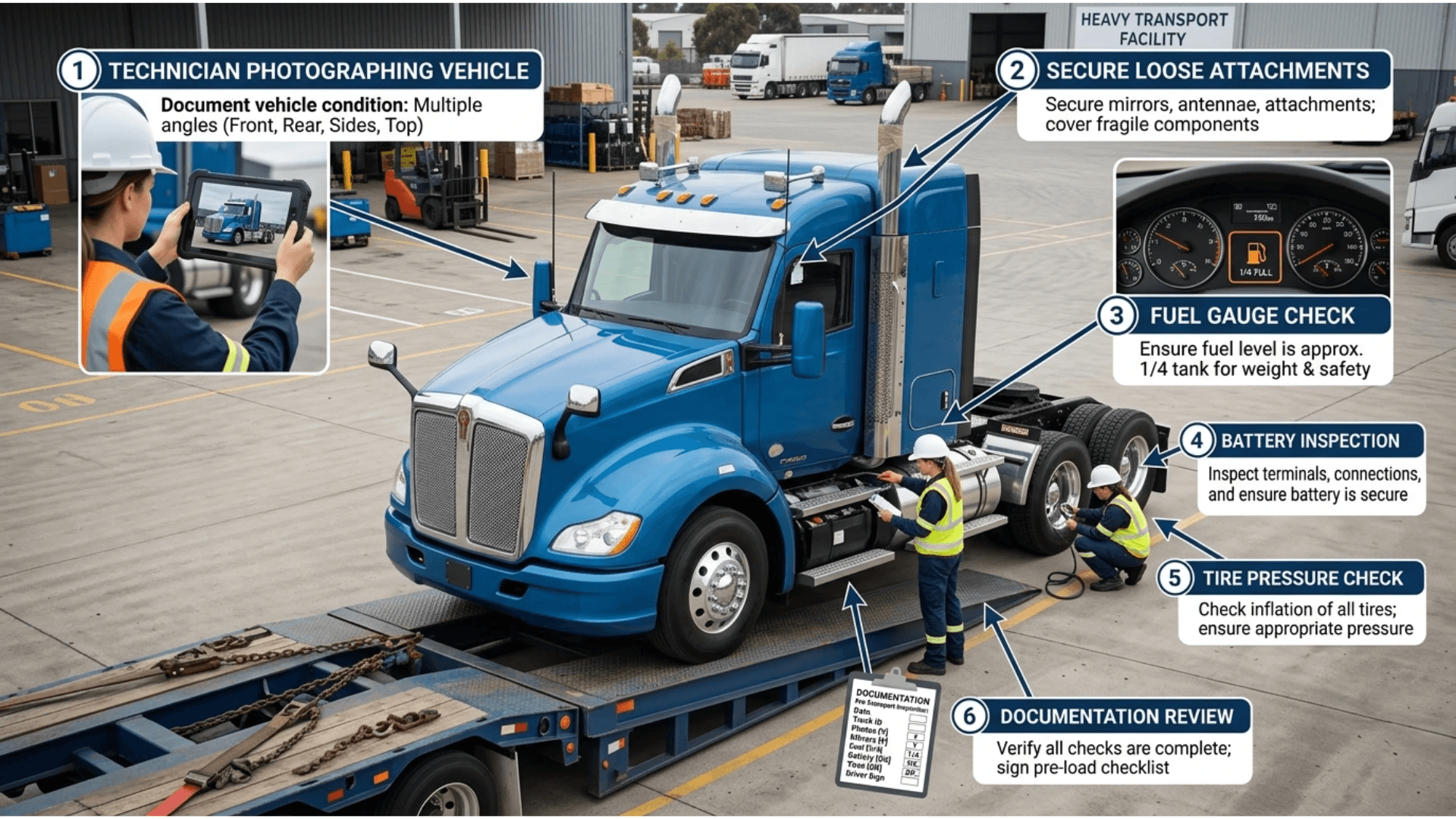
Inspect and Document Vehicle Condition
Before the carrier arrives, conduct a thorough condition inspection and document everything:
Photograph the vehicle from all angles, including underneath where accessible
Note all pre-existing damage, dents, cracks, fluid leaks, and structural issues
Confirm all documentation is accurate and accessible on pickup day
This documentation becomes your reference point if any damage dispute arises during or after transit.
Remove Loose Components
Oversize vehicle transport creates vibration and movement during loading and transit. Loose components that are not secured can shift, fall, or cause damage to the vehicle or carrier equipment. Before pickup:
Remove or secure all external attachments, mirrors, antennas, steps, and mounted accessories
Drain or secure any fluid reservoirs that could leak during transport
Retract or lock any extendable components, including booms, outriggers, or hydraulic arms
Check Operational Requirements
Confirm the following with your carrier ahead of pickup day:
Fuel level requirements: most carriers require tanks at one-quarter full or less
Battery condition: the vehicle must be operable for loading if self-propelled
Tire pressure: correctly inflated tires are required for safe ramp loading and unloading
Tip #4: Know What Affects Heavy Vehicle Transport Costs
Heavy vehicle transport pricing is more variable than standard auto shipping. Understanding the key cost drivers helps you evaluate quotes accurately and avoid unexpected charges after booking.
The main factors affecting your final rate:
Vehicle dimensions and weight: Wider, taller, and heavier vehicles require specialized trailers, additional permits, and escort vehicles
Distance and route complexity: Restrictive permit states add cost regardless of distance
Fuel market fluctuations: Rate increases during fuel price spikes are standard across all heavy-duty truck transport operations
Escort vehicle costs: Where state law requires pilot vehicles, those costs pass directly to the customer
Permit fees: Each state permit carries its own processing fee, and multi-state hauls accumulate these across every jurisdiction
Scheduling urgency: Last-minute bookings on heavy transport truck shipments almost always carry a premium
Accurate logistics accounting for trucking companies and transportation services requires all cost components to be itemized clearly in your quote. A reputable carrier breaks down every charge before you commit, not after.
Transport Scenario | Typical Cost Range | Key Cost Driver |
|---|---|---|
Standard flatbed, short haul under 500 miles | $800 – $1,500 | Distance and fuel |
Oversized load, single state permit | $1,500 – $3,000 | Permit and equipment |
Multi-state cross-country heavy haul | $3,000 – $8,000+ | Permits, escorts, distance |
Non-running or inoperable heavy vehicle | Add 20 – 30% | Special loading equipment |
Expedited or last-minute booking | Add 15 – 25% | Carrier availability |
Estimates only. Contact Safeeds Transport for a detailed quote based on your specific vehicle and route.
Tip #5: Protect Your Investment with Proper Coverage
A heavy transport vehicle represents a significant financial asset, one that standard carrier insurance may not fully protect. Coverage limits, policy exclusions, and claim procedures vary considerably between operators, and the gaps in basic coverage only become visible when a claim is filed. Reviewing policy details before booking is not optional; it is essential. For high-value equipment, the difference between adequate and inadequate coverage can be significant.
Key protection steps before booking any truck transporter service:
Confirm the cargo insurance limit covers the full replacement value of your equipment
Check policy exclusions, many exclude damage during loading and unloading
Ask about supplemental gap protection for high-value or irreplaceable equipment
Review the Bill of Lading carefully at pickup, confirm all pre-existing damage is accurately recorded before signing
Establish scheduled check-in intervals and a direct driver or dispatch contact for the duration of transit
Tip #6: Work with Trucking Transportation Services That Communicate Clearly
Of all the factors that determine whether a heavy vehicle transport move goes smoothly, communication is the one most often overlooked, and most often cited when shipments go wrong. From the first quote to final delivery, clear and consistent communication is what keeps a complex cross-country haul on track and gives customers confidence that their vehicle is in capable hands. A carrier that communicates proactively removes uncertainty at every stage of the process.
A reliable heavy vehicle transporter commits to the following in writing before departure:
Transparent written quotes with every cost component itemized
Shipment tracking access throughout transit
Scheduled updates at agreed intervals, not only when problems arise
A dedicated support contact for escalations and route changes
Fast communication if delays, weather disruptions, or permit issues occur
Trucking transportation services that cannot commit to these basics in writing are a risk not worth taking on a high-value commercial vehicle move.
Common Mistakes That Delay Heavy Vehicle Transport
The road does not cause most heavy truck transport delays; they are caused by avoidable preparation failures on the customer side. Identifying these mistakes before booking is the most effective way to keep your shipment on schedule and within budget.
These are the errors that come up most consistently:
Booking too late: Heavy hauls require permit processing, equipment scheduling, and route analysis, none of which can be compressed into a short window. Book at least two to three weeks ahead for standard heavy hauls and further in advance for complex multi-state routes
Incomplete documentation: Missing title, weight records, or accurate vehicle dimensions causes immediate holds at pickup. Confirm all paperwork is complete and accessible before the carrier arrives; delays at this stage can push your departure to the next available slot
Choosing on price alone: The lowest quote in heavy-duty truck transport almost always reflects missing services, permits not included, escort vehicles not accounted for, or insurance limits below the vehicle's actual value. Evaluate quotes on completeness, not just the bottom line
Ignoring route constraints: Customers who select carriers without verifying route planning capabilities regularly encounter permit delays, bridge weight rejections, and last-minute rerouting. Confirm that your carrier has conducted a full route analysis and received permit approvals before the booking is confirmed

What to Ask Before Booking Heavy Truck Transport Services
Choosing the right heavy vehicle transporter starts with asking the right questions. Here are the five that matter most.
What trailer types do you have available for my vehicle's dimensions?
Equipment availability is non-negotiable in heavy transport. A qualified truck transporter service will assess your vehicle's exact dimensions and weight, confirm the appropriate trailer type, and verify availability before a booking is placed, not after.
How do you handle state permits for multi-state hauls?
Permit management is one of the most complex elements of heavy truck transport. Your carrier should handle every permit application, monitor processing timelines across all states, and confirm approvals well before the vehicle departs. Any carrier that leaves permit coordination to the customer is not equipped for cross-country heavy hauls.
What does your cargo insurance cover, and what are the limits?
Basic cargo insurance has exclusions that many customers only discover at claim time. Request full policy details in writing, confirm the coverage limit against your vehicle's replacement value, and ask specifically about loading, unloading, and transit exclusions before signing anything.
How will you communicate during transit?
For a high-value cross-country haul, communication is not a courtesy, it is a requirement. Establish check-in frequency, tracking access, and a direct escalation contact before the vehicle departs. A carrier that cannot commit to this in writing is one worth reconsidering.
Why choose Safeeds Transport for heavy vehicle logistics?
Safeeds Transport manages heavy duty truck transport with direct carrier coordination, full permit handling, verified insurance, and dedicated communication from first quote to final delivery, with transparent pricing and no hidden fees.
Building a Safer Cross-Country Shipping Strategy
Successful heavy vehicle transport comes down to four things: planning, preparation, protection, and communication. Carriers who deliver consistently on heavy hauls treat every shipment as the high-value operation it actually is, not a standard load on a standard trailer.
The right heavy vehicle transporter does not just move equipment; they manage the full logistics chain, from route analysis and permit acquisition to carrier verification and final delivery confirmation. That level of accountability is what separates a smooth cross-country move from a costly one.
Get a free quote from Safeeds Transport and move your heavy vehicle with a team that handles permits, routing, carrier verification, and delivery from start to finish.