Five things set your car shipping price: distance, vehicle size and weight, open versus enclosed transport, the time of year, and how busy your route is. Distance is the largest single factor, but a rural pickup on a quiet lane can cost more than a longer trip between two major cities.
Anyone comparing quotes eventually asks the same underlying question: what actually determines the number on the page? The factors that affect car shipping prices are consistent across the industry, even though the exact dollar amount varies by carrier and by route. Get your free, price-locked quote today and see exactly which of these factors apply to your specific shipment.
Which Factor Affects the Price Most?
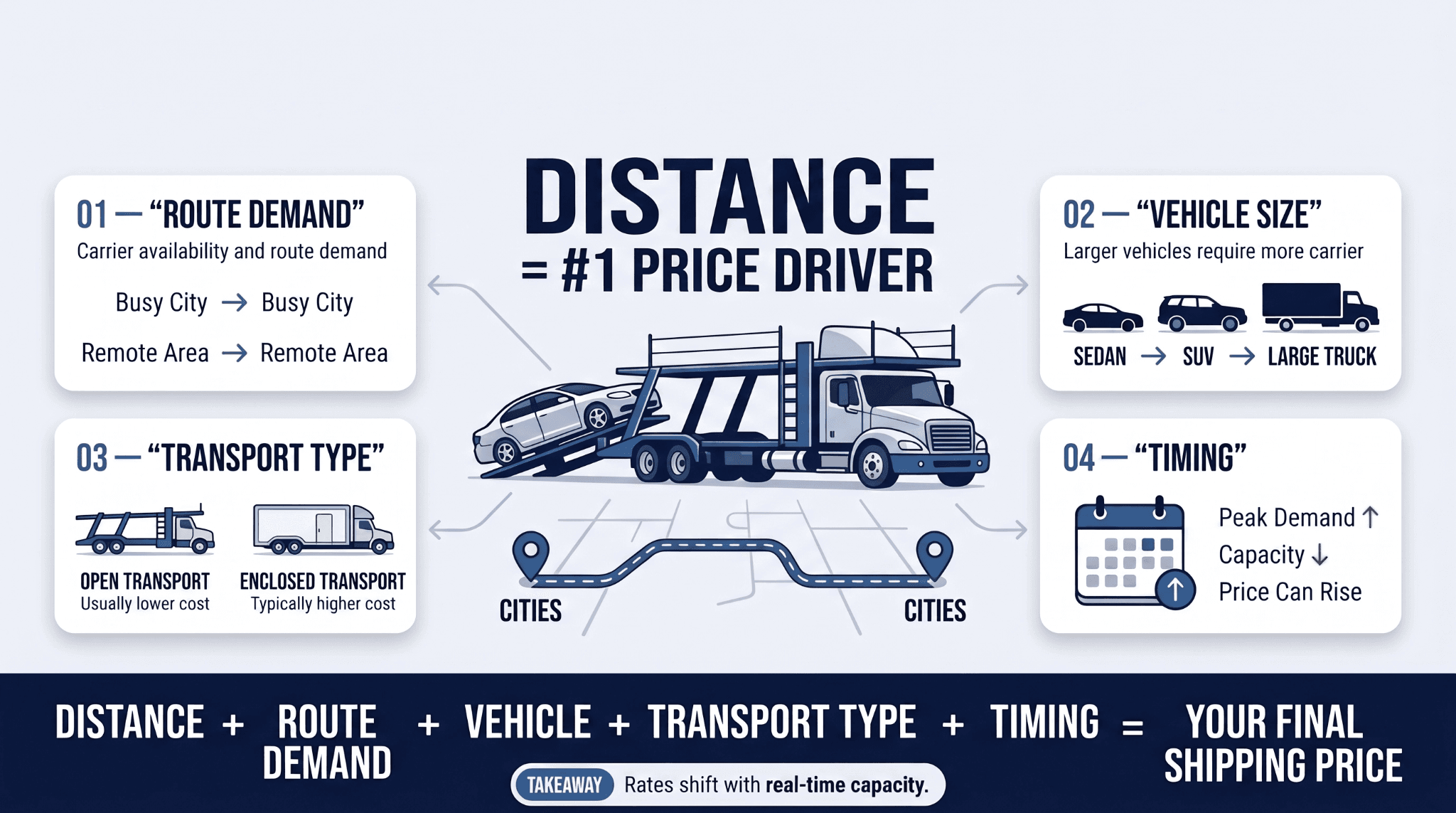
Distance affects the price more than any other single variable, but it rarely acts alone. A short route with a difficult pickup location can end up costing more than a long route between two busy cities, since carriers price based on how easily a vehicle fits into their existing schedule, not just how far it travels.
Understanding factors affecting car shipping prices starts with recognizing that this is a competitive, route-based market. Carriers set rates based on how much demand exists along a given corridor, how much fuel and time a job requires, and how easily your vehicle fits onto a truck already headed in that direction. It's less about a fixed price list and more about factors affecting car transportation prices shifting week to week based on real capacity.
Beyond distance, the next question people usually ask is: what factors affect car shipping prices? Vehicle size, transport type, timing, and route demand round out the list, and each is covered in detail below.
How Much Does Distance Change the Cost?
Distance changes the cost by roughly $0.60 to $2.00 per mile, with the rate dropping steadily the farther the vehicle travels. Per-mile rates fall as total distance increases, since carriers spread fixed costs like fuel and driver time across more miles.
Distance | Typical Cost Per Mile | Estimated Total |
Under 500 miles | $1.50-$2.00 | $400-$800 |
500-1,000 miles | $0.90-$1.20 | $700-$1,000 |
Over 1,000 miles | $0.60-$0.90 | $900-$1,500 |
Understanding how car shipping prices are determined on a per-mile basis explains why a 300-mile move can feel disproportionately expensive next to a 1,500-mile one. Short routes carry more fixed cost per mile, since the truck's overhead does not shrink just because the trip is shorter.
This pricing logic applies domestically and holds true even when comparing it against international car shipping prices, where distance and access still drive much of the variation, though customs and freight handling add their own separate costs on top.
Why Do Rural Routes Cost More?
Rural routes cost more because carriers have to leave their main corridor to reach you, and that detour costs them time and fuel they cannot recover by loading another vehicle along the way. This is often called the last-mile problem in the industry.
Carriers run fixed routes between major metro areas where demand is consistent.
A pickup or delivery address off that path adds driving time without adding another paying vehicle to the load.
Rural surcharges typically run $75-$300, depending on how far the address sits from a major highway or city.
Choosing a pickup or drop-off point near a highway or metro area, even if it means driving your car a short distance yourself, is one of the most effective ways to avoid this surcharge entirely.
How Much More Is Enclosed Transport?
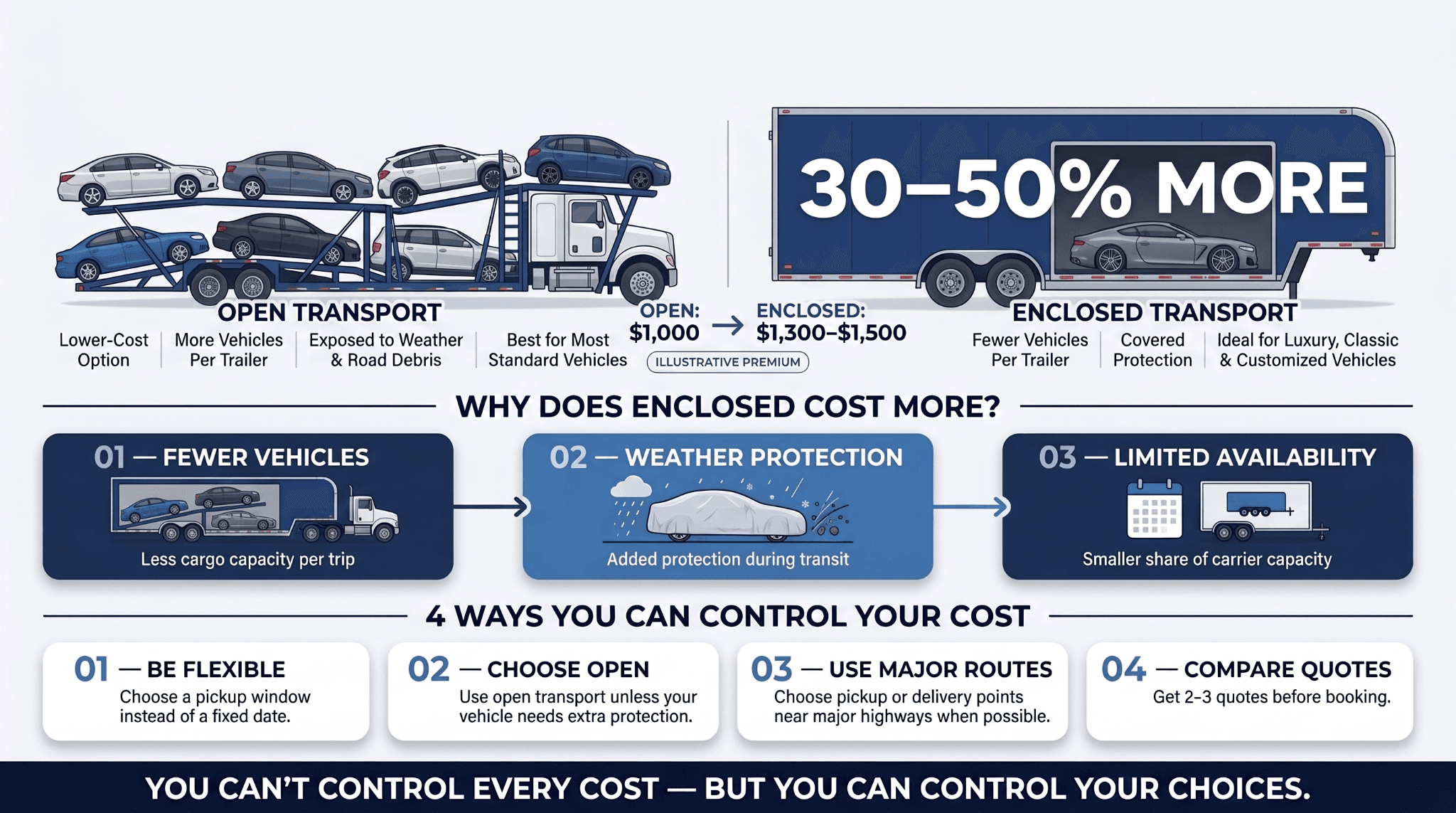
Enclosed transport typically costs 30-50% more than open transport, since covered trailers carry fewer vehicles per trip and offer protection from weather and road debris. Among the factors affecting car shipping prices, transport type is one of the few where you get to make the choice yourself. This is the standard option for luxury, classic, and highly customized vehicles where exposure is not an acceptable risk.
Does the Extra Cost Apply to Every Route?
Yes, generally. Enclosed pricing among the factors that affect car shipping prices cost holds fairly steady across distances, since it's calculated as a percentage premium rather than a flat fee. If you're checking factors that affect car shipping prices cost 2026 figures for a short move or a long one, the enclosed premium lands in that same 30-50% range either way.
How Is the Rate Actually Set?
Carriers set enclosed rates a bit differently from open ones, since covered trailers are a smaller share of any fleet and availability shifts week to week. Among the factors that affect car shipping prices, this is one of the few carriers that price case by case rather than off a fixed sheet. Some publish standard factors that affect car shipping prices rates for enclosed service; others quote it fresh depending on which trailers are free. So how much factors that affect car shipping prices really move between open and enclosed on your route often comes down to trailer supply that week as much as the base rate itself.
Which Costs Can You Actually Control?
You cannot control distance or the season, but you can control your flexibility, your transport choice, and how well you shop around before booking.
Choose a flexible pickup window instead of a fixed date.
Stick with open transport unless your vehicle genuinely needs enclosed protection.
Pick a pickup or delivery point near a major highway when possible.
Compare more than one quote before committing.
If you're searching for factors that affect car shipping prices near me hoping to find a local specialist, know that pricing logic is national, not regional; a reputable factors that affect car shipping prices company applies the same core variables no matter where you're located. Real differences do exist among factors that affect car shipping prices companies, though, particularly in how transparently they price fuel surcharges and rural fees.
A trustworthy factors that affect car shipping prices service will walk you through your specific quote rather than just handing you a number. Request a factors that affect car shipping prices quote from two or three providers, compare the factors that affect car shipping prices quotes side by side, and use an online factors that affect car shipping prices calculator as a starting baseline rather than a final answer. A cheap factors that affect car shipping prices estimate that ignores your route's real demand is rarely the deal it appears to be once the actual booking happens.
Common Queries About Car Shipping Prices
Pricing questions come up on nearly every call we take, so here are direct answers to the ones asked most often.
What affects car shipping prices the most?
Distance is the single biggest factor, though vehicle size, transport type, season, and route demand all combine to set the final number. A short route with a hard-to-reach address can still cost more than a longer one between two major cities.
Why is my rural pickup more expensive?
Carriers have to leave their main corridor to reach a rural address, which adds time and fuel without adding another paying vehicle to the load. This typically adds $75-$300 to the base rate.
Does the make and model change the price?
Yes. Larger and heavier vehicles take up more space on the trailer, which reduces how many other vehicles fit on the same load and raises the price accordingly.
Is a running car cheaper to ship?
Yes. A non-running vehicle requires a winch and extra loading time, which typically adds to the cost compared to a vehicle that can be driven on and off the trailer under its own power.
How can I lower my shipping cost?
Stay flexible with your pickup window, choose open transport unless you need enclosed, pick a pickup point near a major highway, and compare quotes from a few different providers before booking.
Get a Price Built On Your Actual Route
Your final number comes down to a small set of variables working together: distance, vehicle size, transport type, season, and how busy your specific route is. Knowing which of these you can influence, and which you cannot, is the difference between an average quote and a well-priced one.
Working with a carrier that prices transparently, rather than one that quotes low and adjusts later, is the single best safeguard against an unpleasant surprise on pickup day. Request your free, price-locked quote today and see exactly how these factors apply to your shipment.