Most professionals who accept a job transfer think about housing, flights, and onboarding, and leave the vehicle as an afterthought. By the time they realize driving across the country is not practical, their start date is two weeks away. Employee relocation is rarely as straightforward as it looks on paper, and vehicle transport is consistently the part that gets planned last and causes the most stress.
This guide covers everything working professionals need to know about shipping a car during a work relocation, from understanding what employer packages include to choosing the right provider and avoiding costly mistakes. Get a free quote from Safeeds Transport and coordinate your vehicle shipping around your relocation timeline, with transparent pricing, verified carriers, and no hidden fees.
Why Employee Relocation Often Becomes More Complicated Than Expected
Accepting a job offer in another state feels straightforward until the logistics begin. What appears to be a simple move quickly becomes a multi-threaded coordination challenge with competing deadlines and time pressure most professionals have never navigated before.
The Hidden Logistics Behind a Work-Related Move
Employee relocation involves far more than packing boxes. Most professionals are simultaneously managing:
Housing searches in an unfamiliar city under a tight deadline
Lease terminations or property sales at the current location
Job onboarding preparation, meetings, paperwork, and early introductions
School enrollment or childcare arrangements for families with children
Utility transfers, address changes, and financial account updates
When vehicle transport is added to this list without adequate planning, it competes directly with everything else, and something inevitably gives.
Why Moving Your Vehicle Creates Extra Stress
Driving cross-country during an active job transition involves two to four days of travel time most professionals cannot spare, plus wear, mileage, and fuel costs that frequently exceed the price of professional shipping. For most interstate relocations, car shipping for work relocation is the more practical and cost-effective option, provided it is planned early enough.

Understanding Employee Relocation Services and Where Car Shipping Fits
Not all relocation support looks the same. Some employers offer comprehensive packages managed by third-party employee relocation companies. Others provide a lump-sum payment and leave logistics entirely to the employee. Understanding where vehicle transport fits within these structures helps professionals plan their budget more accurately.
What Employee Relocation Services Typically Include
Employee relocation services vary significantly by employer size and role level. Common components include:
Moving company coordination or reimbursement for household goods
Temporary housing allowances during the transition period
Travel reimbursement for flights or mileage
Real estate assistance for buying or selling a home
Vehicle transport is not always explicitly listed, but it is frequently reimbursable when the employee requests it with appropriate documentation. Understanding what are examples of relocation costs for work covered by your employer is the first step before booking any transport service.
Why Vehicle Shipping Is a Key Part of Corporate Employee Relocation
For interstate moves, a vehicle is a necessity, not a discretionary item. Corporate employee relocation that does not account for vehicle transport forces professionals into poor decisions: driving a car that adds unwanted mileage, renting at the destination while waiting for the car to arrive, or leaving a vehicle behind entirely.
According to Worldwide ERC, vehicle transport is among the most commonly reimbursed moving expenses in corporate relocation packages, particularly for long-distance transfers. Positioning vehicle shipping as a planned line item is what separates a smooth corporate relocation with car shipping from a chaotic one.
When Car Shipping Makes the Most Sense for Work Relocation
Not every relocation requires professional vehicle transport, but for most interstate job transfers, it is the most practical option. Understanding the specific scenarios helps professionals make the right decision early.
Cross-Country and Interstate Moving Relocation Logistics
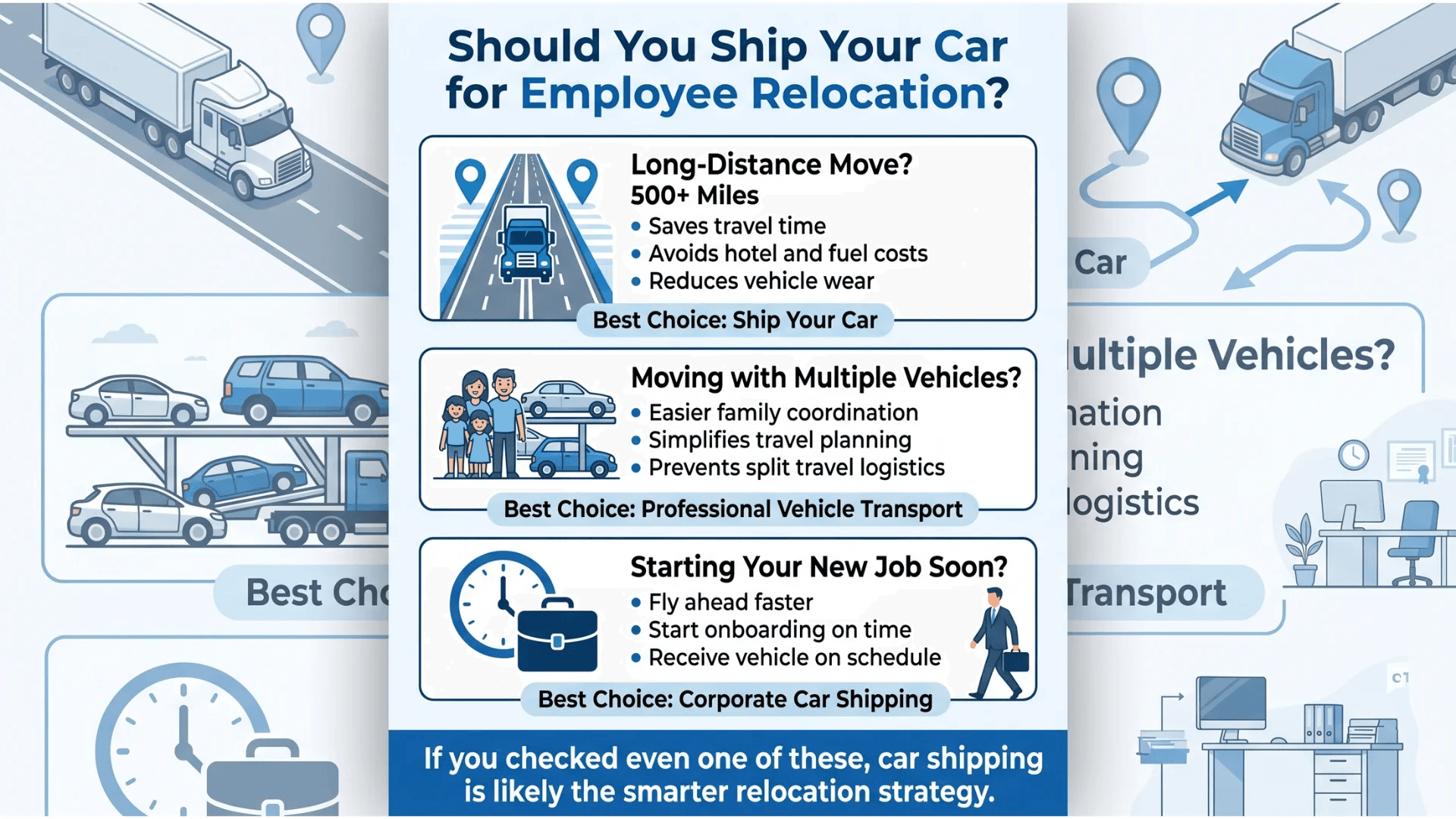
Interstate moving relocation logistics for long-distance transfers present the clearest case for professional shipping. When the distance exceeds 500 miles, driving becomes a multi-day commitment that most relocating professionals cannot accommodate without disrupting their onboarding timeline.
Multi-Car Households and Family Relocations
Households with two vehicles face an immediate problem: two cars cannot be driven to the same destination simultaneously. For families relocating together, professional moving logistics almost always include vehicle shipping as a core component, not an optional add-on.
Tight Start Dates and Limited Travel Time
The most common driver of last-minute decisions is a compressed start date. Car shipping for work relocation in tight-timeline scenarios allows the professional to fly ahead, begin onboarding on schedule, and receive their vehicle within the agreed delivery window.
How to Ship a Car When Relocating for Work
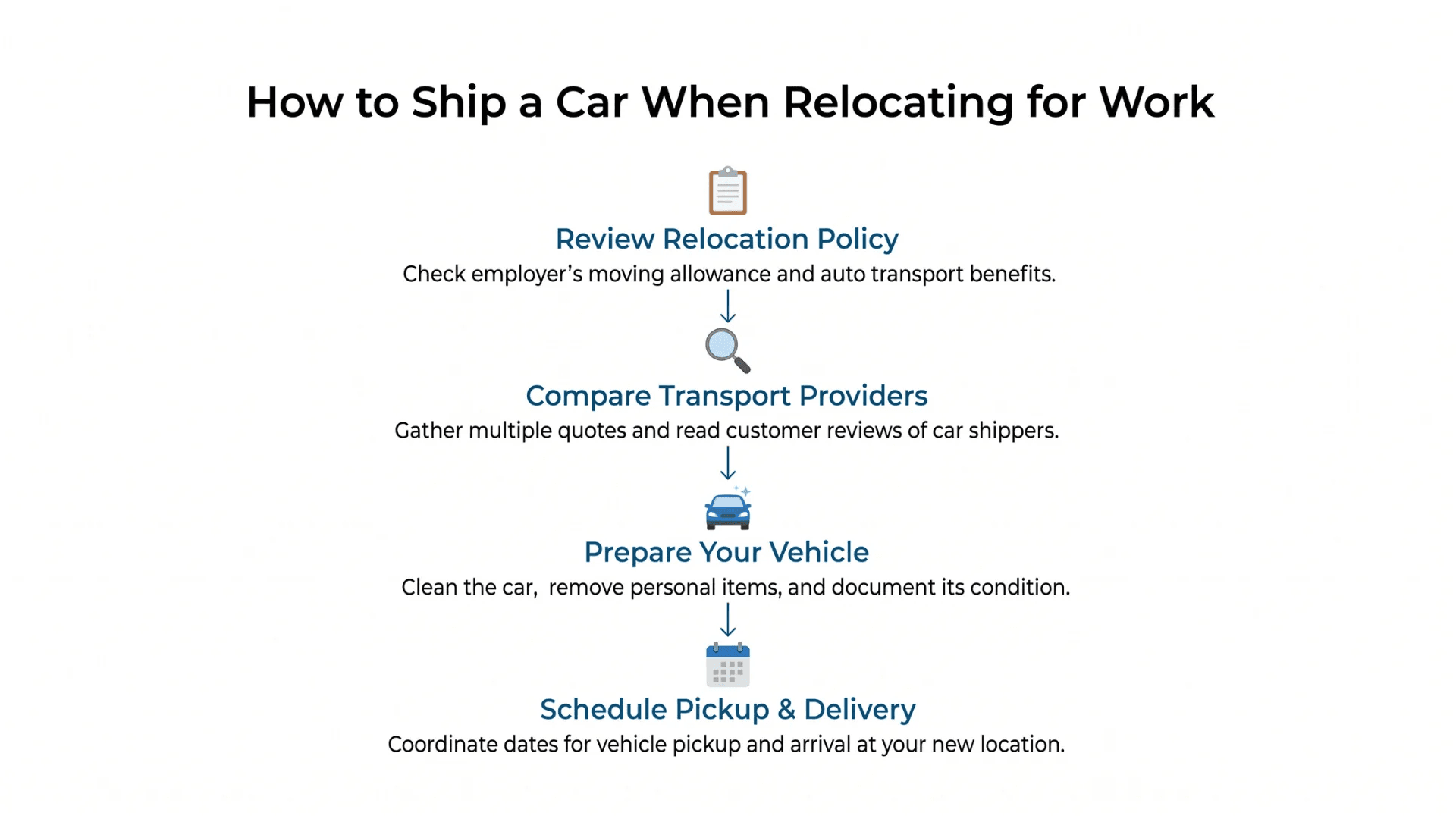
How to ship a car when relocating for work follows a clear four-step sequence. Following these steps in order prevents the scheduling conflicts and documentation gaps that cause the most common relocation delays.
Step 1: Confirm Your Employer's Relocation Policy
Before booking any transport service, review your employer's relocation policy. Key questions to answer:
Is vehicle transport explicitly covered or reimbursable?
What documentation is required, invoice, receipt, or carrier confirmation?
Is there a maximum reimbursement cap for vehicle shipping?
Step 2: Compare Employee Relocation Companies and Brokers
When evaluating providers, confirm the following before committing:
Active MC number registered with the Federal Motor Carrier Safety Administration (FMCSA)
Verified carrier insurance documentation provided before pickup
Transparent, itemized pricing with no post-booking surcharges
Step 3: Prepare Your Vehicle for Transport
Basic preparation before pickup prevents delays and protects against damage disputes:
Photograph all pre-existing damage beforehand
Remove all personal belongings not covered by carrier insurance
Reduce fuel level to one-quarter tank or less
Disable aftermarket alarm systems and confirm the battery holds a charge
Step 4: Coordinate Pickup and Delivery Around Your Move
Book vehicle transport two to three weeks ahead of your move date. Confirm a delivery window that aligns with your housing availability and maintain direct contact with your broker throughout the process.
What Corporate Relocation Car Shipping Typically Costs
Corporate relocation car shipping pricing follows the same variables as standard auto transport, but documentation and itemization matter more because costs may be reimbursable.
What Are Examples of Relocation Costs for Work
Common employee relocation expenses employers reimburse include household goods moving, temporary housing, travel reimbursement, and vehicle transport, open or enclosed, door-to-door or terminal.
Vehicle Transport Pricing Factors
Key variables that determine your quote:
Distance and route demand: Longer routes cost more; high-traffic corridors offer better carrier availability
Vehicle type and size: SUVs and trucks cost more than sedans
Transport method: Enclosed adds 40 to 60 percent over open transport
Seasonality: Summer and snowbird season drive price increases
Booking lead time: Last-minute bookings carry premiums across all routes

How to Budget Without Overpaying
The table below provides general cost ranges for common relocation routes in 2026:
Relocation Route | Estimated Cost (Open) | Transit Time |
|---|---|---|
New York to California | $1,200 – $1,800 | 7 – 10 days |
Florida to Texas | $600 – $950 | 3 – 5 days |
Illinois to Washington | $1,000 – $1,500 | 5 – 8 days |
Texas to New York | $900 – $1,350 | 5 – 7 days |
Georgia to California | $1,100 – $1,600 | 7 – 9 days |
Ohio to Florida | $650 – $1,000 | 3 – 5 days |
Estimates for standard open transport in 2026. Contact Safeeds Transport for a route-specific quote.
Request at least two to three quotes, confirm all fees are itemized upfront, and verify that the quoted price includes carrier insurance, not just the base transport rate.
Choosing Between Employee Relocation Companies and Standalone Car Shipping Providers
Once the decision to ship a vehicle is made, the next question is who to book with. Employee relocations are typically supported by one of two provider types: a full-service corporate relocation company that bundles all moving logistics, or a specialized auto transport broker focused exclusively on vehicle shipping. Each has distinct advantages depending on the professional's situation.
Full-Service Corporate Relocation Providers
Employee relocation companies that offer bundled services manage household goods, temporary housing, travel coordination, and vehicle transport under one contract. For professionals whose employers have an existing relationship with a relocation management company, this route offers convenience, one point of contact, one invoice, and a single reimbursement process.
The trade-off is flexibility. Bundled providers typically work with a fixed carrier network, which can limit pricing options and scheduling flexibility for vehicle transport specifically.
Specialized Corporate Car Shipping Services
Corporate car shipping services offered by dedicated auto transport brokers provide deeper expertise in vehicle logistics, broader carrier networks, and more competitive pricing on transport specifically. A specialized broker can often offer:
More carrier options across a wider range of routes
Faster scheduling for tight relocation timelines
Itemized pricing that simplifies employer reimbursement documentation
Direct carrier verification and insurance confirmation before every pickup
Which Option Delivers Better Value
For professionals whose employer manages relocation through a third-party company, the bundled route is often the path of least resistance. For those managing their own relocation with a lump-sum allowance, a specialized corporate car shipping service typically delivers better pricing, more scheduling control, and clearer documentation for reimbursement.
The deciding factor is almost always flexibility. If your timeline is tight or your route is less common, a dedicated transport broker will outperform a bundled provider on both price and responsiveness.
Common Mistakes That Complicate Employee Relocations
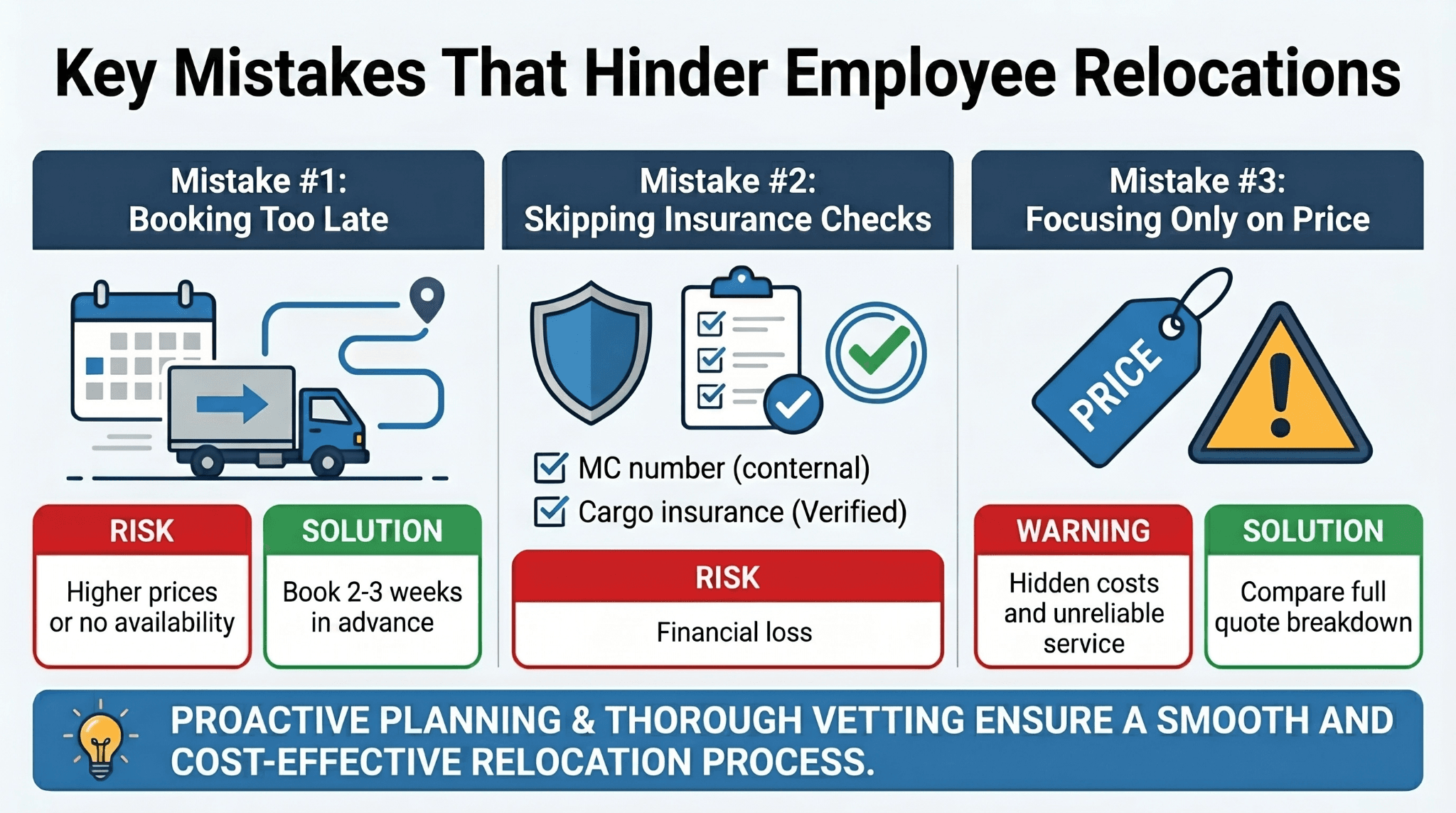
Most relocation problems are avoidable. These are the errors that come up most consistently in employee relocations, and the ones with the clearest prevention strategies.
Booking Too Late
Vehicle transport requires carrier scheduling, route planning, and, in some cases, permit coordination. Booking two to three weeks ahead is the minimum for standard routes. During peak seasons, summer relocation periods and snowbird migration months, demand across all major corridors increases sharply, and last-minute bookings either carry significant premiums or face limited availability.
Overlooking Insurance and Carrier Verification
Basic carrier insurance covers transit damage, but limits and exclusions vary considerably between operators. Before confirming any corporate relocation car shipping booking, verify:
The carrier's active MC number through the FMCSA SAFER system
Cargo insurance limits relative to your vehicle's value
Whether loading and unloading are covered under the policy
Availability of supplemental gap protection for higher-value vehicles
Focusing Only on Price
The lowest quote in professional moving logistics almost always reflects a missing component, inadequate insurance, an unvetted carrier, or hidden fees that surface at delivery. Evaluate quotes on completeness and transparency, not the bottom line figure alone. A broker that itemizes every charge upfront is a more reliable partner than one offering a vague low estimate.
Answers Professionals Often Need Before Booking Vehicle Transport
These are the questions that come up most consistently from professionals navigating car shipping for work relocation for the first time.
How Long Does Corporate Car Shipping Take?
Transit times for corporate car shipping services vary by route. Short regional moves of under 500 miles typically take two to four days. Cross-country routes, such as Florida to California or New York to Washington, generally take seven to ten days. Add one to three days for overland pickup coordination from your origin address.
Can Employers Reimburse Vehicle Shipping Costs?
Yes, vehicle transport is among the most commonly reimbursed employee relocation expenses in corporate packages. Reimbursement typically requires a formal invoice from the transport provider, proof of payment, and in some cases, prior approval from HR or the relocation management company. Confirm the documentation requirements with your employer before booking.
Should You Choose Open or Enclosed Transport?
Open transport is the standard option for most vehicles and offers the best value for corporate employee relocation shipments. Enclosed transport is recommended for luxury, classic, or high-value vehicles where additional protection justifies the higher cost, typically 40 to 60 percent more than open. For standard sedans, SUVs, and trucks, open transport is reliable and cost-effective.
Can Personal Items Stay in the Vehicle?
No. Carrier insurance does not cover personal belongings left inside the vehicle during transport, and port or terminal regulations at some facilities prohibit items in the cabin entirely. Remove all personal items before handoff and transport them separately with your household goods shipment.
Planning a Smarter Employee Relocation Move
The professionals who navigate employee relocation most successfully are not the ones with the most generous packages; they are the ones who plan earliest. Vehicle transport rewards early action with better pricing, more carrier options, and delivery windows that align with housing availability.
Work backward from your start date. Confirm your employer's reimbursement policy first, select a transport provider four to five weeks out, and align your vehicle delivery window with your confirmed move-in date. Book flights independently so onboarding is not held hostage to carrier scheduling.
Professional moving logistics is not complicated, but it requires deliberate sequencing. Professionals who book four to six weeks ahead consistently pay less and experience fewer conflicts. Vehicle transport planned early becomes one less variable in an already complex process. Get a free quote from Safeeds Transport and ship your vehicle as part of a relocation plan built around your timeline.