Shipping a motorcycle across the country is not as complicated as it sounds, but the cost can catch you off guard without the right information. Whether you are relocating, selling a bike to a buyer in another state, or heading to a rally across the country, understanding what drives the price before you book makes the entire process smoother and less stressful.
Cross-country motorcycle shipping cost in 2026 ranges from $600 to $1,200 for most coast-to-coast routes. The final price depends on distance, transport type, bike size, and when you book. Carriers do not price every shipment the same way, and small differences in how and when you book can shift your quote by hundreds of dollars. This guide breaks down every factor so you can plan your shipment with a clear budget in mind. Get a free motorcycle shipping quote from Safeeds in 30 seconds.
What Is the Average Motorcycle Shipping Cost for Cross-Country Routes in 2026?
The first question most riders have is how much it costs to ship a motorcycle, and the honest answer depends on several variables working together. Most riders shipping coast to coast in 2026 will pay between $600 and $1,200 for standard open transport. Routes under 500 miles typically fall in the $300 to $550 range, while enclosed transport on long routes can exceed $1,500.
A cross-country route generally covers 1,500 miles or more, connecting regions like the East Coast to the West Coast or the Midwest to the South. Knowing your distance band is the fastest way to set a realistic budget.
What Are the Average Motorcycle Shipping Rates by Distance?
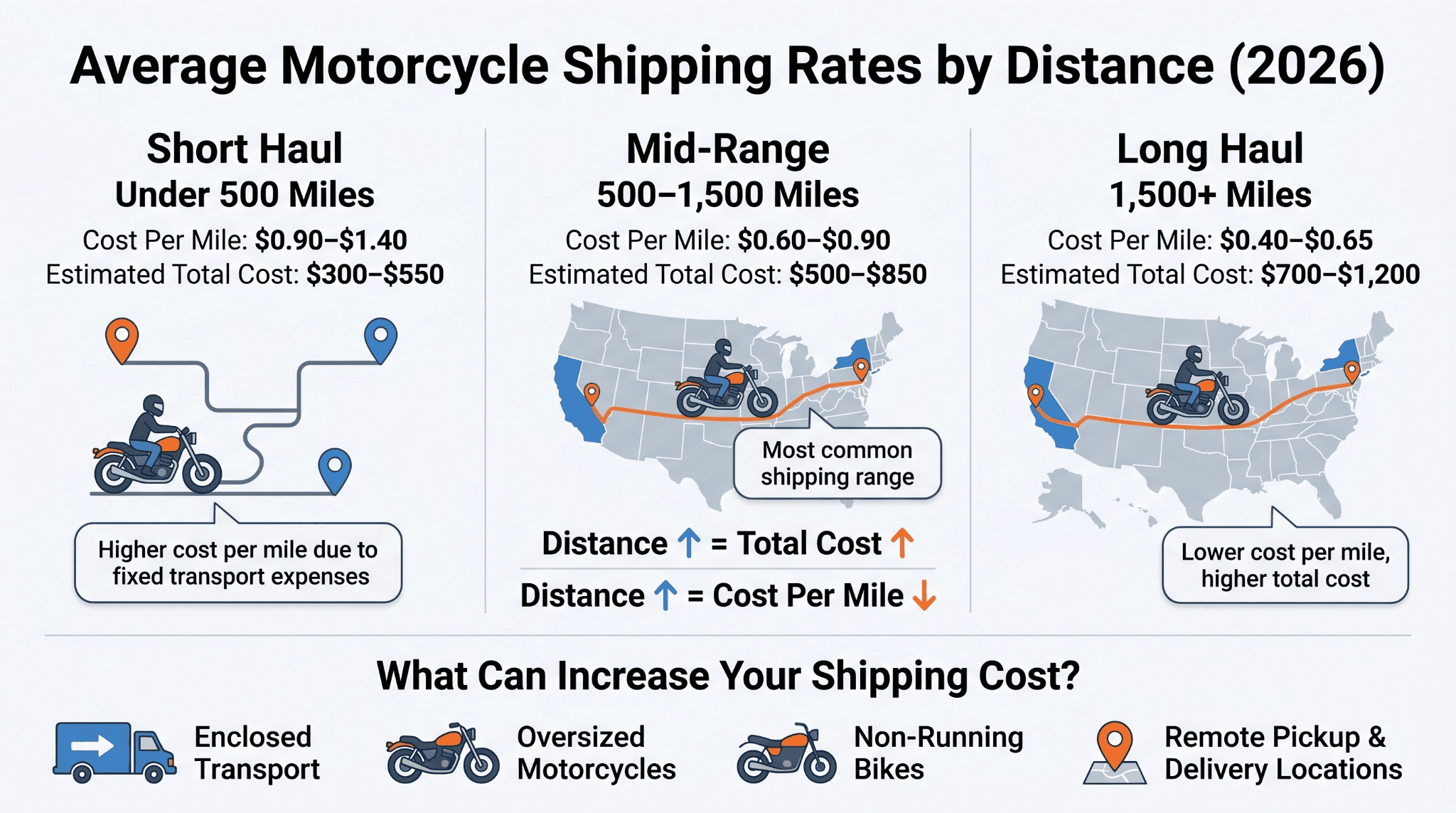
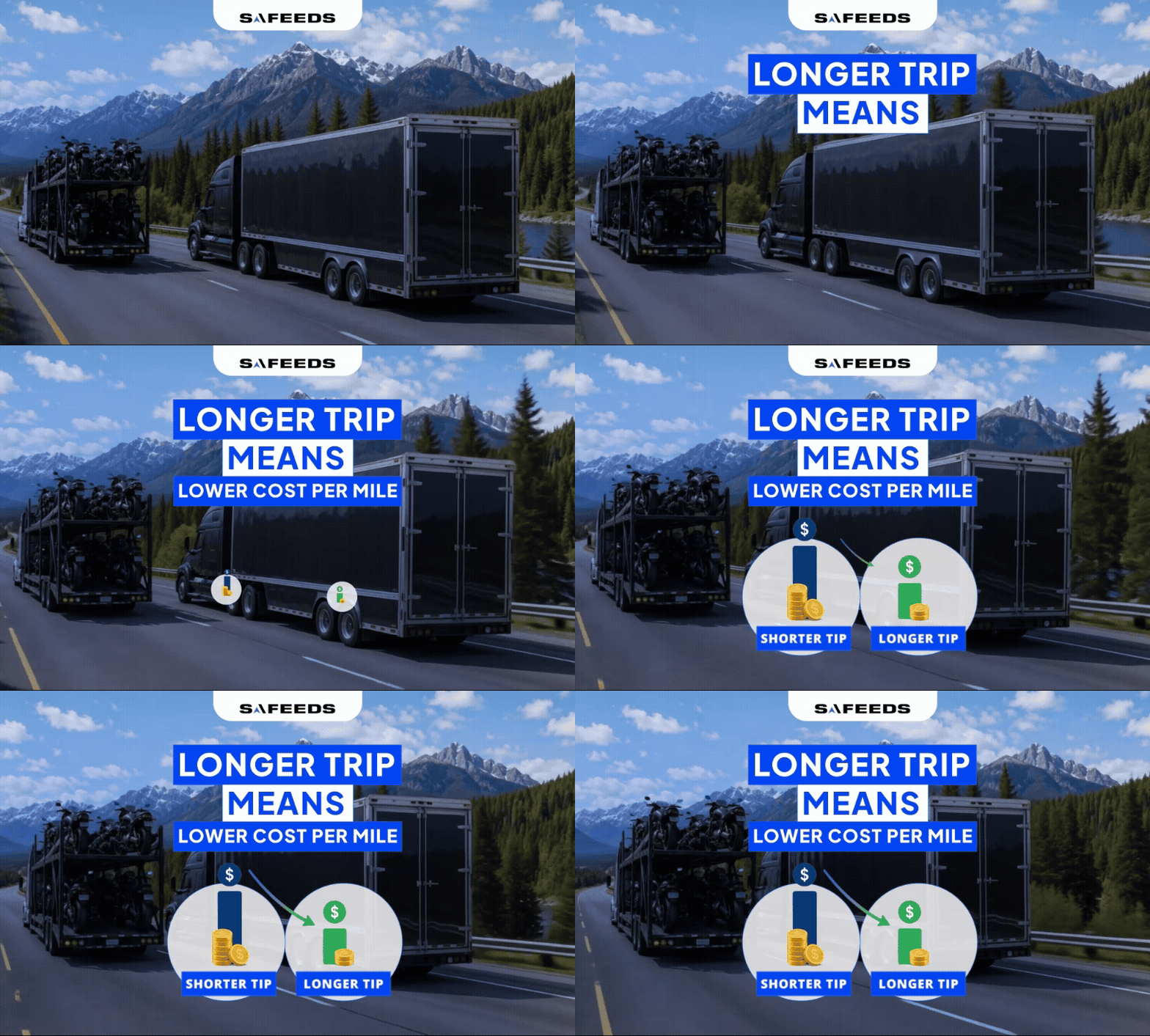
Carriers price shorter routes at a higher cost per mile because fixed costs are spread across fewer miles. On longer routes, those same costs are distributed over a greater distance, which lowers the per-mile rate even as the total increases.
The table below shows the average motorcycle transport cost per mile across three distance bands in 2026.
Distance Band | Approx. Miles | Cost Per Mile | Est. Total Cost |
Short Haul | Under 500 miles | $0.90 to $1.40 | $300 to $550 |
Mid-Range | 500 to 1,500 miles | $0.60 to $0.90 | $500 to $850 |
Long Haul | 1,500+ miles | $0.40 to $0.65 | $700 to $1,200 |
These figures apply to standard open transport for a single motorcycle in running condition. Enclosed shipping, oversized bikes, and non-running models each add to the base estimate.
What Factors Affect Motorcycle Shipping Cost the Most?
No two shipments are priced the same. Even on identical routes, two bikes can produce two different quotes. Carriers factor in several variables beyond mileage when calculating a rate.
Does the Type of Transport Change the Price?
Transport type is one of the biggest cost variables in motorcycle shipping. The two main options are open and enclosed transport.
Open transport loads your bike onto an open-air carrier with other vehicles. It is the most widely used and most affordable method. Enclosed transport places your bike inside a sealed trailer, protecting it from weather and road debris.
Enclosed shipping typically adds 30 to 50 percent to the base open transport rate. It is worth the extra cost for vintage bikes, custom builds, or any motorcycle where cosmetic condition matters.
Does the Size or Weight of the Motorcycle Matter?
Carrier pricing is partly based on the space your bike occupies on the trailer. Larger bikes require more room and sometimes special securing equipment.
A standard sport bike or mid-size cruiser will generally fall within the base-rate range. A full-dress touring model or trike can add $75 to $200 to the same route, depending on its footprint. Always provide accurate dimensions when requesting a quote; carriers may adjust the rate at pickup if the bike is larger than quoted.
Does Shipping Season Affect Motorcycle Transport Cost?
Motorcycle shipping rates are not consistent year-round. Two periods drive the highest demand and tightest carrier availability.
Spring and early summer see heavy volume as northern riders prepare for the season. The fall snowbird migration, when riders move south for the winter, creates a second surge. During both windows, motorcycle shipping rates rise. Booking four to six weeks ahead during peak periods is the most reliable way to lock in a competitive price.
How Much Does It Cost to Ship a Motorcycle on Popular Cross-Country Routes?
Route popularity directly affects price. High-traffic corridors have more carrier availability, which keeps rates competitive. For anyone calculating the cost of shipping a motorcycle cross-country, route popularity and carrier density are two factors that directly affect the final rate. Less common routes with fewer carriers often cost more due to limited supply.
The table below shows estimated 2026 motorcycle shipping rates for six of the most frequently booked cross-country routes.
Route | Approx. Distance | Est. Transit | Open Rate Range |
New York to Los Angeles | 2,800 miles | 7 to 10 days | $850 to $1,200 |
Chicago to Miami | 1,380 miles | 4 to 7 days | $600 to $950 |
Seattle to Dallas | 2,100 miles | 6 to 9 days | $750 to $1,050 |
Boston to Phoenix | 2,650 miles | 7 to 10 days | $800 to $1,150 |
Atlanta to Denver | 1,400 miles | 4 to 7 days | $600 to $900 |
Houston to New York | 1,630 miles | 5 to 8 days | $650 to $1,000 |
Actual quotes vary based on timing, carrier availability, and bike specifications. Requesting a direct quote gives you the most accurate current rate for your route.
How Is Motorcycle Shipping Cost Calculated Per Mile in 2026?
When a carrier generates a quote, the base calculation starts with distance. A per-mile rate is applied to the total mileage, then adjusted for bike size, transport type, and seasonal demand. Any applicable service fees are added on top to produce the final quote.
Why Does Cost Per Mile Drop on Longer Routes?
Every shipment carries fixed costs that do not change regardless of distance, fuel, driver time, trailer maintenance, and administrative processing. Knowing how much to ship a motorcycle per mile helps you evaluate whether a quote is reasonable for your distance.
On short hauls, those fixed costs are divided across fewer miles, driving the per-mile rate up. On long hauls, they are spread across far more miles, bringing the per-mile rate down.
This is why a cross-country shipment at $900 total can offer better per-mile value than a regional shipment at $400. According to the Federal Motor Carrier Safety Administration, long-haul freight consistently shows lower per-unit cost structures than short-haul equivalents because of this fixed-cost distribution effect.
What Should You Know About Motorcycle Shipping Rates Before You Book?
No base quote tells the full story. Understanding what your rate includes, what it leaves out, and where hidden fees can appear puts you in a much stronger position before you confirm a booking.
What Extra Fees Should You Watch for When Shipping a Motorcycle?
A base quote is not always the final number on your invoice. Several additional charges can apply depending on your shipment circumstances, and knowing them in advance helps you budget accurately.
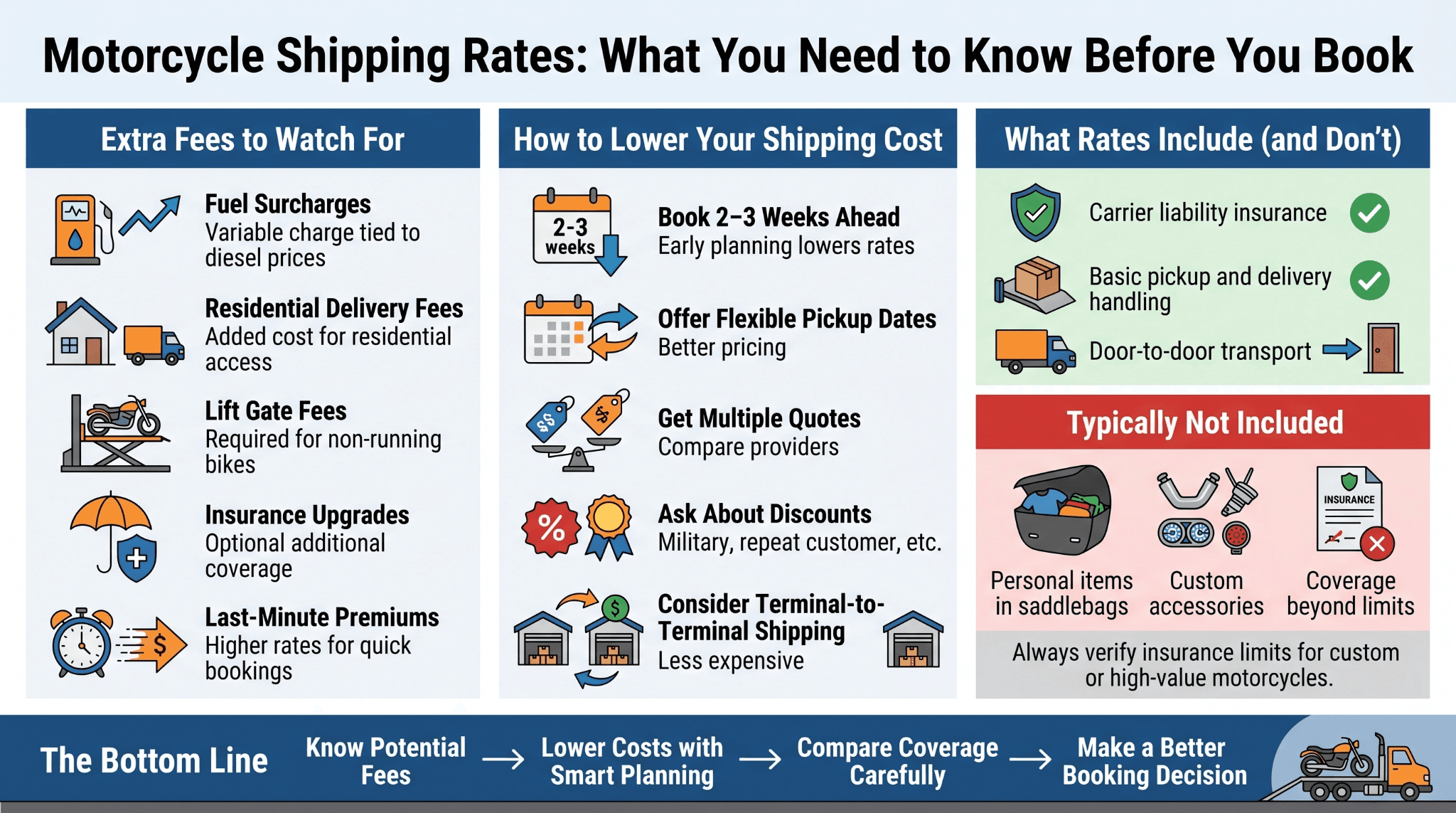
The following fees appear most frequently on motorcycle shipping invoices. Ask about each one before confirming your booking.
Fuel surcharges: A variable charge tied to diesel prices, standard across the freight industry and typically disclosed upfront.
Residential delivery fees: Large carrier trailers may not access tight residential streets, requiring a smaller vehicle for the final leg at added cost.
Lift gate fees: Non-running bikes need specialized loading equipment. This must be disclosed at booking or additional charges may apply at pickup.
Insurance upgrades: Standard carrier coverage is adequate for most bikes, but supplemental insurance is available for high-value or custom motorcycles.
Last-minute premiums: Booking within 48 to 72 hours of your desired pickup typically results in a higher rate due to limited carrier availability.
How Can You Lower Your Motorcycle Shipping Cost Without Cutting Corners?
Reducing your rate does not mean choosing a less reliable carrier. Several strategies consistently produce better pricing without compromising service quality.
Experienced shippers use these approaches regularly to get competitive rates on repeat shipments.
Book two to three weeks ahead. Early bookings give carriers time to plan loads efficiently, and that efficiency is often reflected in a lower rate.
Offer a flexible pickup window. A two-to-three-day range increases the pool of available carriers and improves your chances of a better price.
Get multiple quotes. Comparing providers is the most direct way to confirm whether a rate is competitive for your route.
Ask about discounts. Military, returning customer, and multi-vehicle discounts are rarely advertised but almost always available on request.
Consider terminal-to-terminal shipping. Dropping off and collecting your bike at a carrier terminal can reduce cost, particularly in dense urban areas.
What Do Motorcycle Shipping Rates Include, and What Don't They?
Two quotes at similar prices can represent very different scopes of service. Understanding what is and is not covered helps you compare providers accurately.
Standard motorcycle shipping rates typically cover carrier liability insurance during transit, basic handling at pickup and delivery, and door-to-door transport where offered by the provider.
Standard rates generally do not cover personal items left in saddlebags, custom accessories, or aftermarket modifications. The Motorcycle Industry Council notes that custom and accessory additions represent a significant share of total motorcycle value for many riders, making it important to confirm insurance limits before booking.
What Riders Ask Before Booking Cross-Country Motorcycle Shipping
If you're shipping a motorcycle for the first time, it's natural to have questions about timing, insurance, preparation, and the overall process. Here are answers to the most common questions riders ask before booking cross-country motorcycle shipping.
How long does cross-country motorcycle shipping take?
Most routes spanning 1,500 miles or more take 7 to 10 business days. Shorter regional routes are often completed in 2 to 5 days. Expedited options are available at a premium for time-sensitive moves.
Is my motorcycle insured during transport?
Yes. Licensed carriers are required to carry cargo insurance. Coverage limits vary, so confirm the specific amount before booking, especially for high-value bikes. Supplemental coverage is available if needed.
Can I ship a non-running motorcycle cross-country?
Non-running bikes can be shipped but require specialized loading equipment. This must be disclosed at booking. Failing to mention a non-running condition can result in added charges or refusal at pickup.
Do I need to drain the fuel tank before shipping?
Most carriers require the tank to be no more than a quarter full at pickup. This is a standard industry safety requirement. A near-full tank adds unnecessary weight and increases fuel vapor risk during enclosed transport.
How far in advance should I book motorcycle transport?
Two to three weeks is the standard recommendation. During peak periods, spring, early summer, and fall snowbird season, booking four to six weeks ahead helps secure availability and protects against rate increases.
What to Know Before You Request a Motorcycle Shipping Quote
Motorcycle shipping cost for cross-country routes in 2026 is shaped by factors that are largely within your control once you understand the pricing structure. Distance sets the baseline, but transport type, bike size, timing, and fee awareness all influence what you pay.
The riders who consistently get the best rates plan, ask the right questions, and choose providers who are upfront about pricing from the first quote to the final invoice.
At Safeeds, every motorcycle shipping quote includes a 7-day price lock, no upfront payment, and full carrier insurance validation before your bike moves. No surprises at pickup, no hidden fees on delivery. Safeeds connects riders with licensed, insured carriers for motorcycle transport across all 50 states. Get your free motorcycle shipping quote today and lock in your rate for 7 days.