Heavy equipment transport is the process of moving large machines, such as excavators, bulldozers, and tractors, on specialized trailers. A licensed heavy haul carrier picks the right trailer, gets state permits for oversize loads, plans a safe route, and chains the machine down. Costs depend on weight, size, distance, and permits.
A mid-size excavator weighs about as much as eight pickup trucks, so you can't just roll it onto a car carrier. Heavy equipment transport has its own rules for trailers, permits, and chains, and skipping one can mean fines, delays, or damage. This guide breaks down how heavy haul transport works, so construction equipment shipping feels less like guesswork.
Ready to move a machine? Request a free quote from Safeeds Transport. There's no upfront payment, and your price is locked for 7 days.
Key Takeaways
Heavy equipment transport uses flatbed, step deck, or RGN trailers, and the right choice depends mainly on the machine's height, weight, and loading method.
Machinery transport cost depends on weight, dimensions, trailer type, distance, permits, pilot cars and site access, so a quote for the exact machine is more reliable than an average price.
Loads wider than 8.5 feet or heavier than 80,000 pounds gross on Interstate highways need an oversize or overweight permit from every state on the route.
Federal securement rules require at least four tie-downs for equipment weighing 10,000 pounds or more, with a combined working load limit of at least half the cargo's weight.
Cleaning the machine, fixing leaks, photographing its condition and sharing exact measurements before pickup helps avoid delays and disputes after delivery.
Trailer Types: Flatbed, Step Deck and RGN
Before you think about price or permits, you need to answer one question: which trailer fits your machine?
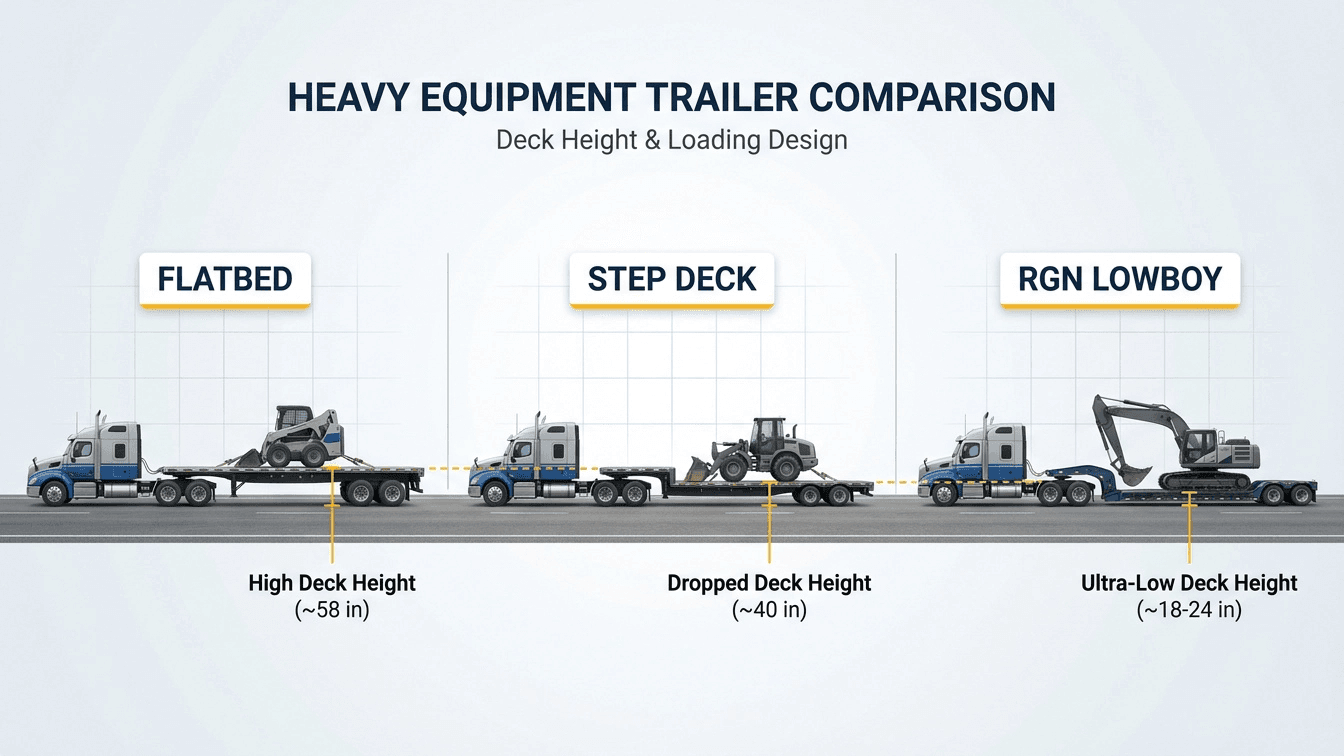
Trailer choice comes first because it decides three things: how tall your load can be, how the machine gets on board, and what the move will cost. The number to watch is deck height. The lower the deck, the more room a tall machine has before it reaches the legal height limit, which is about 13.5 feet in many states.
Here's a quick side-by-side:
Trailer | Deck height (approx.) | Legal cargo height (approx.) | Typical machines | Loading method |
|---|---|---|---|---|
Flatbed | 5 ft | 8.5 ft | Skid steers, mini excavators, forklifts | Crane, forklift or ramps |
Step deck | 3.5 ft (lower deck) | 10 ft | Mid-size tractors, scissor lifts, compact loaders | Ramps or drive-on |
RGN (lowboy) | 1.5 to 2 ft | 11.5 to 12 ft | Dozers, large excavators, cranes | Drive-on through detached front |
Figures are typical industry measurements and vary by trailer model and state.
When is a standard flatbed enough?
If your machine is on the smaller side, a flatbed is often all you need. Most are 48 to 53 feet long, with a deck about 5 feet off the ground. That gives you roughly 8.5 feet of cargo height to work with.
Think skid steers, mini excavators, and forklifts. One thing to know: the deck sits high, so loading usually takes a crane or forklift.
Why would you choose a step deck trailer?
A step deck (also called a drop deck) has a raised front section and a lower rear deck about 3.5 feet high. That "step" buys you around 1.5 extra feet of height, so cargo up to about 10 feet tall can ride legally.
It's a solid fit for mid-size tractors, scissor lifts, and compact loaders. Plus, many step decks carry their own ramps.
What makes an RGN trailer different?
RGN stands for removable gooseneck. The front section detaches so the deck can drop to the ground and act as a ramp. That means machines, including tracked equipment like dozers and excavators, can drive right on.
With a deck just 18 to 24 inches high, an RGN can carry cargo close to 12 feet tall. You'll also hear the word "lowboy," which is the broader name for low-deck trailers. An RGN is simply the detachable kind. Versions with extra axles spread the load so the axle weight stays within legal limits.
Pro tip: Measure your machine with its attachments on and in transport position. A bucket or cab that's a few inches taller than you expected can push you into a different trailer, and a different price.
What Heavy Equipment Transport Costs
Let's get to the question everyone asks first: how much will this cost?
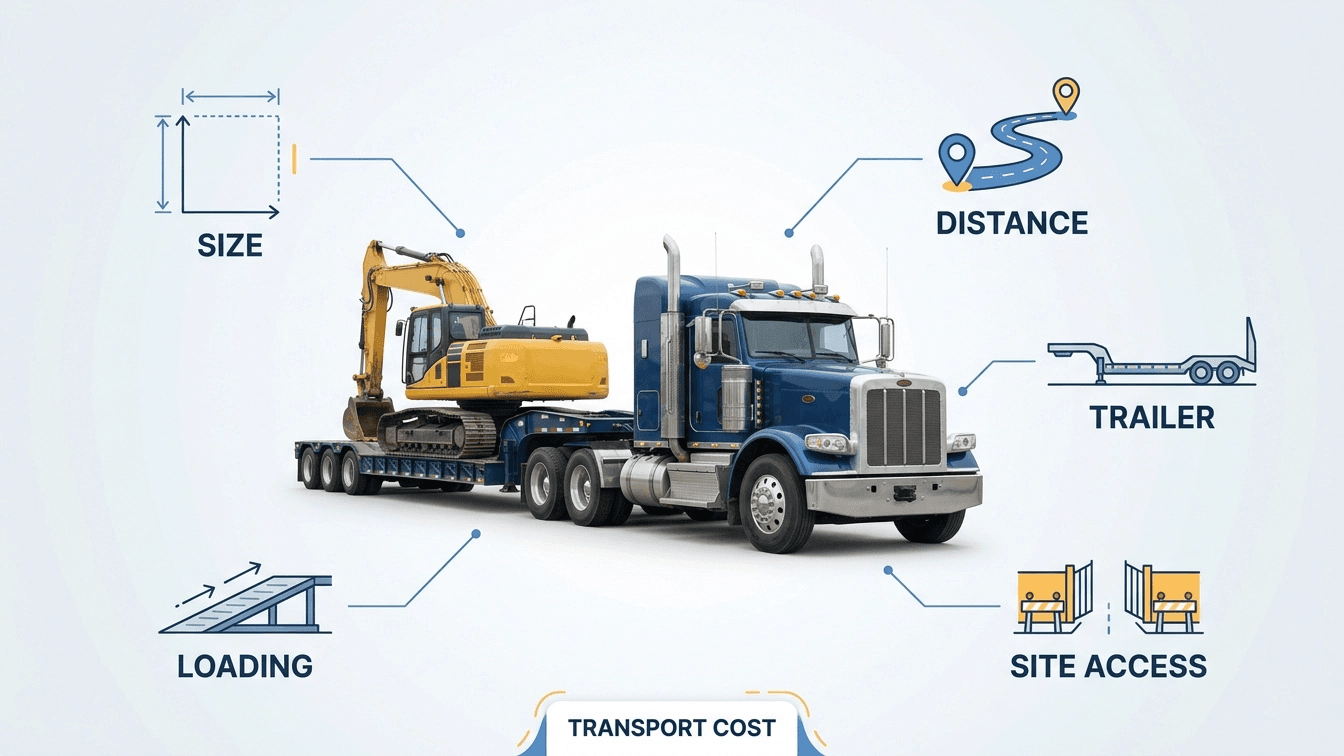
The short answer is that it depends. Machinery transport cost isn't one fixed number. It's built from a few inputs, and once you know them, comparing quotes gets a lot easier. Here's what moves the needle:
Weight and dimensions: heavier, wider or taller machines need specialized trailers and permits.
Trailer type: an RGN or multi-axle lowboy costs more to run than a standard flatbed.
Distance and route: longer trips cost more overall, and detours around low bridges add miles.
Machine condition: equipment that doesn't run needs extra loading time and tools.
Site access: tight, muddy or restricted job sites can slow down pickup and delivery.
Here's how booking works with Safeeds Transport: you don't pay anything upfront. A $1 card verification hold secures your booking, and your quoted price stays locked for 7 days, so you have time to compare options.
How is heavy haul priced: per mile or flat rate?
Carriers usually price one of three ways: by the mile, by the load, or a mix of both. Per-mile pricing is common on long interstate trips. Flat rates show up more on short local moves.
This explains something that surprises a lot of people: a 50-mile haul often costs more per mile than a 1,000-mile haul. Loading, securing, and permit work take the same time no matter how far the truck goes. On a short trip, that fixed work is spread across fewer miles.
What extra costs should you plan for?
These are the line items that can catch you off guard:
Permit fees: every state charges its own, and overweight loads often cost more.
Pilot car fees: escort vehicles usually bill by the mile or by the day.
Tarping: some equipment needs covering to protect it from weather and road debris.
Loading equipment: a crane or forklift at pickup or delivery is often billed separately.
Detention time: waiting at a site past the agreed window can add hourly charges.
Seasonal demand: spring construction season and the fall harvest tighten carrier capacity.
Pro tip: Ask for an itemized quote. When every fee is listed up front, you can compare carriers fairly, and nothing shows up as a surprise on the final bill.
Oversize and Overweight Permits
Every state has limits on how big and heavy a truck can be without special approval. Once your load goes past those limits, the carrier needs an oversize permit, an overweight permit, or both. In a nutshell, that's what oversize load transport means.
Here's the part people often miss: permits are issued state by state. If your machine crosses four states, it needs four separate permits, each with its own rules and fees.
What makes a load oversize or overweight?
The Federal Highway Administration publishes the federal truck size and weight limits that every state builds on. Here are the numbers to know:
Limit | General standard | If exceeded |
|---|---|---|
Width | 8.5 ft (102 inches) | Oversize permit |
Height | 13.5 to 14.5 ft, set by each state | Oversize permit and route survey |
Length | Varies by state | Oversize permit |
Gross weight | 80,000 lbs on the Interstate system | Overweight permit |
Single axle | 20,000 lbs | Overweight permit |
Tandem axle | 34,000 lbs | Overweight permit |
Keep in mind that axle weight matters just as much as total weight. Your load could come in under 80,000 pounds overall and still need an overweight permit if too much of that weight sits on one axle group.
What is a superload?
A superload is a load so big or heavy that a standard permit won't cover it. Each state sets its own threshold, but it's usually far beyond normal oversize dimensions or well above 100,000 pounds.
These moves can require engineering reviews of bridges on the route, a detailed travel plan, and several weeks for approval.
Route Surveys and Escort Requirements
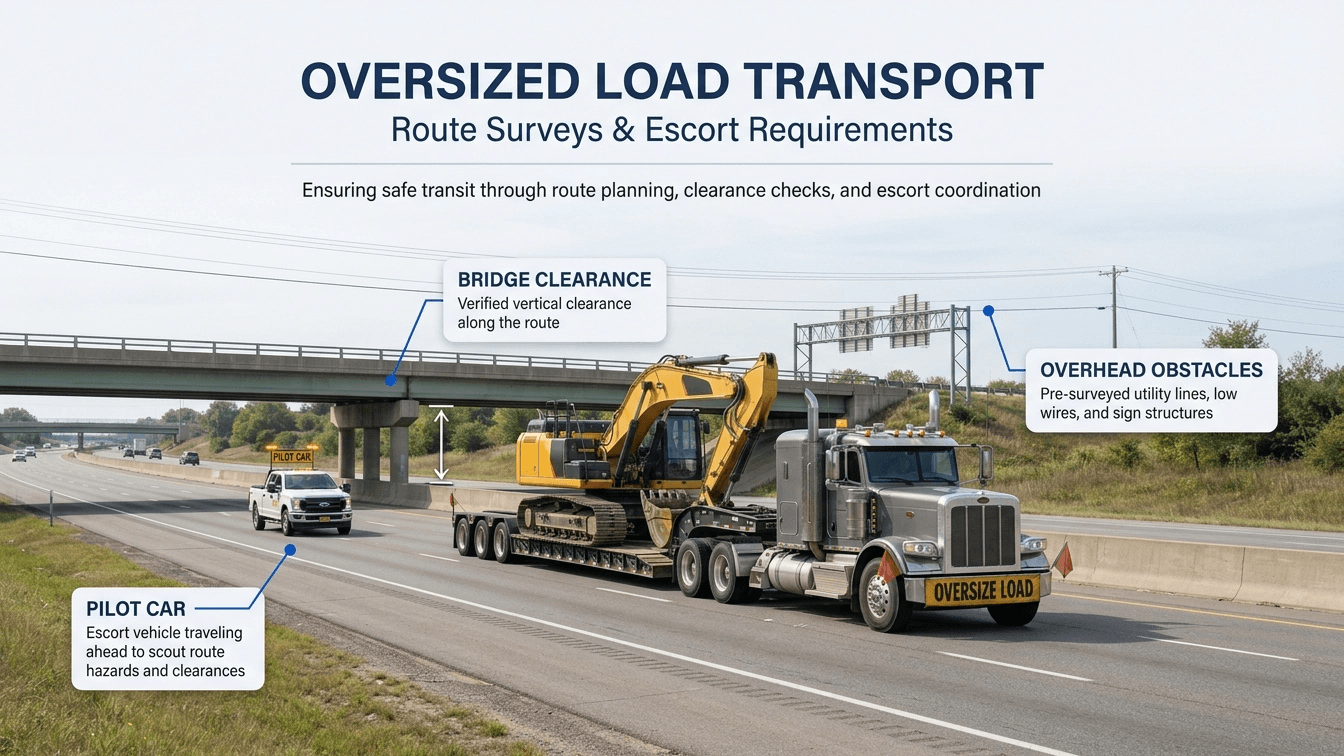
Think of it this way: a permit says your load can travel, and a route survey shows how it can travel safely. Safe oversize load transport is all about spotting problems that a regular truck never has to worry about.
What does a route survey check?
Before the truck rolls, the route gets checked for:
Bridge and overpass clearances
Weight ratings on roads and bridges
Turning room at intersections and job site entrances
Construction zones and lane closures
Overhead power lines, traffic signals and signs
Travel restrictions (many states allow oversize moves only in daylight and ban them on weekends or holidays)
For very tall loads, a surveyor may even drive the route ahead of time with a height pole to confirm every clearance.
When do you need pilot cars or police escorts?
A pilot car is an escort vehicle that warns other drivers and guides the truck through tight spots. The one in front watches for low clearances and oncoming traffic. The one behind warns drivers coming up from the rear.
Whether you need one depends on the state and the size of your load. Many states require one pilot car once a load is wider than about 12 feet, and two at around 14 to 16 feet. Loads over roughly 14.5 feet tall often need a front escort with a height pole. For really large moves, police escorts may join in, and utility crews sometimes have to raise power lines along the way.
Loading and Securement Standards
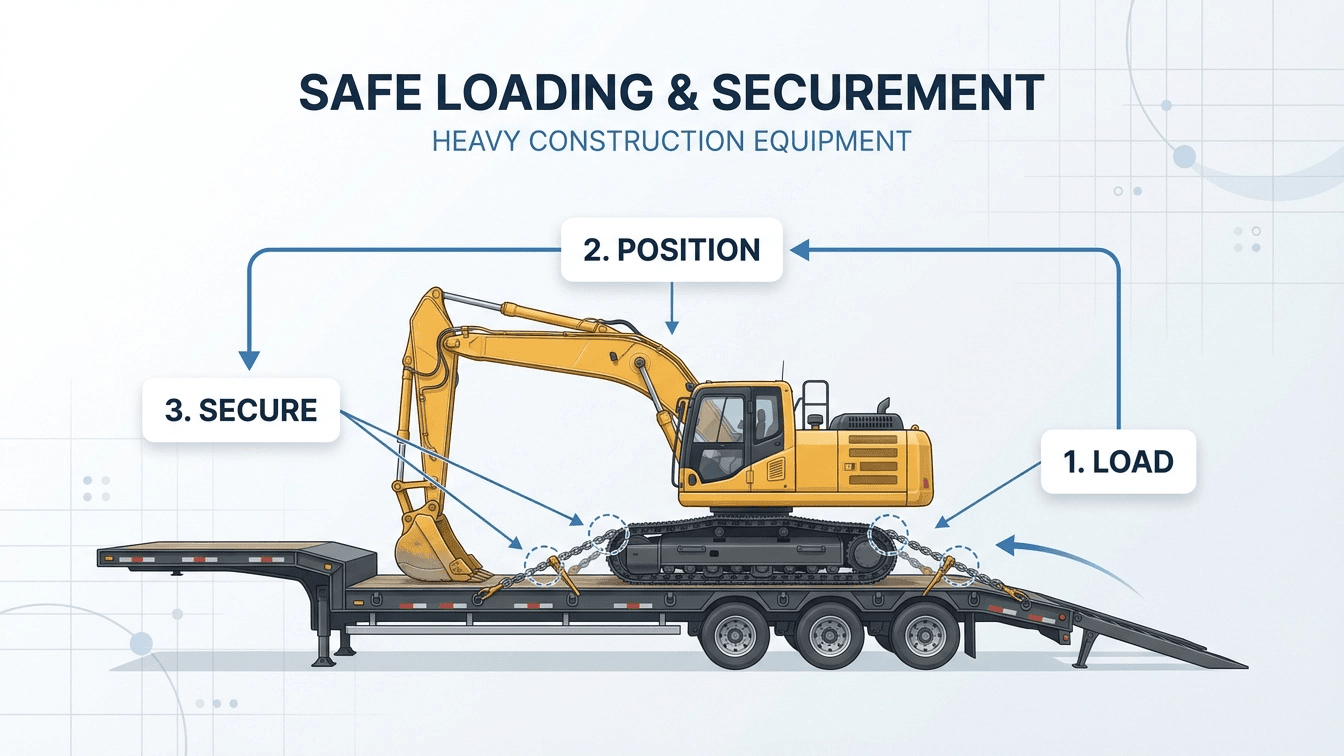
Getting the machine onto the trailer depends on two things: whether it runs, and which trailer you're using. Here are the three common methods:
Drive-on: an operator drives or tracks the machine up ramps or onto a lowered RGN deck.
Winch: a cable pulls a non-running machine onto the deck.
Crane or forklift: the machine is lifted onto a higher deck, like a flatbed.
Once it's on, the goal is simple: the machine shouldn't be able to move in any direction. The federal cargo securement rule 49 CFR 393.130 sets the standard for heavy vehicles, equipment and machinery weighing 10,000 pounds or more.
How is heavy equipment tied down safely?
Every chain and binder has a working load limit, which is the most force it's rated to hold safely. Federal rules say the combined working load limit of all tie-downs must equal at least half the weight of the cargo.
Let's put that in real numbers. A 30,000-pound excavator needs securement chains rated for a combined total of at least 15,000 pounds. Many carriers go beyond that minimum. The rules also require:
At least four tie-downs, holding the machine against forward, backward, sideways and upward movement
Buckets, blades, booms and other attachments lowered to the deck and secured
Articulated machines, like wheel loaders, restrained so the frame can't pivot
Chains should hook to the machine's designated tie-down points, never to hydraulic lines or other fragile parts.
Pro tip: Ask the driver if you can take a photo of the secured load before it leaves. It's a quick way to document that everything was chained down properly.
Preparing Equipment for Transport
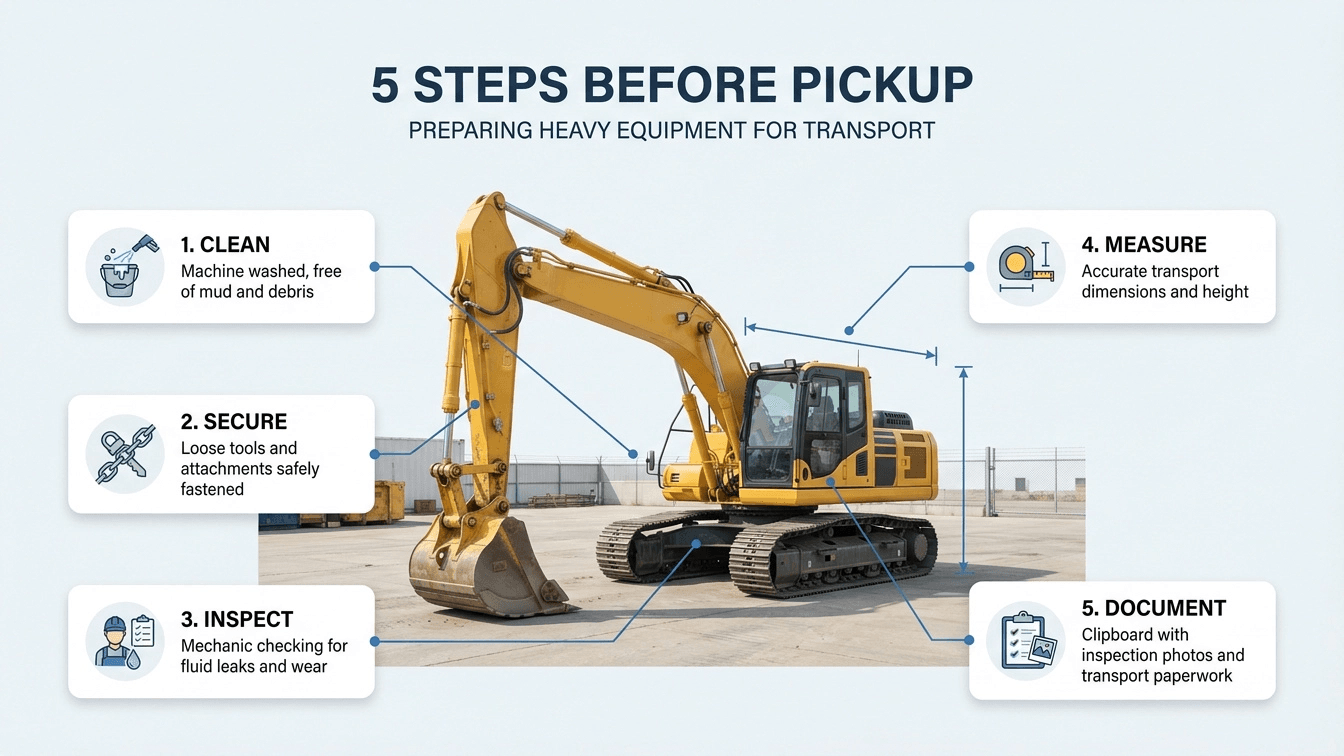
A little prep goes a long way. It shortens loading time and makes disputes after delivery much less likely. Most of these tasks take an hour or two, and you can knock them out the day before pickup.
What should you do before pickup day?
Clean the machine. Remove mud, soil and plant material. Some states run agricultural inspections and can hold equipment that's carrying soil or seeds.
Secure loose parts. Take out tools and spare attachments, or fasten them so they can't shift.
Check for leaks. Fix any hydraulic, fuel or oil leaks so nothing drips onto the road.
Photograph the machine. Take dated photos from every side to record its condition.
Confirm exact measurements. Share the length, width, height, and operating weight, including attachments. A few inches can change the trailer or permit you need.
What paperwork should you have ready?
Keep these on hand so pickup goes smoothly:
Bill of lading: the inspection report and receipt signed at pickup and delivery
Ownership or rental documents: proof that you have the right to move the machine
Spec sheet: the manufacturer's weights and dimensions
Site access details: gate codes, contact names, working hours and ground conditions
Keys and operating notes: anything the driver needs to load and unload safely
Common Questions About Heavy Equipment Transport
Still have questions? Here are quick answers to the ones we hear most.
How much does heavy equipment transport cost?
It depends on five things: your machine's weight and size, the trailer it needs, the distance, the number of state permits, and whether pilot cars are required. Because those inputs vary so much, a quote for your exact machine beats any average. Safeeds Transport offers free heavy equipment transport quotes with no upfront payment and a 7-day price lock.
What trailer do I need for my equipment?
Start with height. Under about 8.5 feet tall? A flatbed usually works. Up to about 10 feet? Look at a step deck. Anything taller or heavier, especially tracked equipment that needs to drive on, typically calls for an RGN or lowboy. And don't forget weight: very heavy loads need extra axles to keep axle weight legal.
Who handles oversize load permits?
Good news: usually not you. The carrier or a professional permit service applies with each state's transportation department. As a broker, Safeeds Transport coordinates with licensed heavy haul carriers who handle permits as part of the move. Your job is to share accurate dimensions and weight, since every permit is issued for the exact load described.
When is a pilot car required?
Each state writes its own pilot car rules, so there's no single answer. As a rule of thumb, many states require one escort once a load passes about 12 feet wide and two escorts at around 14 to 16 feet. Height and length can trigger escorts too. Your carrier will confirm the rules for every state on your route.
How long does permitting take?
Faster than you might think for standard loads. Many oversize and overweight permits are issued the same day or within one to three business days, often through online state systems. Superloads are a different story: they can take several weeks because of bridge engineering reviews. The takeaway? Book early so permits are ready before pickup day.
Can you transport equipment across state lines?
Absolutely. Interstate heavy haul transport happens every day. The catch is that each state on the route issues its own permit, with its own rules on size, travel hours and escorts. A load that's legal in one state may need a pilot car in the next, so carriers plan the whole route before the truck moves.
What is the weight limit without a permit?
On Interstate highways, the federal limit is 80,000 pounds gross, counting the truck, trailer and cargo together. Axle limits apply too: 20,000 pounds on a single axle and 34,000 pounds on a tandem. Since a truck and heavy haul trailer often weigh 30,000 to 40,000 pounds on their own, cargo over roughly 40,000 pounds usually needs an overweight permit.
Do I need to drain fluids before transport?
Usually not. Most carriers don't ask you to drain fuel, oil or hydraulic fluid, but they do expect a leak-free machine. Some prefer a low fuel level, often a quarter tank or less, to cut weight and spill risk. Secure the battery, and check with your carrier if anything on board counts as hazardous material.
How is heavy equipment secured?
With grade-rated securement chains and binders hooked to the machine's designated tie-down points. Federal rules call for at least four tie-downs on equipment weighing 10,000 pounds or more, with a combined working load limit of at least half the cargo weight. Buckets and blades go down on the deck, and articulated machines are restrained so they can't pivot.
Can you transport equipment that does not run?
Yes. A non-running machine can be loaded with a winch, forklift or crane, depending on its size and the trailer. Just tell the carrier up front, because it means extra time, equipment and sometimes extra crew at both ends. That usually raises the machinery transport cost, so mention the machine's condition when you request your quote.
Choosing a Heavy Haul Partner You Can Trust
Here's the bottom line: the right trailer and the right permits only help if the company handling your move knows what it's doing. So before you book, take ten minutes to do some homework. Look up the carrier's USDOT and MC numbers in the FMCSA database to make sure its operating authority is active. Ask for a certificate of insurance, and check that the cargo coverage matches what your machine is worth, because a standard policy may not fully cover a high-value excavator or crane.
Find out whether the carrier has handled permits and escorts for loads like yours, and get the pickup window, delivery terms, and any extra charges in writing. Once those pieces are in place, construction equipment shipping stops feeling like a gamble and becomes a plan you can count on. Safeeds Transport connects shippers with licensed, insured heavy haul carriers, and getting started is simple. Request a free quote for your machine, locked for 7 days with no upfront payment.