New Jersey to New York car shipping costs $150–$300 on average and takes 1–2 days. The route spans approximately 30–100 miles, depending on exact pickup and delivery locations, making it one of the shortest and most affordable examples of short-distance car shipping in the northeast corridors in the country. Despite the distance, pricing on this route is shaped by unique factors including toll infrastructure, urban delivery complexity, and metro-area demand cycles. Let's break down the actual costs, what affects the price on this specific route, and how to book transport with Safeeds.
How Much Does It Cost to Ship a Car from New Jersey to New York?
New Jersey to New York car shipping is one of the most affordable routes in the country. At under 100 miles in most cases, this is a short-haul shipment, and the pricing reflects that. Most customers shipping a standard passenger vehicle on this corridor pay between $150 and $300 for open-carrier transport.
That said, the final NJ to NY car transport cost depends on more than just distance. The exact pickup and delivery addresses, vehicle size, transport type, and scheduling all influence the quote you receive.
Transport Type | Estimated Cost |
Open carrier (standard) | $150 – $300 |
Enclosed carrier (premium) | $300 – $500 |
Door-to-door (open) | $175 – $325 |
Expedited service | $250 – $400 |
Why short-haul routes are priced differently
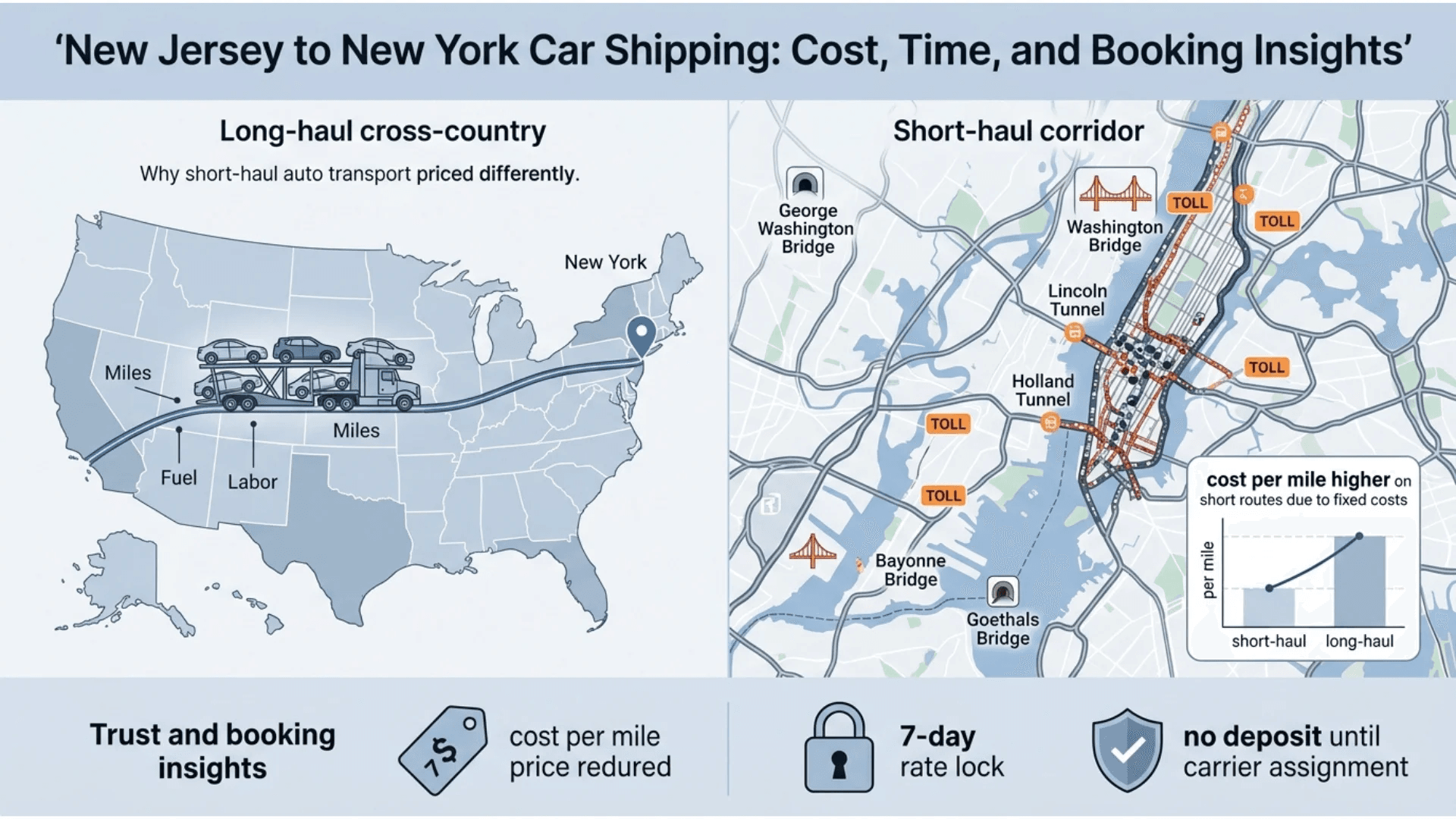
On long-haul routes, carriers distribute their operating costs, fuel, time, tolls, and labor across thousands of miles. On a short-haul route like New Jersey to New York auto transport, those same fixed costs are compressed into a much shorter run. That is why the cost-per-mile on regional routes is often higher than on cross-country shipments, even though the total dollar amount is significantly lower.
Tolls and urban routing
The New Jersey to New York corridor involves some of the most congested and toll-heavy infrastructure in the United States. Carriers factor toll costs and urban routing complexity into their quotes on this corridor. Key crossing points include:
George Washington Bridge
Lincoln Tunnel
Holland Tunnel
Bayonne Bridge
Goethals Bridge
Each crossing carries significant commercial vehicle toll fees, and the choice of crossing affects both cost and transit time depending on the origin and destination addresses.
What keeps your quote stable
Carrier market rates fluctuate based on fuel costs, driver availability, and seasonal demand. When you book with Safeeds Transport, your quoted price is locked for seven days, giving you time to finalize your plans without worrying about rate changes.
A few things to keep in mind when reviewing quotes:
Prices reflect current market averages and are subject to change
Vehicle modifications, non-running vehicles, or oversized loads may carry additional fees
No deposit is required until a carrier has been confirmed for your shipment
Door-to-door service may require adjustments in areas with restricted vehicle access
How Long Does New Jersey to New York Car Shipping Take?
New Jersey to New York car shipping is one of the fastest routes in the country by transit time. Once a carrier picks up your vehicle, delivery typically occurs within 1 to 2 days. In many cases, particularly for Newark to NYC car shipping or pickups elsewhere in northern New Jersey destined for New York City, same-day or next-day delivery is achievable.
Plan for a total booking-to-delivery window of 2 to 4 days, accounting for carrier assignment time of 1 to 2 business days before transit begins.
What affects where your shipment lands in that range
Despite the short distance, a few factors can influence exactly when your vehicle arrives. Carrier schedules, road conditions, and the complexity of urban delivery all contribute to where your shipment lands within the standard window.
Traffic and urban congestion: The New York metropolitan area is among the most congested in the United States. Carrier transit times can be extended by bridge and tunnel delays, particularly during peak commuting hours and weekends.
Pickup and delivery accessibility: Dense urban environments, particularly in New York City, can create challenges for large transport vehicles. Narrow streets, parking restrictions, and low-clearance structures may require the carrier to arrange an accessible nearby meeting point.
Number of stops: Even on short routes, open carriers may be transporting multiple vehicles. If your shipment shares a load with other pickups or deliveries in the region, transit time may extend slightly.
Expedited service: If same-day or guaranteed next-day delivery is a priority, expedited options are available at a premium.
Planning tip: Given the short transit window, confirm your delivery address accessibility with Safeeds at the time of booking. This avoids last-minute adjustments that could delay delivery.
What Affects Pricing on the New Jersey–New York Route Specifically?
New York to New Jersey vehicle transport, and the reverse, operates within one of the most complex logistics environments in the country. While the distance is short, the pricing factors on this corridor are distinct from those on long-haul or rural routes. Understanding them helps you evaluate quotes accurately and avoid surprises.
The dense urban infrastructure, high toll costs, and concentrated demand in the New York metropolitan area all shape what carriers charge on this route.
Short-haul economics
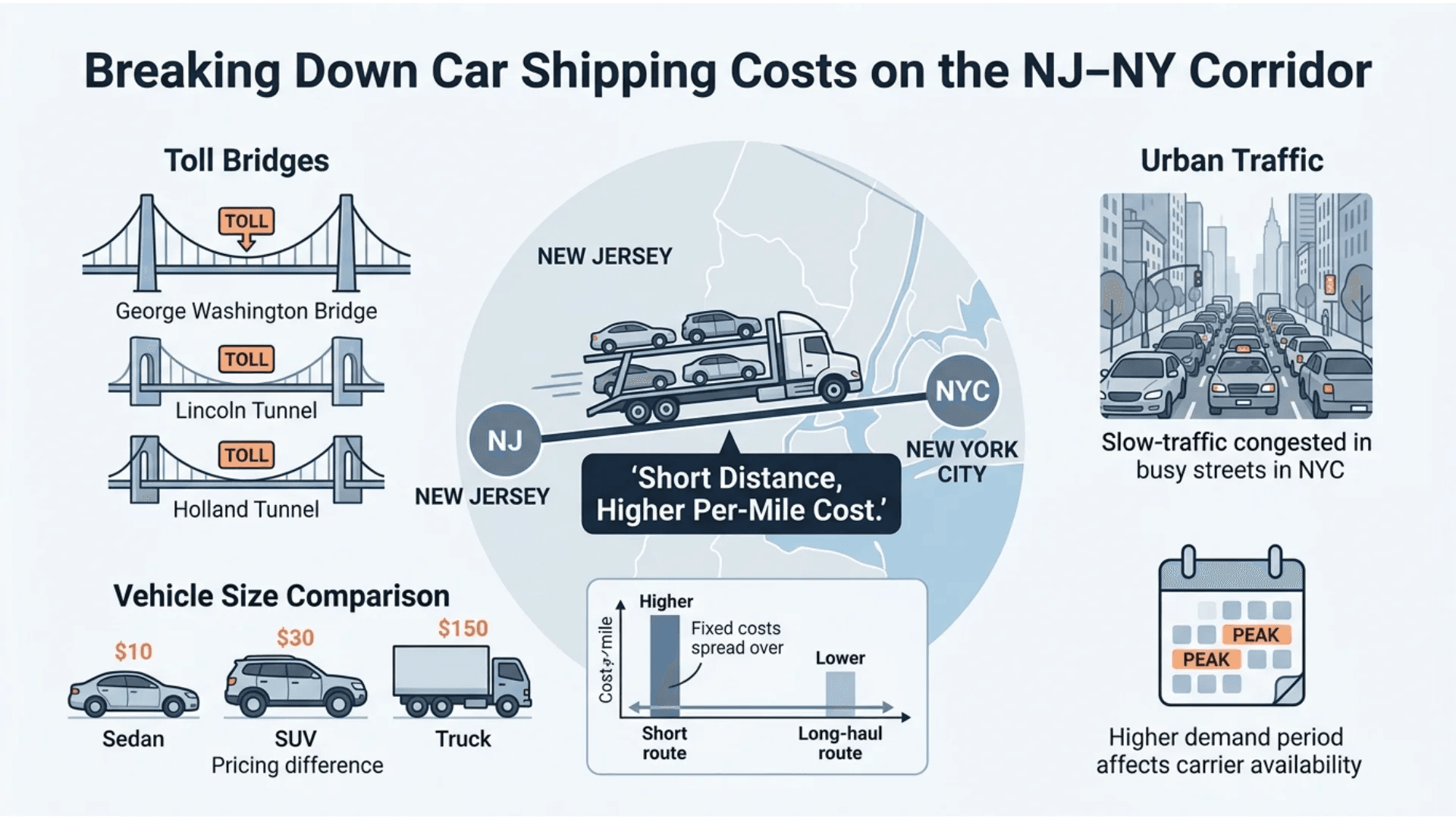
Short-haul routes like New Jersey to New York auto transport carry higher per-mile costs than long-haul shipments. Carriers must cover fixed operating expenses within a much shorter distance. Here is what that means in practical terms:
Fixed costs, fuel, tolls, labor, and insurance remain largely the same regardless of distance
A 50-mile route does not cost one-tenth of a 500-mile route; it typically costs one-third to one-half
Carriers price short hauls to ensure the run is economically viable
Urban complexity adds operational time that is not present on rural or highway-only routes
Toll and infrastructure costs
Crossing between New Jersey and New York involves some of the highest toll infrastructure in the country. Commercial vehicle toll fees at Port Authority crossings are factored into every carrier quote on this corridor. Key cost factors include:
Commercial toll rates at major crossings are significantly higher than passenger vehicle rates
Carriers may select crossings based on load routing, not just proximity to the destination
Toll costs are a routine and transparent part of pricing on this corridor, not an add-on
Urban delivery complexity
New York City presents unique operational challenges for auto transport carriers. What this means for your shipment:
Street-level access for large vehicles is limited in many neighborhoods
Manhattan, Brooklyn, and the Bronx have significant restrictions on oversized vehicle movement
Carriers may need additional time to navigate restricted zones or find suitable unloading locations
Building management coordination may be required in high-density residential or commercial areas

Vehicle size and type
As with all routes, larger vehicles occupy more carrier space and cost more to ship. On this short corridor, the size premium is proportionally more noticeable given the lower base price.
Sedans and compact cars: Usually at the lower end of the range
Mid-size SUVs and crossovers: Mid-range pricing
Full-size SUVs, trucks, and vans: Higher end of the range
Modified or oversized vehicles: May require a custom quote
Carrier availability in the metro area
The New York metropolitan area has strong carrier coverage year-round. However, demand spikes can affect availability and pricing:
Summer and major corporate relocation cycles create a temporary tightening of carrier supply
High regional shipment volumes generally support faster carrier assignment than rural routes
Booking in advance during peak periods secures better rates and faster assignment
Seasonal Pricing Variations from New Jersey to New York
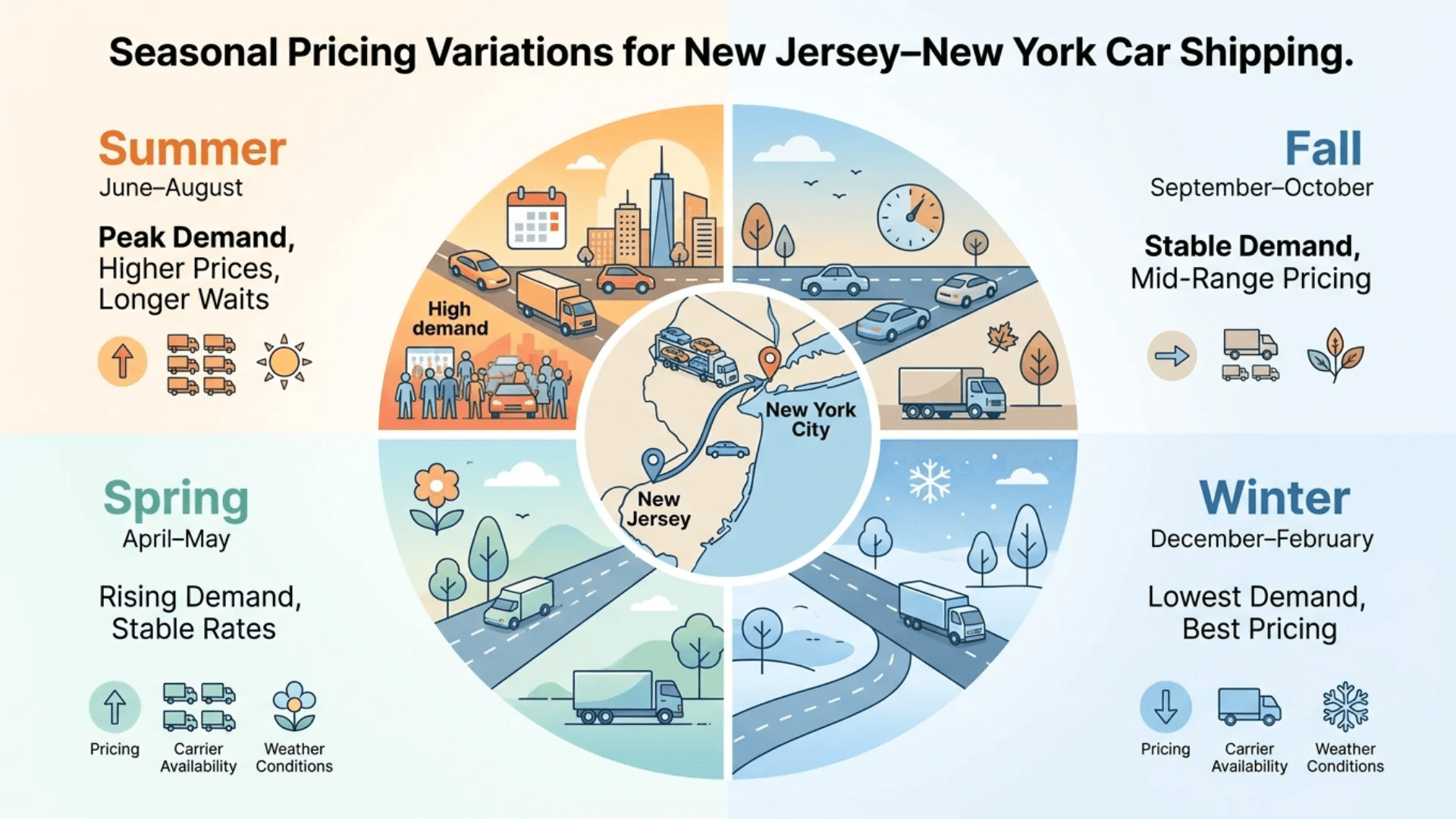
While New Jersey to New York car shipping does not follow the dramatic seasonal swings seen on long-haul corridors, pricing and carrier availability on this route do shift across the year. The New York metropolitan area's unique demand patterns, driven by corporate relocations, academic calendars, and real estate cycles, create predictable fluctuations worth planning around.
Summer (June – August): Peak relocation season
Summer is the busiest period for residential moves in the New York metropolitan area. Lease turnovers, corporate transfers, and post-graduation relocations all concentrate between June and August, driving up demand for auto transport alongside other moving services.
What to expect in summer:
Prices toward the upper end of the standard range
Carrier availability is tighter than in other seasons
A booking lead time of one to two weeks is recommended
Slightly longer carrier assignment windows due to high regional volume
Fall (September – October): Moderate demand, good availability
Demand eases after Labor Day, and fall offers a reliable window for competitive pricing on this corridor. Corporate relocation activity continues into October, but the peak pressure of summer has passed.
What to expect in fall:
Pricing settles back toward the mid-range
Carrier availability generally strong
Shorter booking lead times required compared to summer
Good balance of cost and scheduling flexibility
Winter (December – February): Lowest demand, best pricing
Post-holiday demand on this route is typically the lowest of the year. For customers with flexible timing, winter months often yield the most competitive quotes.
What to expect in winter:
Most competitive pricing of the year
Strong carrier availability due to lower overall demand
Minimal weather-related delays compared to long-haul mountain routes
Occasional snow events may temporarily slow urban traffic
Spring (April – May): Rising demand, stable pricing
Spring sees a gradual increase in relocation activity ahead of the summer peak. Pricing remains moderate through April and into May before summer demand begins to push rates higher.
What to expect in spring:
Moderate pricing before summer rates take effect
Strong carrier availability
Favorable weather conditions across the corridor
Good window for customers with flexible timelines.
How to Book New Jersey to New York Car Shipping with Safeeds
Booking your New York to New Jersey vehicle shipping, or the reverse, through Safeeds Transport is a straightforward process with no upfront deposits, no hidden fees, and full transparency at every step.
Here is how it works from start to finish:
Request a quote: Provide your pickup and delivery addresses, vehicle make and model, preferred transport type, and target ship date. Safeeds returns a price-locked quote valid for seven days.
Confirm the booking: Review the terms and confirm your order. No deposit is collected until a licensed motor carrier has been matched to your shipment and you have agreed to the final price.
Carrier assignment: Your shipment is matched with a licensed, insured motor carrier operating in the New Jersey–New York corridor. You will receive the carrier's contact information prior to pickup.
Pickup and vehicle inspection: Conduct a walk-around inspection with the carrier driver at pickup. All pre-existing marks, scratches, or damage are documented on the Bill of Lading. Photograph your vehicle from multiple angles before handing over the keys.
Transit and delivery: Given the short distance, delivery typically follows within 1 to 2 days of pickup. At delivery, inspect your vehicle against the Bill of Lading before signing off and completing payment.
Insurance and added protection
Every carrier arranged holds the required insurance coverage, validated as part of the carrier vetting process. For customers seeking additional protection beyond standard carrier insurance, AFTA GAP Protection is available, offering coverage for scenarios that basic carrier insurance may not address.
What to Know Before You Ship: NJ to NY
New Jersey to New York auto transport generates a consistent set of questions from first-time shippers and repeat customers alike. The answers below cover everything you need to know before booking your shipment.
How much does it cost to ship a car from New Jersey to New York?
New Jersey to New York vehicle shipping typically costs between $150 and $300 for standard open-carrier transport. Enclosed carrier service runs $300 to $500 on this corridor. Final pricing depends on your vehicle size, chosen transport type, exact pickup and delivery locations, and current carrier availability. Safeeds Transport provides a price-locked quote valid for seven days with no hidden fees.
How long does New Jersey to New York car shipping take?
Transit time is 1 to 2 days from pickup, making this one of the fastest auto transport routes in the country. The full booking-to-delivery window is typically 2 to 4 days, accounting for carrier assignment time. Expedited options are available if same-day or guaranteed next-day delivery is required.
What's the cheapest time of year to ship from New Jersey to New York?
Winter months, particularly January and February, typically offer the most competitive pricing on this route, as demand is lowest after the holiday season. Spring (April–May) also offers good value before summer relocation demand peaks. Summer, June through August, is consistently the most expensive and busiest period on this corridor.
Should I use open or enclosed transport for New Jersey to New York?
Open transport is the right choice for the vast majority of vehicles on this short corridor and offers the best balance of cost and availability. Enclosed transport is recommended for luxury vehicles, classic or collector cars, or any vehicle requiring maximum protection. Given the short transit time and distance, weather exposure risk on open carriers is minimal on this route.
Do I need to be present for pickup and delivery in New Jersey to New York?
You, or a designated representative aged 18 or older, must be present at both pickup and delivery to complete the vehicle inspection, sign the Bill of Lading, and verify vehicle condition before completing payment. If you cannot be present personally, a trusted representative may be arranged in advance. Given the short transit window, coordinating both ends of the shipment on the same day is often practical.
New Jersey to New York, Get a Quote in Minutes
Short-haul does not mean low-stakes. Whether you are relocating within the metro area, moving a recently purchased vehicle, or coordinating a corporate fleet transfer, getting your car from New Jersey to New York efficiently and without damage requires the same professional coordination as any long-distance shipment. Safeeds Transport handles every detail, including carrier vetting, scheduling, insurance validation, and delivery coordination, so you do not have to.
Get a price-locked quote in minutes. No deposit, no hidden fees, and a rate that holds for seven days. Get a New Jersey to New York shipping quote from Safeeds Transport.