Electric vehicle shipping follows the same basic process as shipping a gas car, but four things change: the battery charge level at pickup, extra weight that can raise the price, carrier rules for EVs, and extra prep such as turning off alarm and sentry modes. Most EVs ship safely on open or enclosed carriers.
Quick question: do you know how much your EV weighs? If you drive a Tesla Model Y, it's at least 4,061 pounds, several hundred pounds more than a similar gas SUV.
That extra weight is just one of the things that changes with electric vehicle shipping. The good news is that none of it is complicated once you know what to expect. This guide covers everything you need to know before shipping an electric car: battery charge, weight and price, carrier rules, trailer choice and prep.
Getting ready to move your EV? Get your free quote in about 30 seconds. There's no upfront payment, and your price is locked for 7 days.
Key Takeaways
Electric vehicle shipping uses the same open and enclosed carriers as gas cars, with extra steps for charge level, weight, and security features.
Most carriers ask for an EV's battery to be at about 30% to 50% state of charge at pickup.
Battery weight can make an EV hundreds to thousands of pounds heavier than a similar gas car, which can raise shipping costs.
EVs with damaged lithium batteries fall under federal hazardous materials rules, according to a 2023 PHMSA safety advisory.
Turning off sentry mode, setting transport mode, and removing the charging cable before pickup helps an EV ship smoothly.
Why EVs Ship Differently
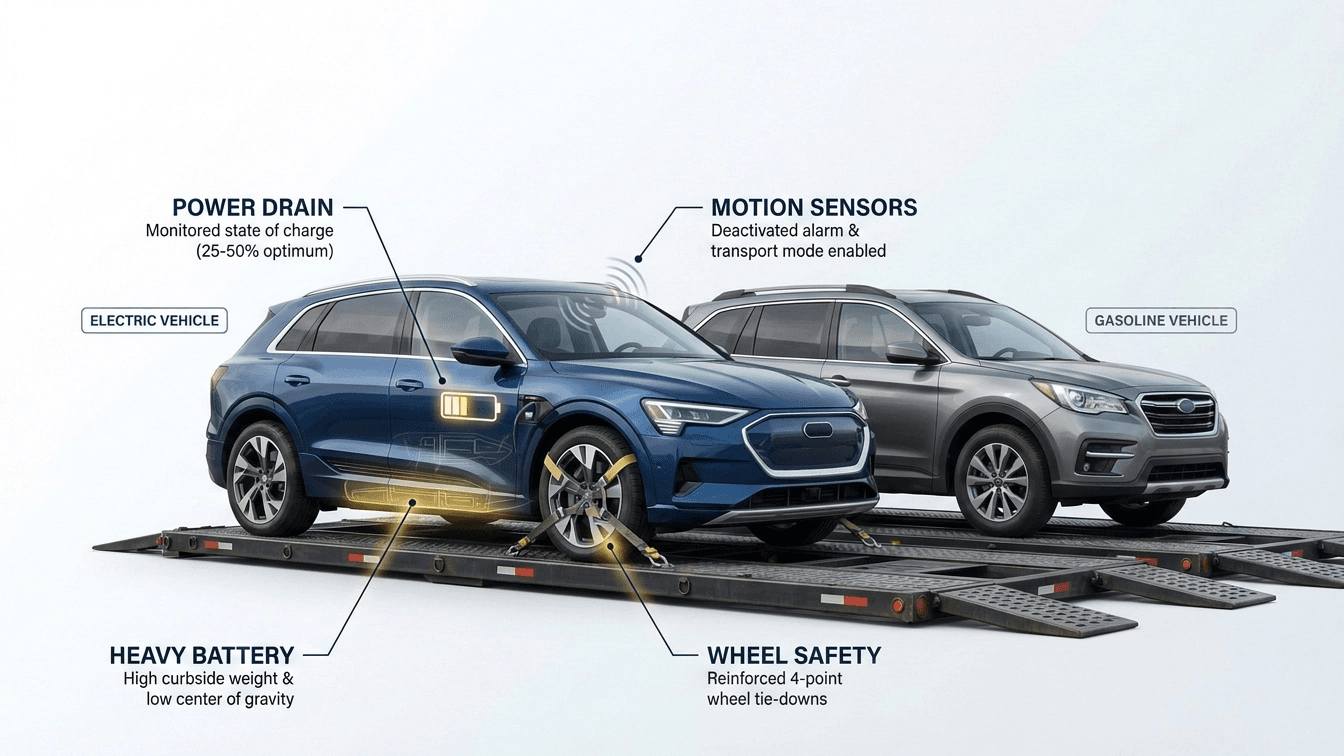
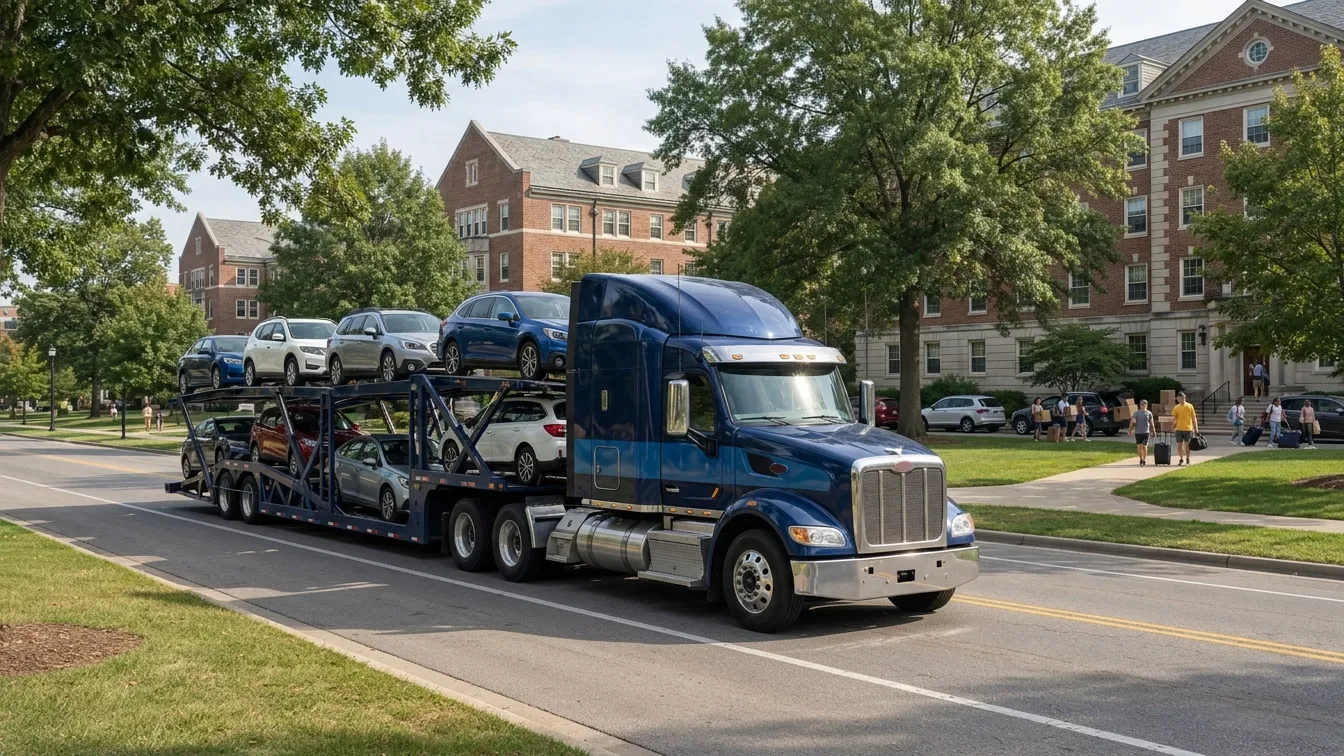
On a trailer, an EV looks like any other car. Under the hood (or the frunk), it's a different story. That's why EV car shipping comes with a few extra steps, even though the basic process stays the same.
Here are the four things that make the difference:
A heavy battery pack: the high-voltage battery can add hundreds or even thousands of pounds.
Electronics that never fully sleep: an EV keeps some systems running while parked, slowly using battery power.
Motors that make power: the same system behind regenerative braking can generate electricity if the wheels spin, so the wheels have to stay still in transit.
Movement-sensitive security: features like sentry mode watch for motion and nearby people, and a moving truck can set them off.
Here's a quick side-by-side:
Shipping factor | Electric vehicle | Gas car |
|---|---|---|
Energy level at pickup | Battery at about 30% to 50% charge | About a quarter tank of fuel |
Weight | Often several hundred to several thousand pounds heavier | Lighter than a similar EV |
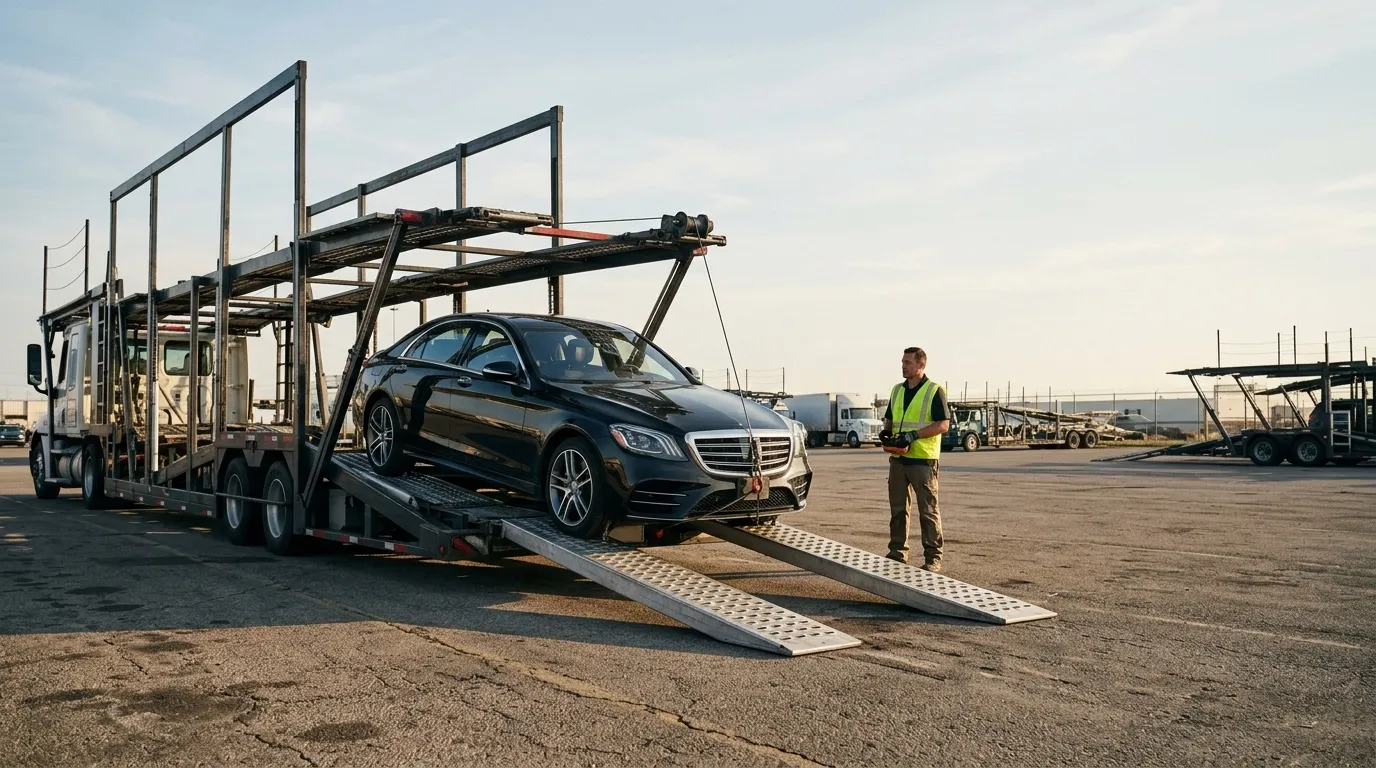
Loading method | Driven on, or winched on in transport mode; wheels must not spin in transit | Driven on or winched |
Prep steps | Set charge, turn off sentry mode, set transport mode, remove charging cable | Remove items, check for leaks |
Alarm systems | Cameras and motion alerts can trigger and drain the battery | Standard alarm, rarely an issue |
Let's break each one down.
Battery Charge Level at Pickup
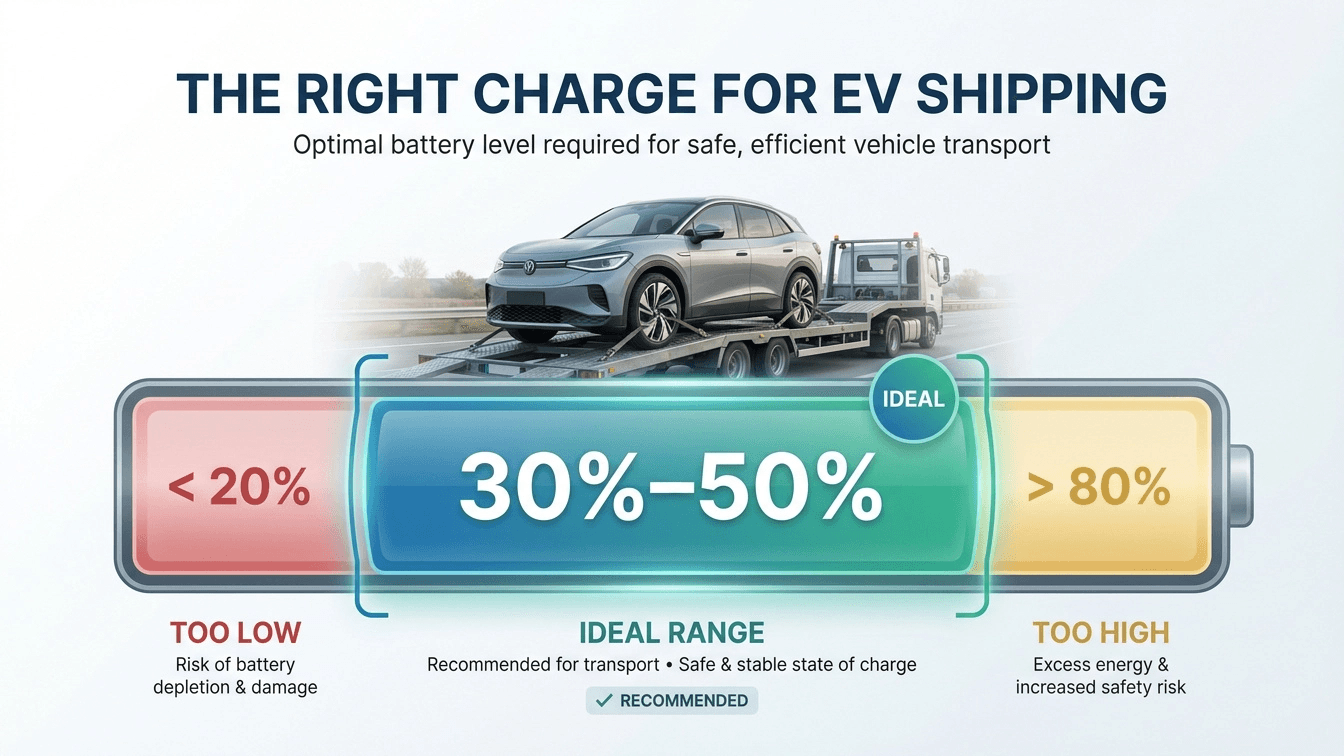
This is the question EV owners ask first. There's no single U.S. law that sets a charge level for moving an EV by truck. Instead, most carriers ask for a middle range, usually a state of charge between about 30% and 50%.
Other kinds of EV transport use similar numbers. Crowley, a U.S. ocean shipping company, requires EVs to arrive with a state of charge between 30% and 50% under its published electric and hybrid vehicle compliance rules. For air freight, the 67th edition of IATA's Dangerous Goods Regulations, effective as of January 1, 2026, caps the share of battery-powered vehicles at 30%.
So why the middle?
Why not 100%: a full battery stores more energy, so it carries more risk if something goes wrong.
Why not near empty: your car still sips a little power on the road, and it has to drive on and off the trailer.
Think of it like three zones:
Too low (under 20%): the car may not have enough power to unload, especially in cold weather.
Just right (30% to 50%): enough power to load, reposition, and unload safely.
Too high (over 80%): more stored energy than the trip needs.
Always follow your carrier's instructions, since some set a tighter range.
Pro tip: Write the exact battery percentage on the bill of lading at pickup. If anyone questions the charge level at delivery, you'll have it in writing. And if your EV is heading north in winter, start closer to 50%, because batteries drain faster in the cold.
Weight and Why It Affects Price
Battery weight is the biggest physical difference between an EV and a gas car. A large pack can add hundreds of pounds to a sedan, and well over 1,000 pounds to a full-size pickup.
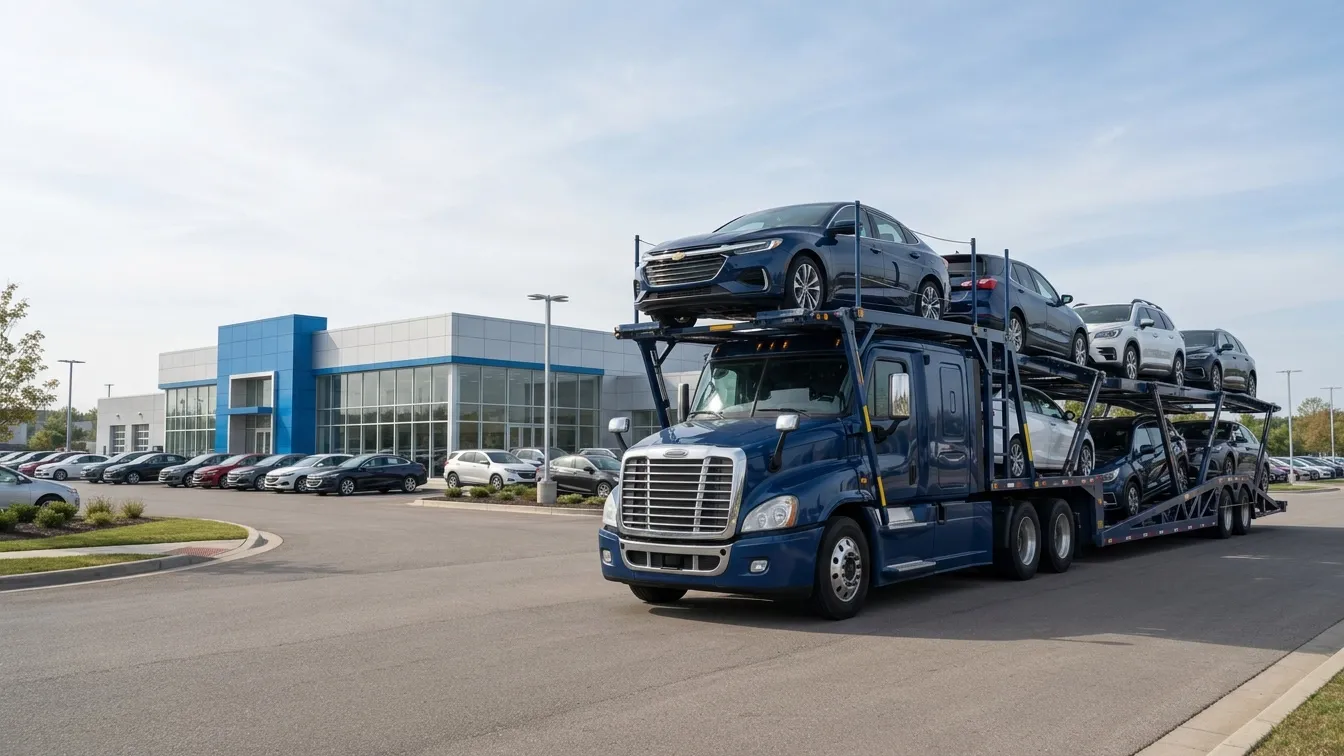
Why does that matter? Every car carrier works within a carrier weight limit. A typical nine-car open carrier has to stay within the 80,000-pound federal gross weight limit on Interstate highways. Once you subtract the truck and trailer, that leaves roughly 45,000 pounds for cargo.
Let's do the math. Nine sedans at 3,500 pounds each total about 31,500 pounds, which is no problem. Nine electric pickups at 6,500 pounds each total 58,500 pounds, which is way over. So when heavy EVs come aboard, the carrier may fit fewer cars on the trailer, and each one may cost more to ship.
Here's how some popular EVs compare:
Electric vehicle | Approx. curb weight | Similar gas model | Approx. curb weight |
|---|---|---|---|
Tesla Model 3 (RWD) | 3,757 lbs | Toyota Camry | 3,450 to 3,680 lbs |
Tesla Model Y (RWD) | 4,061 lbs | Toyota RAV4 | 3,590 to 3,920 lbs |
Hyundai Ioniq 5 | 4,550 to 4,860 lbs | Hyundai Tucson | 3,430 to 3,710 lbs |
Ford F-150 Lightning | 6,360 to 6,880 lbs | Ford F-150 (gas) | 4,300 to 5,900 lbs |
GMC Hummer EV | 9,000 to 9,700 lbs | No direct gas equivalent | Not applicable |
Curb weight is the weight of the car with no passengers or cargo. Figures are approximate 2026 model year ranges by trim, from manufacturer specs as listed by Tesla, Cars.com, Kelley Blue Book, and iSeeCars.
How much does Tesla shipping cost compared to a gas car?
Tesla shipping cost follows the same pricing as any vehicle of the same size. Based on Safeeds Transport's published rates, shipping a standard sedan on an open carrier costs about $500 to $1,900, depending on distance. Trips under 500 miles usually run $500 to $900, while cross-country routes run $1,300 to $1,900.
Here's how that applies to each Tesla:
Model 3: priced like a standard sedan, so about $500 to $1,900.
Model Y and Model X: priced like a mid-size SUV, which usually adds about $100 to $250 to the sedan price.
Cybertruck: at roughly 6,600 pounds, it's priced like a full-size pickup, which usually adds about $200 to $400.
A few other factors move the final number:
Season: summer and snowbird season push demand and prices up.
Carrier type: enclosed transport costs more than open.
Running condition: a Tesla that won't power on needs a winch, which usually adds about $150 to $300.
For a route-by-route breakdown, check out our car shipping cost guide.
Carrier Restrictions on EVs
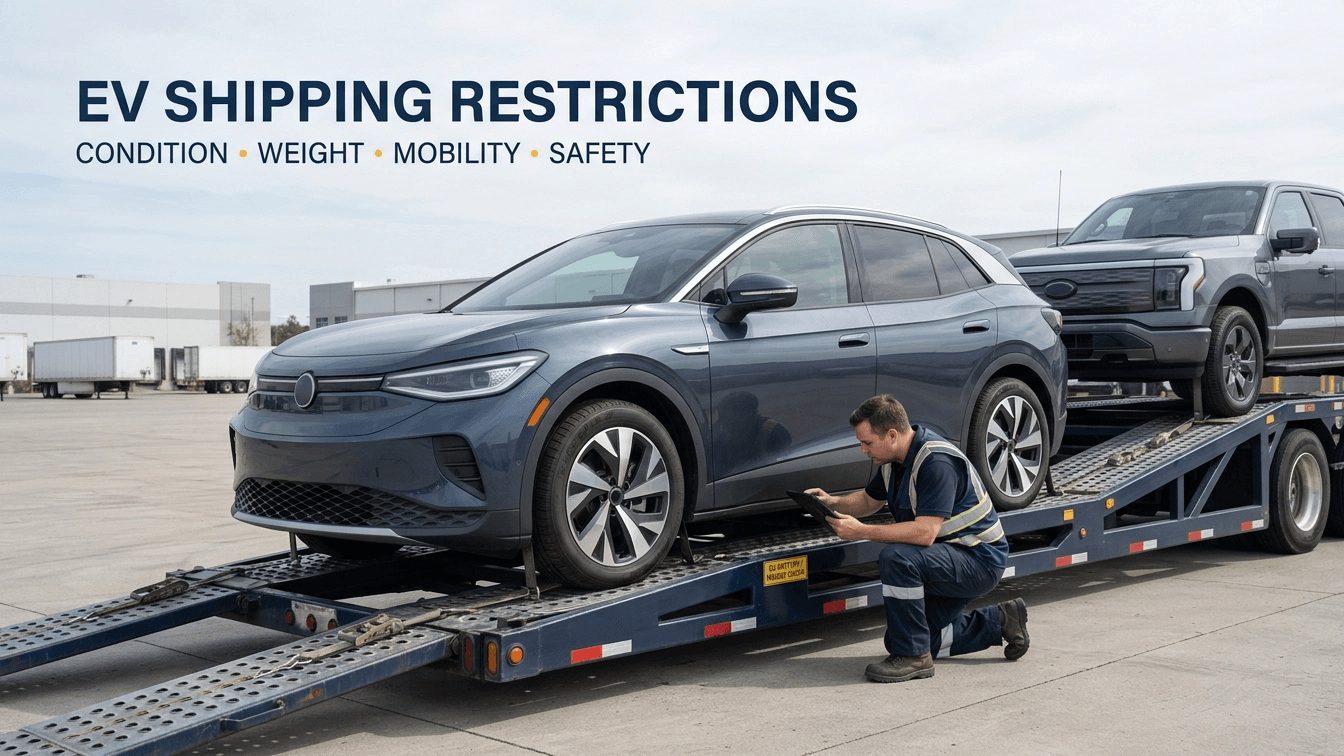
Most carriers take everyday EVs without a second thought. But some will decline certain vehicles or charge extra for them:
EVs that won't power on: these need winching and sometimes extra equipment.
EVs with damaged batteries: these can count as hazardous materials.
Very heavy electric trucks: models near 9,000 pounds can push a load past the carrier weight limit.
Cars that can't roll freely: if the car can't be put in transport mode or neutral, the driver needs tire skates or dollies.
Damaged batteries are the big one. In April 2023, the U.S. Pipeline and Hazardous Materials Safety Administration (PHMSA) published a safety advisory on transporting electric vehicles with lithium batteries, focused on EVs damaged by floods and extreme weather.
Here's what it says, in plain English:
Lithium batteries are regulated as hazardous materials in transport.
Damaged or defective batteries are more likely to overheat and catch fire, so extra rules apply.
The shipper is responsible for judging whether a battery is damaged before it ships.
Pro tip: If your EV has been through a flood, a crash, or a fire, say so when you request a quote. It helps match your car with a carrier that can handle it properly. For cars that won't start, our guide to non-running vehicle transport explains how loading works.
Open vs Enclosed for an EV
Here's some reassurance: most everyday EVs ship safely on open carriers, the same trailers used for most cars in the U.S. Enclosed transport adds protection, but it costs more and there are fewer trucks to choose from.
Factor | Open transport | Enclosed transport |
|---|---|---|
Cost | Lower | Higher |
Protection | Exposed to weather and road debris | Fully covered from weather and debris |
Availability | Widely available on most routes | Fewer trucks, so booking may take longer |
Best for | Everyday EVs such as Model 3, Model Y and Ioniq 5 | High-value models, new deliveries and winter routes with road salt |
But here's what matters even more than the trailer: how the car is loaded. Tesla's own instructions for transporters recommend a flatbed or similar transport vehicle and warn never to transport the car with any wheels able to spin. The reason? The motors generate power when the wheels turn, which can cause damage and overheating.
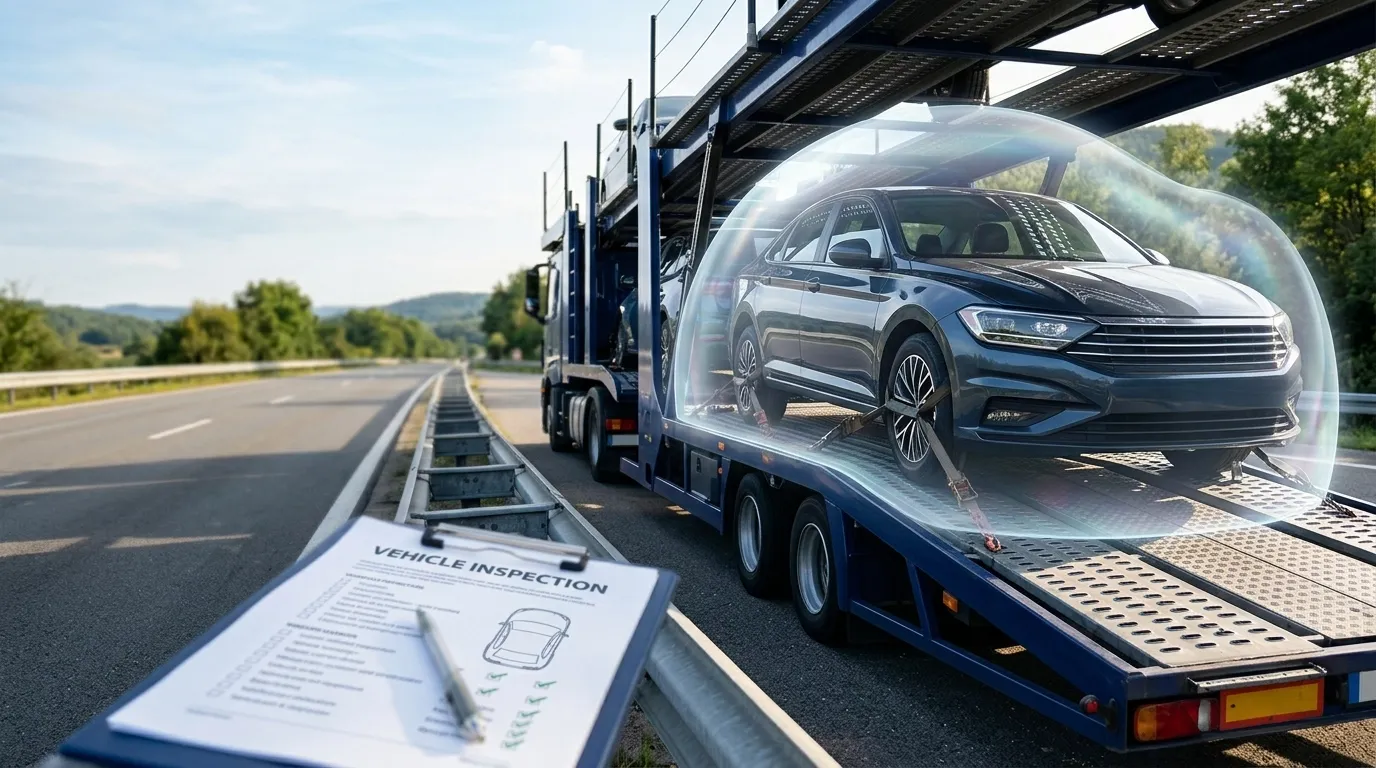
Both open and enclosed car carriers keep all four wheels on the deck with the tires strapped down, so they meet that requirement. Problems usually come from other methods, like towing a car with two wheels on the ground.
Still deciding? Compare both options on our open car transport and enclosed auto transport pages.
Preparing Your EV for Transport
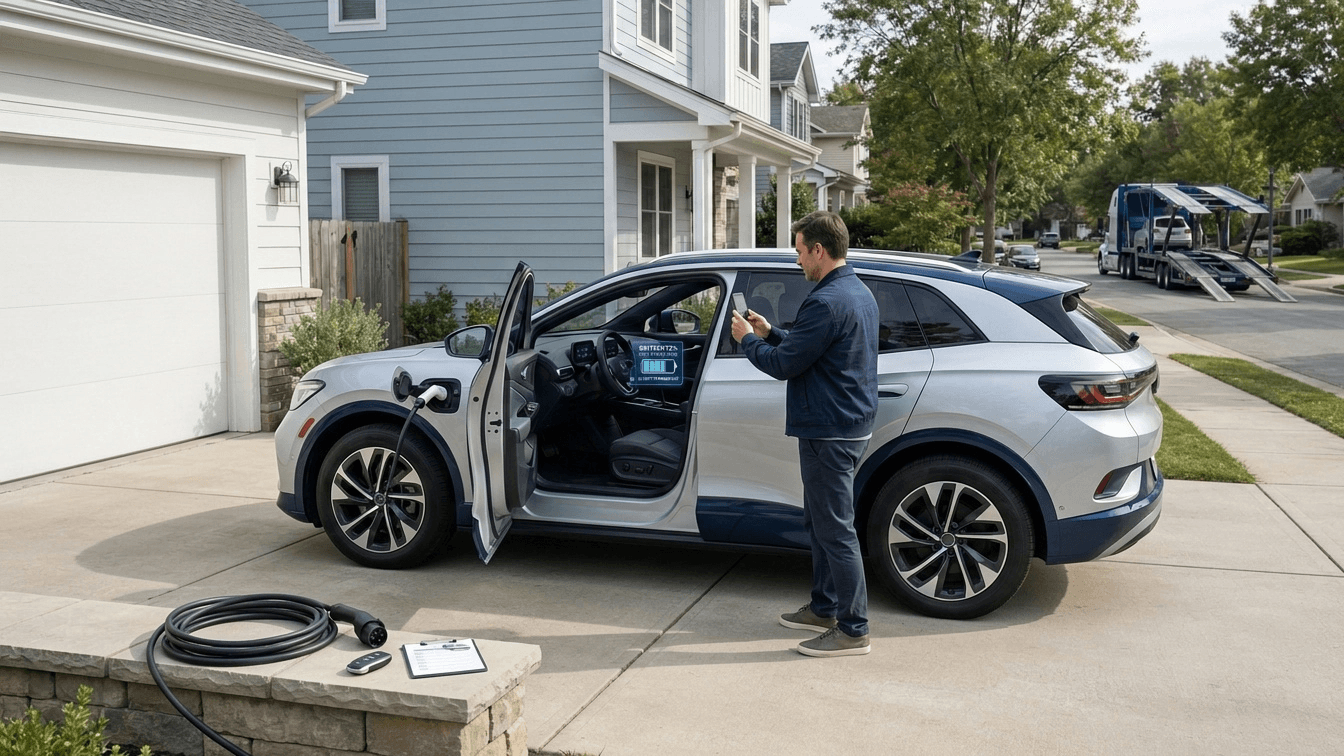
A little prep goes a long way when shipping an electric car. It makes loading easier and protects you if there's ever a question about the car's condition at delivery. Run through this checklist a day or two before pickup:
Set the charge to your carrier's range. Aim for about 30% to 50% unless your carrier asks for something different.
Turn off sentry, alarm, and auto-lock features. Sentry mode and motion alarms can go off on a moving truck and drain the battery. Auto-lock can also lock the driver out during loading.
Learn how to set transport or tow mode. Transport mode keeps the car free-rolling so it can be winched on without the wheels locking. Your owner's manual has the steps for your model.
Remove personal items and loose accessories. That includes the charging cable and adapters, which are easy to lose and generally not covered by carrier insurance.
Photograph the car and note the battery percentage. Take dated photos from every side, and record the state of charge on the bill of lading.
Hand over a working key card or fob. Many EVs need a physical key card or fob to start or switch modes, since your phone key leaves with you.
Share any warning lights with the carrier. A battery, charging or high-voltage warning can change how the car is handled, so mention it before loading.
The whole list takes less than an hour. Want to know what to check before you sign at pickup and delivery? Our guide to the bill of lading walks you through it.
Electric Vehicle Shipping Questions Owners Ask Before Booking
Still have questions? Here are quick answers to the ones EV owners ask most, with more detail in the sections above.
Can you ship an electric vehicle?
Absolutely. Electric vehicle shipping is routine, and most EVs ride on the same open or enclosed carriers as gas cars. The differences come down to charge level, battery weight and a few prep steps. We'll walk you through each one, so moving your EV feels as easy as booking any other car.
What charge level should my EV be at for shipping?
Aim for the middle: about 30% to 50%. That's enough power to load and unload without storing more energy than the trip needs. Some carriers set their own range, and we'll confirm the exact number when you book, so there's no guesswork on pickup day.
Does shipping an EV cost more?
Sometimes, but not always. EV car shipping is priced on distance, route, season and trailer type, just like any car. Weight is the wild card: heavier EVs use more of the truck's capacity. For a Model 3 or Model Y, prices are often close to a gas SUV. A free quote shows your exact number in about 30 seconds.
Are there restrictions on shipping EVs?
A few. Some carriers decline or charge extra for EVs that won't power on, EVs with damaged batteries, very heavy electric trucks, and cars that can't roll freely. Damaged lithium batteries also fall under federal hazmat rules. Tell us about your EV upfront, and we'll look for a carrier equipped to handle it.
Can an EV be shipped on an open carrier?
Yes. Open transport is the go-to option for everyday EVs: it costs less, it's easier to book and it's safe for most models. If your EV is high-value, brand-new or shipping through a salty winter, enclosed transport adds full coverage. Either way, your wheels stay strapped down and still.
What about the charging cable and accessories?
Take them out before pickup, including adapters and any loose accessories. Carriers generally don't cover personal items, and small adapters are easy to lose. Pack the cable in your luggage if you'll need it right away. Our prep checklist above covers this and every other step before pickup day.
Will my EV lose charge during transport?
A little, usually a few percent on a typical trip. EVs keep some electronics awake while parked, and cold weather or features like Sentry Mode can drain the battery faster. Start at 30% to 50%, and your EV should arrive with plenty of power to drive off the truck and straight to the nearest charger.
Do I need to disable Sentry or alarm modes?
Yes. Sentry mode and motion alarms react to movement, so on a moving truck they can trigger alerts, record nonstop and drain your battery. Switch them off before pickup, along with automatic locking. If a setting can't be disabled, just let the driver know. It's a two-minute step that makes delivery day much smoother.
Can you ship an EV that will not start?
In many cases, yes. A non-running EV usually needs a winch and a free-rolling or transport mode, or tire skates if the electronics are dead. If the battery may be damaged, hazmat rules can apply. Share the details when you request your quote, and Safeeds Transport will look for a carrier with the right equipment.
Is an EV insured the same as a gas car?
Largely, yes. Licensed carriers typically carry cargo insurance that covers damage in transit, whether your car runs on gas or electricity. Since EVs often cost more to repair, confirm the carrier's cargo coverage matches your car's value. Safeeds Transport works with licensed, insured carriers, so you can check that coverage before your EV leaves the driveway.
Booking Electric Vehicle Shipping With Confidence
Here's the bottom line: shipping an EV isn't harder than shipping a gas car. It just takes a few decisions made in the right order. Set the battery to the charge range your carrier asks for, and check whether your car's weight affects which carrier can take it. Make sure the car can go into transport mode, and switch off Sentry Mode and alarms before the driver arrives. Once those details are handled, EV transport works just like it does for any other vehicle: your car is loaded, secured, moved, and delivered. Safeeds Transport connects EV owners with licensed carriers that handle these vehicles regularly, and getting started takes less than a minute. Request your free quote to get a price locked for 7 days, with no upfront payment.