Auto transport damage is typically covered through four tiers: basic carrier liability, full value protection, broker-arranged supplemental insurance, and the shipper's personal auto policy. Each tier determines how much of the repair cost is covered, who pays first, and what documentation is required to file a successful claim.
Most people booking a shipment for the first time assume "insured" means fully covered, no matter what happens. That assumption causes more disputes than the damage itself. Understanding which of the four coverage tiers applies to a specific shipment, before the truck ever arrives, is what separates a smooth claim from a frustrating one. Get an instant quote and see your options before you book.
What Is Auto Transport Damage Coverage?
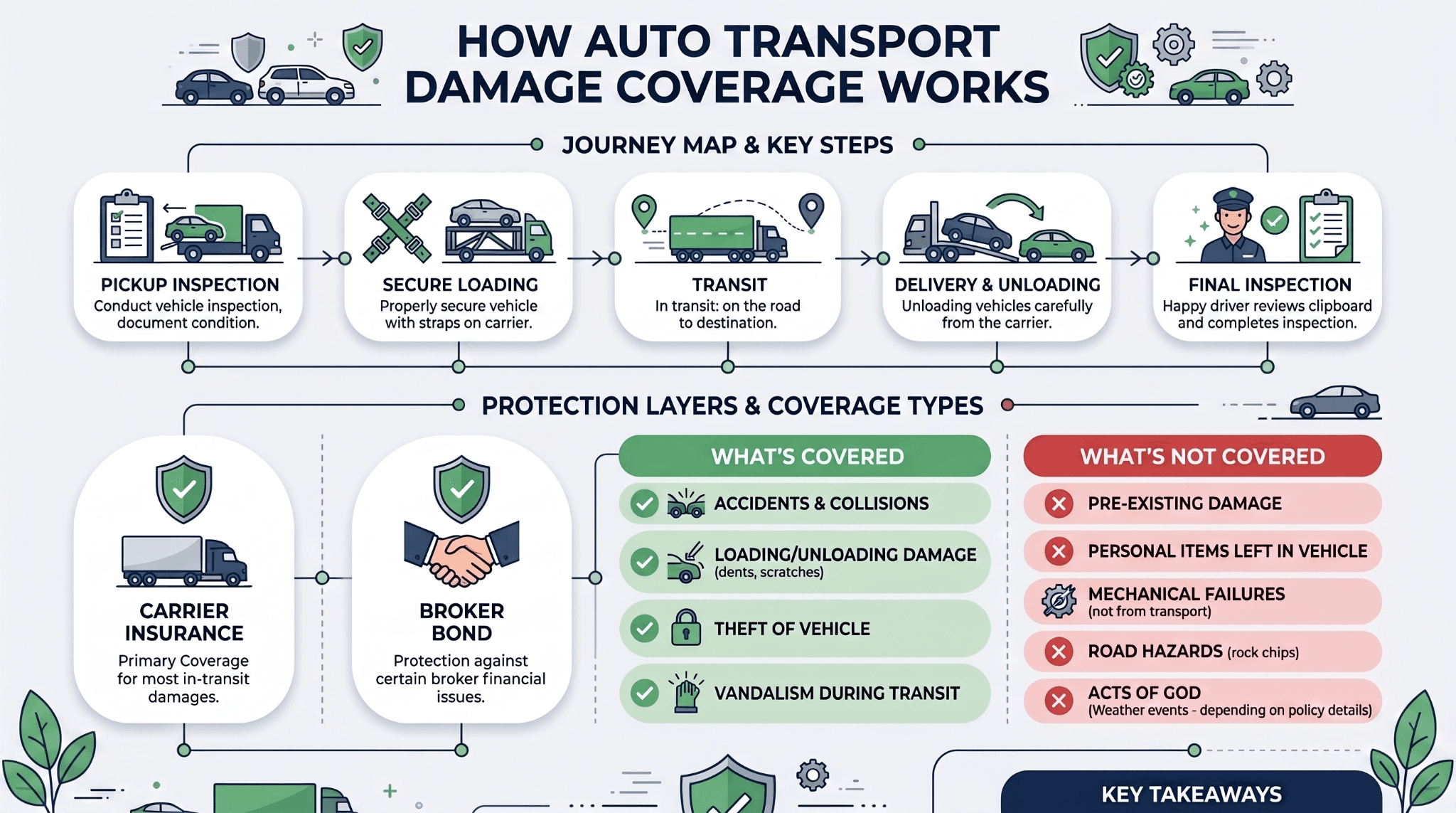
Auto transport damage coverage is not a single insurance policy. It is a layered system comprising several coverage sources that may apply depending on the carrier, the broker, and the shipper's own policy. Each layer has its own rules, limits, and exclusions.
This matters because most shipping disputes come from a mismatch between what a customer expected and what a specific tier actually pays for. A carrier's cargo insurance, for example, covers physical damage caused during transit, but it will not cover a mechanical issue that existed before pickup.
Because of this layered structure, two shipments with the same carrier can have very different outcomes if the vehicles fall under different coverage tiers. Knowing which tier applies avoids surprises later.
At its core, auto transport damage coverage activates when a covered event happens during loading, transit, or unloading. Every FMCSA-licensed carrier is legally required to carry cargo insurance, which pays for damage they directly cause.
This protection typically excludes:
Pre-existing damage noted at pickup
Mechanical or electrical failures unrelated to transit
Damage from severe weather or other events outside the carrier's control
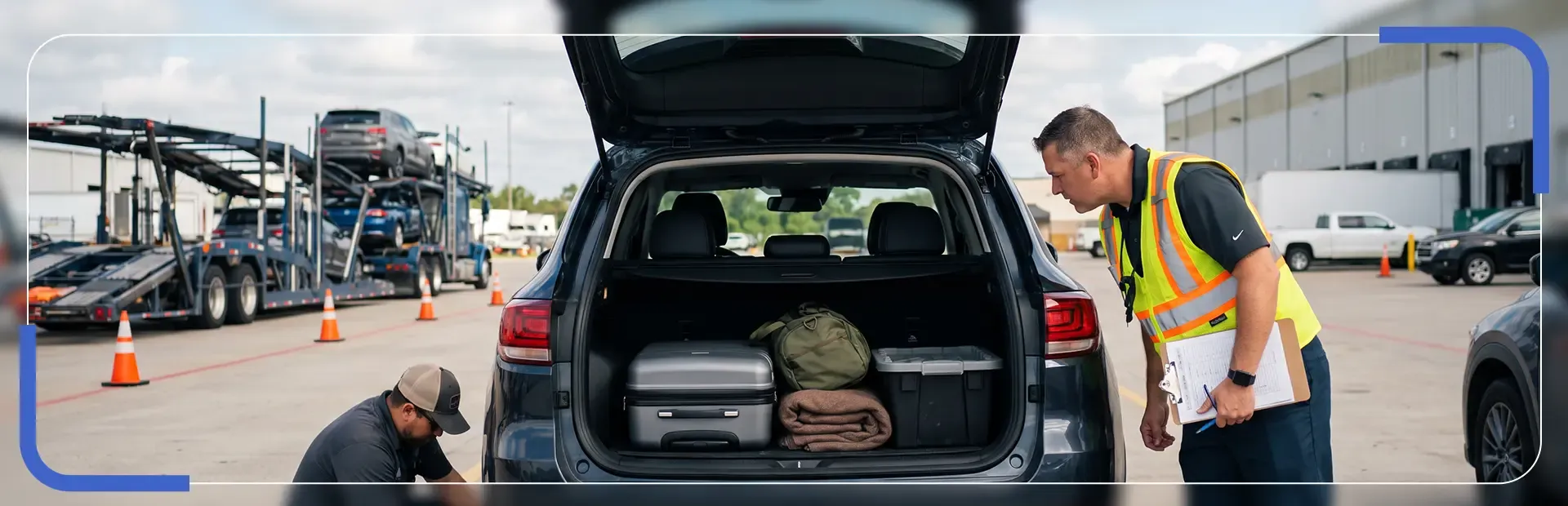
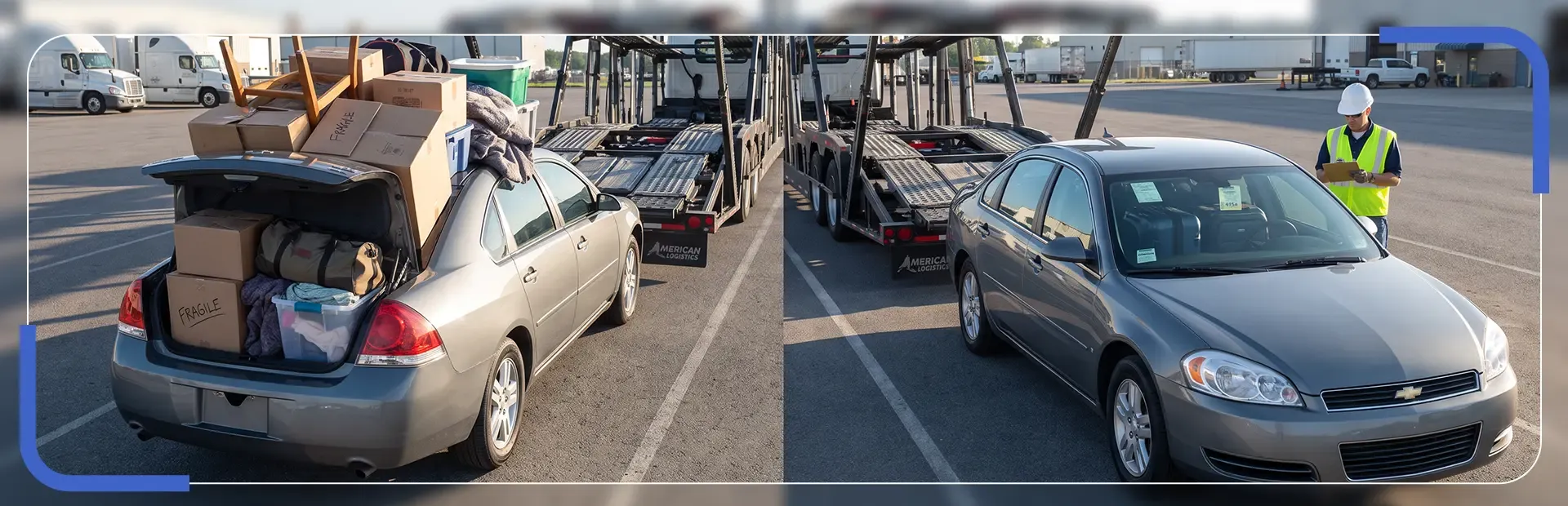
Items left inside the vehicle, in most cases
Because these exclusions are common across the industry, the inspection completed at pickup is what determines whether damage found at delivery is "new" or "pre-existing." This is where the bill of lading becomes central to the entire coverage process, a point covered in more detail later in this guide.
What Are the 4 Tiers of Auto Transport Damage Coverage?
Coverage for a shipped vehicle generally falls into four tiers. Not every shipment includes all four; which ones apply depends on the carrier's policy, whether a broker is involved, and the vehicle's declared value.
Here is how the four tiers compare at a glance:
Tier | Who Provides It | Typical Coverage Limit | Best For |
|---|---|---|---|
1. Basic Carrier Liability | Carrier (FMCSA-required) | Varies, often capped per shipment | Standard vehicles under market value |
2. Full Value Protection | Carrier (optional add-on) | Vehicle's declared value | Higher-value or classic vehicles |
3. Broker-Arranged Supplemental Insurance | Broker (if offered) | Varies by broker agreement | Shipments with coverage gaps |
4. Personal Auto Insurance | Shipper's own insurer | Per personal policy terms | Backup or gap coverage |
Tier 1: Basic Carrier Liability Coverage
Every licensed carrier operating under the Federal Motor Carrier Safety Administration is required to carry cargo liability insurance. This is the baseline layer of auto transport damage protection and applies automatically to nearly every shipment.
The catch is that this coverage often comes with a per-shipment cap, and older or high-mileage vehicles may be valued below what a full repair would cost. Shippers with standard vehicles are usually well protected under this tier alone, but it is worth confirming the carrier's specific policy limits before booking.
Tier 2: Full Value Protection
Full value protection is an optional, higher tier of coverage some carriers offer, particularly for vehicles above average market value. Rather than a flat cap, this tier ties coverage to the vehicle's declared value.
This tier typically costs more upfront but removes the guesswork around whether a payout will cover the full repair. It is most relevant for classic cars, exotic vehicles, or any car being shipped with aftermarket modifications that raise its replacement cost.
Tier 3: Broker-Arranged Supplemental Insurance
Some brokers coordinate additional insurance on top of what the assigned carrier provides. This is not a universal offering, and its availability depends entirely on the individual broker's business model and carrier network.
Because this tier varies so widely, it should never be assumed. Shippers should ask directly whether supplemental coverage is included, what it adds beyond carrier liability, and whether there is an additional cost.
Tier 4: Shipper's Personal Auto Insurance Coverage
A shipper's own comprehensive auto insurance policy can sometimes serve as a secondary layer, filling gaps that carrier or broker coverage does not address. This tier is not designed to be a primary source of protection, but rather a backstop.
Before shipping, it is worth a quick call to a personal insurer to confirm whether the policy extends to third-party transport and under what conditions.
How Does Carrier vs Broker Liability Affect My Coverage?
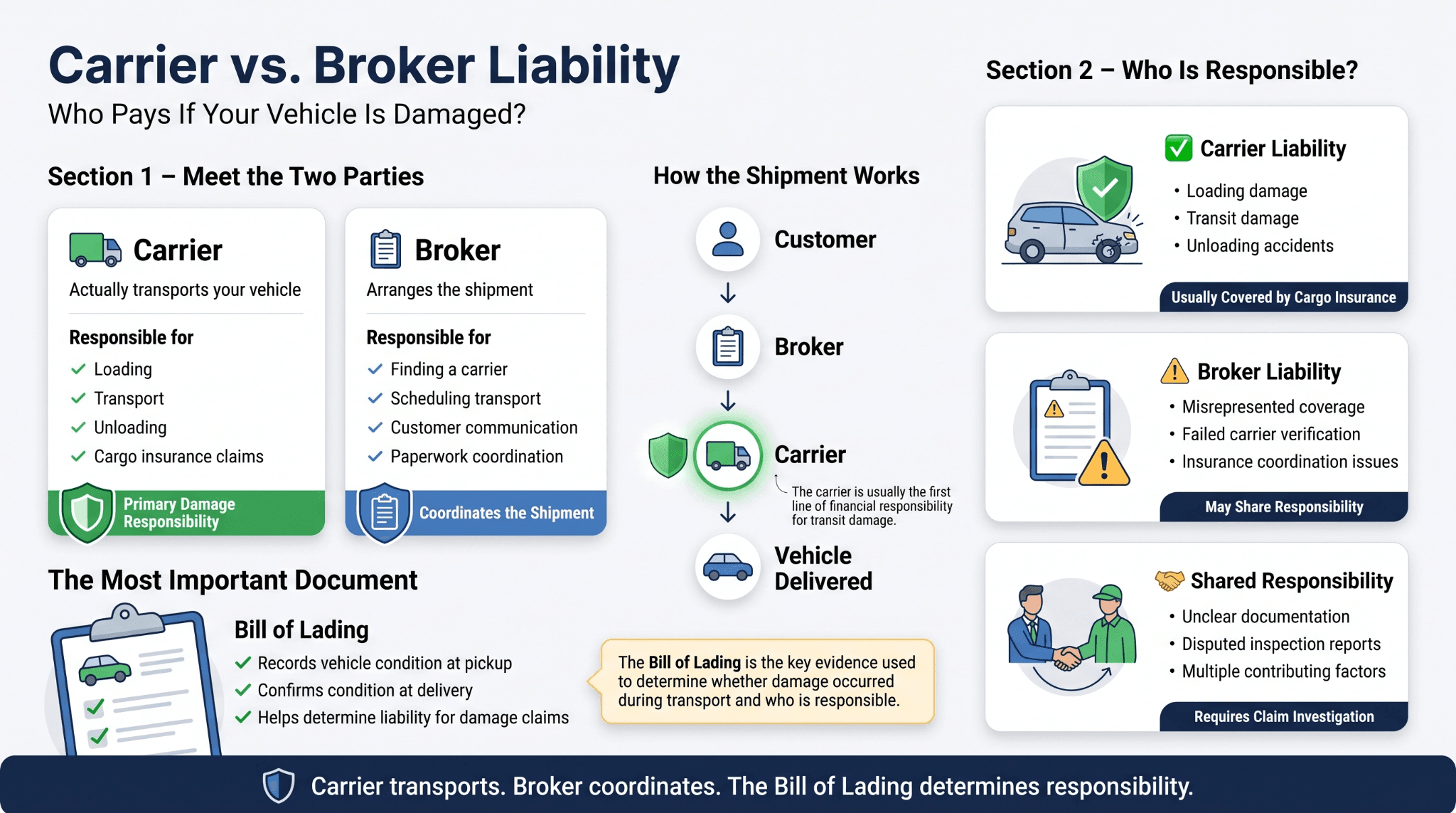
One of the most common points of confusion in auto transport is the difference between carrier vs broker liability. A broker arranges the shipment and connects a customer with a carrier, but the broker generally does not physically transport the vehicle. The carrier is the party actually responsible for the vehicle in transit.
This distinction matters directly for damage coverage. In most cases, the carrier's cargo insurance is the first line of financial responsibility if damage occurs during loading, transit, or unloading. The broker's role is typically limited to coordination, unless they have separately arranged supplemental insurance, as described under Tier 3 above.
When a car is damaged, responsibility generally depends on where the failure occurred:
Carrier-caused damage: Physical damage during transit is typically the carrier's liability, covered under Tier 1 or Tier 2.
Broker coordination failure: If a broker misrepresented coverage or failed to vet a carrier's insurance status, this can shift some responsibility to the broker.
Shared responsibility: Some disputes involve both parties, particularly when documentation is unclear.
The bill of lading, signed at both pickup and delivery, is the primary document used to determine which scenario applies. This is why its accuracy is treated as a legal record, not a formality.
Steps to Take If Your Car Is Damaged During Shipping
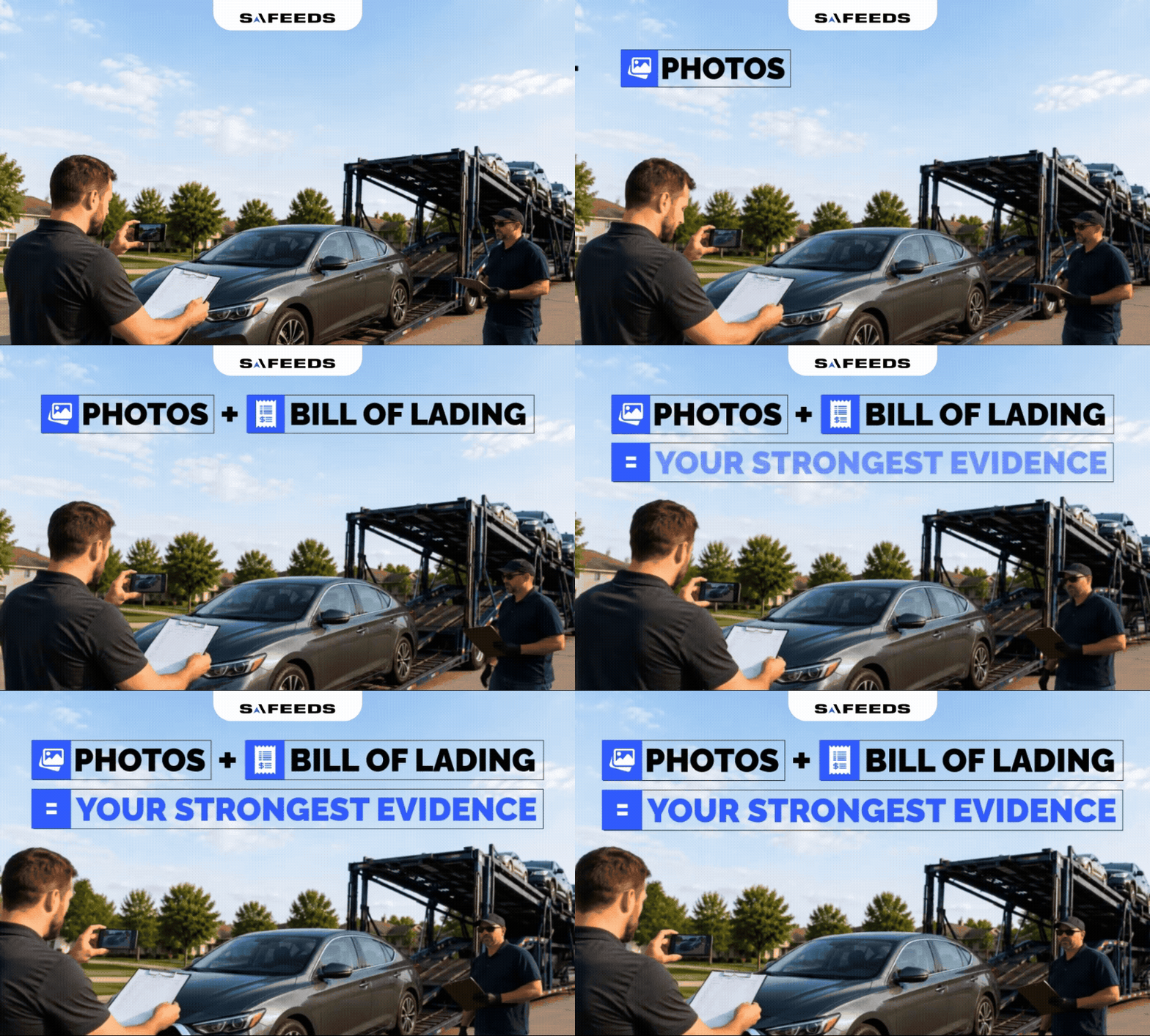
Knowing what to do if your car is damaged during shipping can significantly affect the outcome of a claim. The actions taken in the minutes after delivery, before signing off, matter more than most shippers realize.
The general sequence to follow is:
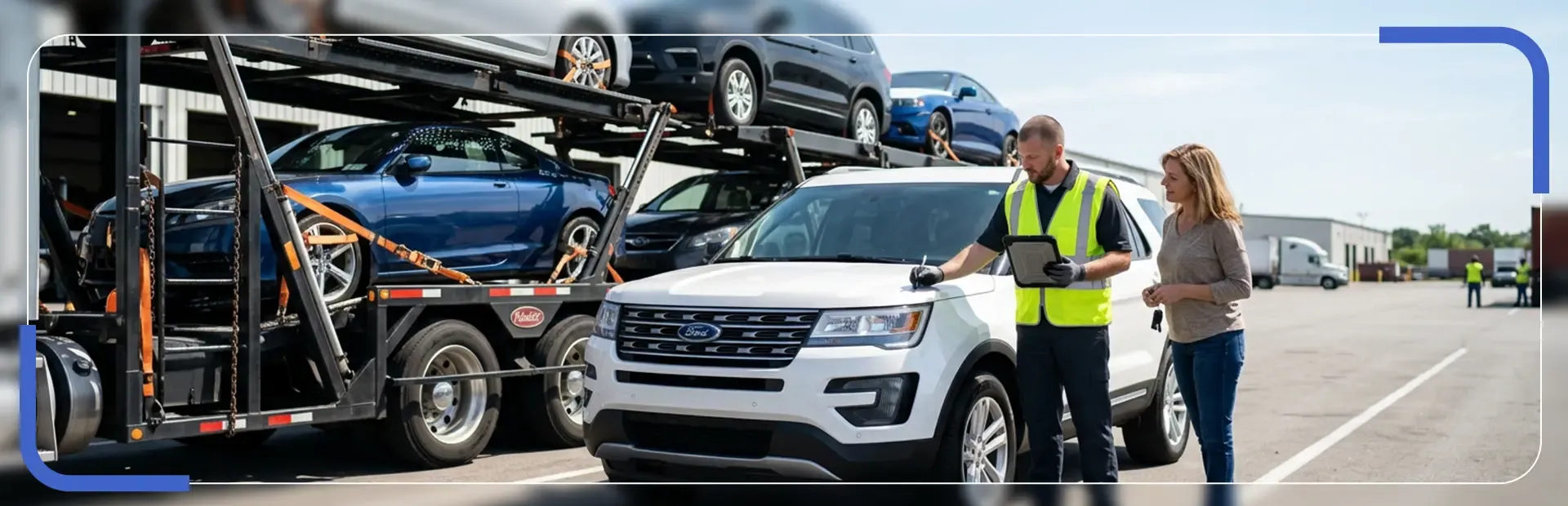
Inspect the vehicle in daylight, before signing any delivery paperwork.
Compare its condition against the pickup inspection notes.
Note any new damage directly on the bill of lading before signing.
Take dated photos and video from multiple angles.
Contact the carrier or broker the same day to begin the claims process.
Signing the bill of lading without noting damage is one of the most common reasons claims are later denied, since it is treated as confirmation that the vehicle arrived in the condition described.
Correct documentation means creating a clear, timestamped record that cannot be easily disputed. This includes:
Photos and video taken immediately at delivery, in good lighting
Close-up images of the specific damage alongside a wider shot for context
A written description added directly to the bill of lading
Written notice sent to the carrier or broker within 24 hours
Reporting promptly is not just good practice; most carrier insurance policies and federal regulations impose strict notice windows for cargo damage claims, so delays can weaken or void an otherwise valid claim.
How Does a Bill of Lading Affect a Damage Dispute?
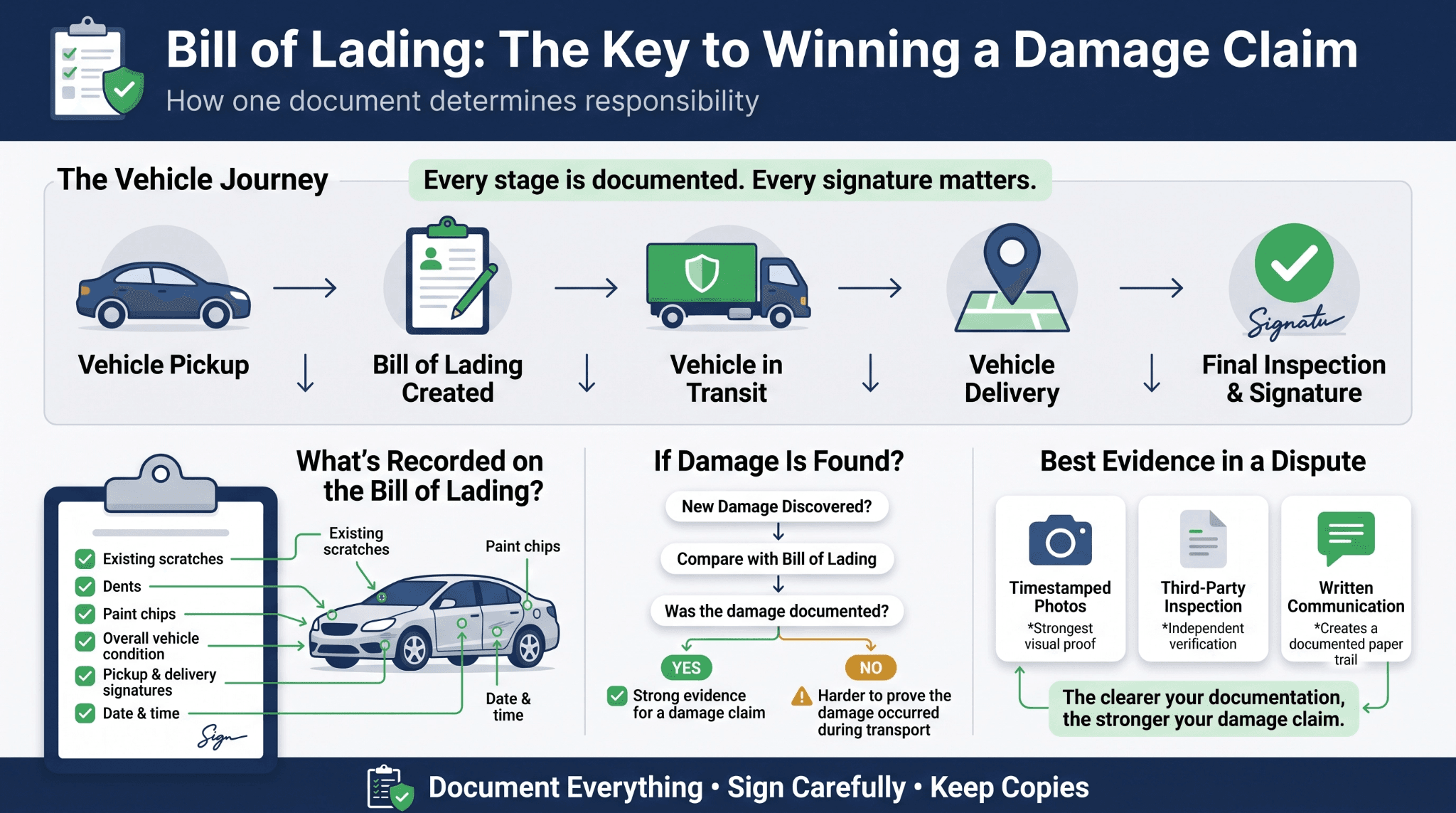
The bill of lading is the single most important document in any car shipping damage claim. It records the vehicle's condition at pickup and again at delivery, and it becomes the legal reference point if a dispute arises.
A properly completed bill of lading includes a diagram or written notes identifying any existing scratches, dents, or wear at pickup. When the vehicle is delivered, this same document is reviewed and signed again, and any new damage should be noted at that exact moment, not afterward.
According to the Carmack Amendment governing interstate carrier liability, carriers are generally held liable for cargo loss or damage that occurs while the shipment is in their possession, which makes accurate pickup and delivery documentation legally significant, not just procedural.
A bill of lading damage dispute typically arises when the carrier's account of the vehicle's condition differs from the customer's. In these situations:
Timestamped photos from pickup and delivery are the strongest evidence.
A third-party inspection report can help resolve conflicting accounts, particularly for higher-value claims.
Written communication with the carrier or broker should be kept as a paper trail throughout the dispute.
When documentation on both sides is thorough, most disputes are resolved without escalation. When it is not, the case often comes down to whichever party has clearer, dated evidence.
Filing a Car Shipping Damage Claim
Filing a car shipping damage claim follows a fairly consistent process across the industry, regardless of which coverage tier applies. It starts with notifying the carrier or broker immediately, ideally the same day as delivery, followed by submitting the bill of lading showing the noted damage along with photo and video evidence from both pickup and delivery.
From there, a repair estimate from a licensed auto body shop supports the formal claim filed through the carrier's insurance provider, and if the claim isn't acknowledged within the carrier's stated timeframe, following up in writing keeps it moving. The table below breaks down each step, what's needed, and how long it typically takes.
Step | What's Needed | Typical Timeframe |
|---|---|---|
1. Report damage | Written notice to carrier/broker | Same day as delivery |
2. Submit documentation | Bill of lading, photos, video | Within 24–48 hours |
3. Get repair estimate | Written quote from licensed shop | Within 1 week |
4. File formal claim | Claim form with insurer | Varies by carrier policy |
5. Claim review | Insurer evaluates evidence | 2–4 weeks on average |
A well-supported claim includes the signed bill of lading, timestamped photos and video of the damage, a written repair estimate, correspondence with the carrier or broker, and proof of the vehicle's pre-shipment condition. Claims with all five are far less likely to be delayed or disputed.
What Do Shippers Usually Want to Know About Damage Coverage?
Beyond the coverage tiers themselves, a few specific questions come up consistently among people shipping a vehicle for the first time.
Is my car automatically insured during auto transport?
Yes, in most cases. Every FMCSA-licensed carrier is required to carry cargo liability insurance that applies automatically. However, coverage limits vary, so confirming the specific policy details before booking is a smart step.
Can I ship a car with existing damage or cosmetic issues?
Yes. Existing damage should simply be noted clearly on the bill of lading at pickup, which protects both the shipper and the carrier from confusion later.
Does auto transport insurance cover items left inside the vehicle?
Generally, no. Most carrier policies exclude personal belongings left inside the car, so it is best to remove valuables before pickup.
How long does a car shipping damage claim usually take to resolve?
Most claims are resolved within two to four weeks, depending on the complexity of the damage and how complete the submitted documentation is.
Is enclosed transport worth it for damage protection?
For higher-value or specialty vehicles, enclosed transport significantly reduces exposure to road debris and weather, which is why many shippers choose it for added peace of mind.
Choosing the Right Coverage Before You Ship
The four coverage tiers outlined here are best thought of as a decision framework rather than a checklist to work through after something goes wrong. Basic carrier liability handles most standard shipments, full value protection closes the gap for higher-value vehicles, broker-arranged supplemental insurance fills in where it is offered, and a personal auto policy acts as a final backstop.
The shippers who avoid the most frustration are the ones who confirm their coverage tier, ask direct questions about carrier vs broker liability, and understand the bill of lading process before the vehicle is ever loaded. A few minutes of clarity upfront consistently saves hours of dispute later. Get an instant quote and confirm your coverage tier before you book.