Double brokering happens when a broker or carrier passes your shipment to another company instead of the carrier you actually booked, often without your knowledge. It can lead to lost communication, voided insurance, payment disputes, and delivery delays. Verifying carrier credentials and booking through a transparent provider prevents most of these risks.
This practice has become more common as digital load boards make it easy for a shipment to change hands more than once before a truck ever arrives. Knowing how it works and what to check before you book keeps the decision in your hands rather than leaving it to chance.
Get a free, no-obligation quote from Safeeds Transport and work with a transport partner who tells you exactly who's handling your vehicle, every step of the way.
What Is Double Brokering in Trucking and Car Shipping?
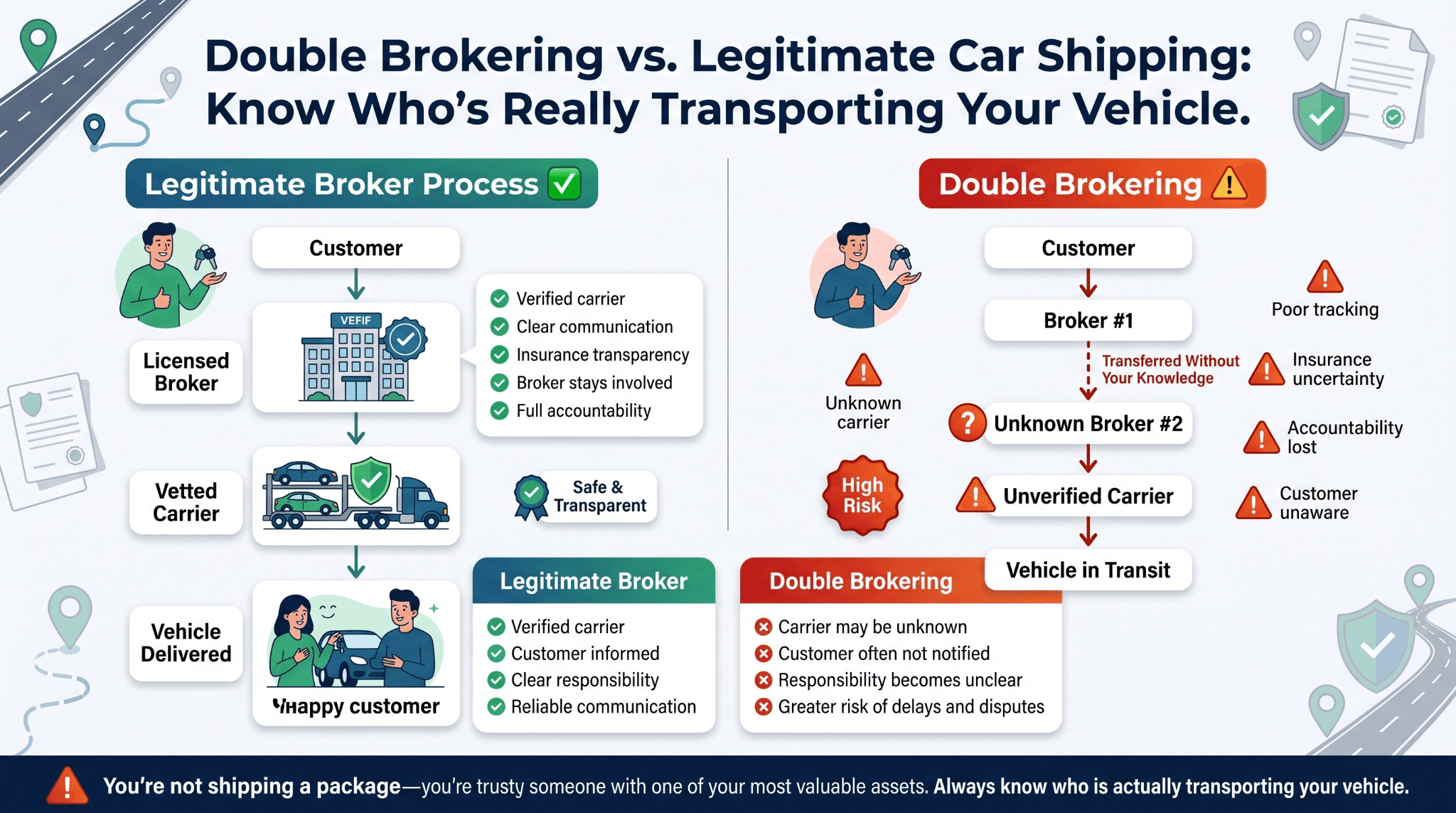
So, what is double brokering in trucking terms, and how does it apply to something as personal as shipping your own vehicle? In simple terms, double brokering happens when a company hired to arrange transportation quietly transfers that job to another company, without telling the customer or the carrier originally involved.
This differs from a normal broker-carrier relationship in a few key ways:
A licensed broker matches your shipment with a vetted carrier and stays involved from booking through delivery.
Everyone in the chain knows who is responsible for what, so accountability stays clear if something goes wrong.
The broker verifies the carrier's credentials before ever assigning your vehicle to them.
Double brokering breaks that chain. A second, often unverified, party steps in, and the original broker loses visibility into who is actually driving the vehicle.
In general freight, this is mostly a costly inconvenience. In car shipping, it's more personal:
You're not shipping a pallet of goods; you're handing over a car, truck, or motorcycle that likely represents a significant financial investment.
When double brokering occurs, tracking, insurance, and accountability can all become uncertain at the same time.
The customer is usually the last person to find out that anything has changed.
That's why this issue deserves attention before you ever book a transport company.
How Does a Double-Brokered Load Actually Happen?
A double-brokered load rarely starts with bad intentions. More often, it begins with a capacity problem. Here's the typical sequence:
A customer books a shipment with Broker A, who confirms a price and timeline.
Broker A cannot find an available carrier in the customer's area or on the requested dates.
Instead of notifying the customer, Broker A lists the load on a public load board.
Broker B picks up the load and assigns it to a carrier that neither the customer nor Broker A has vetted.
The vehicle is transported by a company the customer never agreed to work with.
This happens for a few practical reasons. Broker margins are thin, carrier capacity shifts by season and region, and load boards make it fast and easy to move a shipment along without much oversight. Not every broker who re-lists a load is acting maliciously, but the moment a shipment changes hands without the customer's knowledge, the risk profile changes significantly. That lack of transparency, more than any single bad actor, is what makes double brokering worth understanding.

Single-Brokered vs. Double-Brokered Shipments at a Glance
The difference between these two arrangements often comes down to a handful of key factors, each with real consequences for your shipment. The table below breaks it down side by side.
Factor | Single-Brokered Shipment | Double-Brokered Shipment |
|---|---|---|
Carrier known to the customer | Yes, confirmed at booking | Often unknown until pickup |
Insurance verification | Broker verifies before assignment | May be skipped entirely |
Tracking accuracy | Direct line to assigned carrier | Information passed through multiple parties |
Payment chain | One clear transaction | Two or more parties, higher dispute risk |
Accountability if damage occurs | Clear and traceable | Often disputed between parties |
What Are the 7 Biggest Risks of Double Brokering?
Once a load changes hands more than once, accountability gets blurry fast. Understanding what double-brokering trucking practices lead to helps explain why these seven risks matter most to someone shipping a personal vehicle.
1. Your Vehicle's Location Becomes Hard to Track
When a shipment moves from one broker to another, tracking details, such as the driver's contact information and estimated arrival, often don't transfer cleanly. Customers can be left calling a company that no longer has current information about their vehicle's location.
2. Insurance Coverage May Not Apply
Cargo insurance is typically tied to the specific carrier assigned to a load. If a shipment is quietly handed to a different, unvetted carrier, that carrier's insurance may not have been confirmed or may not apply to your vehicle at all, leaving you exposed if damage occurs in transit.
3. Payment Disputes Between Brokers
When two brokers are involved in a double-brokered load, payment can get complicated. If the original broker pays a carrier who has already re-brokered the job, the actual driver may go unpaid, and in worst-case scenarios, may refuse to release the vehicle until the payment dispute is resolved.
4. Unlicensed or Unvetted Carriers Take Over
The carrier who ultimately shows up may not have been checked for safety ratings, insurance, or FMCSA authority. According to England Logistics, carriers who haul a double-brokered load often go unpaid because the arrangement bypasses standard broker bonding requirements, a sign of how little oversight exists in these transactions.
5. Delivery Delays and Communication Breakdowns
Every additional party in a shipment adds a layer of communication that can break down. Updates get delayed, pickup windows shift without notice, and customers are often the last to know when something changes.
6. Legal and Liability Confusion
If a vehicle is damaged in transit, determining who is legally responsible becomes more complicated when three parties, not two, are involved in arranging the shipment. This can stretch out claims and disputes well beyond what a standard single-broker arrangement would involve.
7. Higher Risk of Fraud or Load Abandonment
In the most serious cases, a double-brokered load is abandoned mid-transit, or a carrier holds a vehicle until an additional, unauthorized payment is made. This is widely referred to as a double brokering scam, and it represents the most damaging version of this practice for shippers, which is exactly why understanding what double brokering trucking involves matters before you ever book a carrier.
How Can You Tell a Shipment Has Been Double-Brokered?
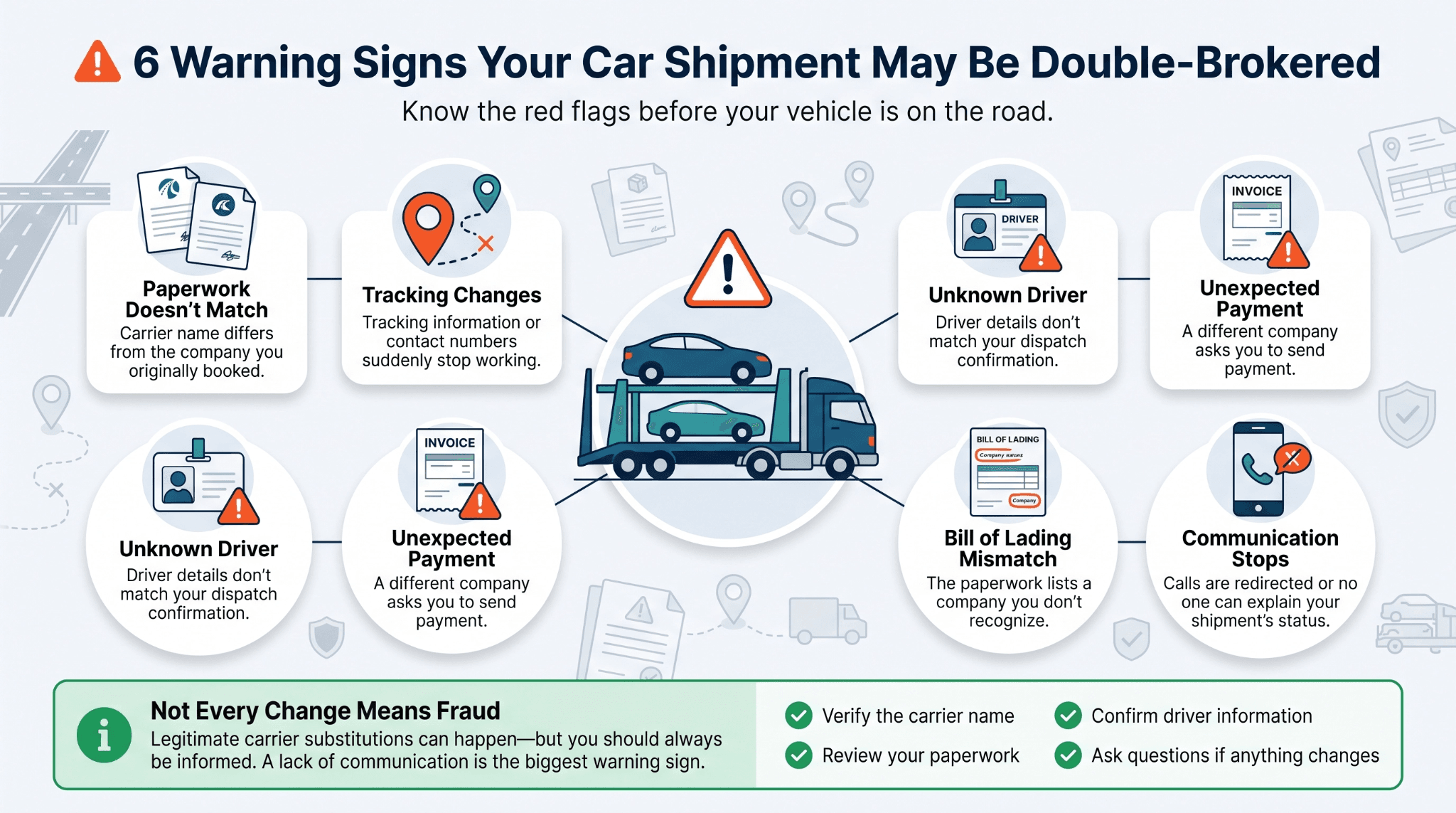
Most double brokering isn't obvious at first glance, but a few details tend to give it away:
The carrier name on your paperwork doesn't match the company you originally booked with.
Tracking information changes unexpectedly, or the number you were given no longer works.
The driver's contact details don't match anything in your original dispatch confirmation.
A payment request arrives from a company name you don't recognize.
The Bill of Lading lists a company different from the one on your original quote.
Communication suddenly slows down, or your calls get redirected to someone unfamiliar with your shipment's history.
If you notice any of these signs, it doesn't automatically mean fraud is involved. Sometimes a legitimate carrier substitution happens with proper notice. But when a shipment changes hands without any communication, that silence is the real warning sign, more than the change itself. Trusting your instincts and asking questions early can save you significant stress later.
How Can You Avoid Double Brokering When Booking Auto Transport?
Prevention is easier than damage control. A few checks before booking can rule out this risk almost entirely, and knowing how to avoid double brokering starts well before your vehicle is ever picked up.
Verify the Carrier's FMCSA Registration Before Booking
Before confirming any shipment, look up the assigned carrier's DOT and MC numbers through the FMCSA's SAFER system. This free tool shows whether a carrier's operating authority is active, along with basic safety and insurance information.
Confirm the Carrier's Name Matches Your Paperwork
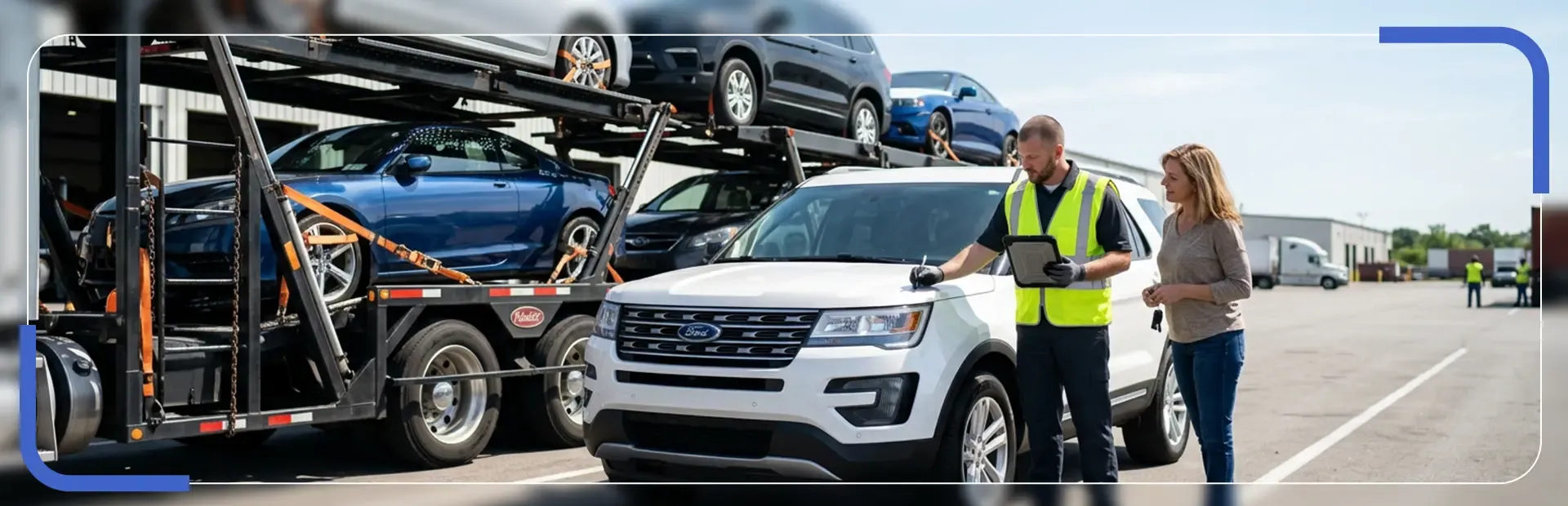
When your vehicle is picked up, compare the company name on your Bill of Lading with the name printed on the truck and the driver's paperwork. A mismatch here is one of the clearest indicators of an undisclosed handoff.
Choose a Transport Company With a Transparent Carrier Network
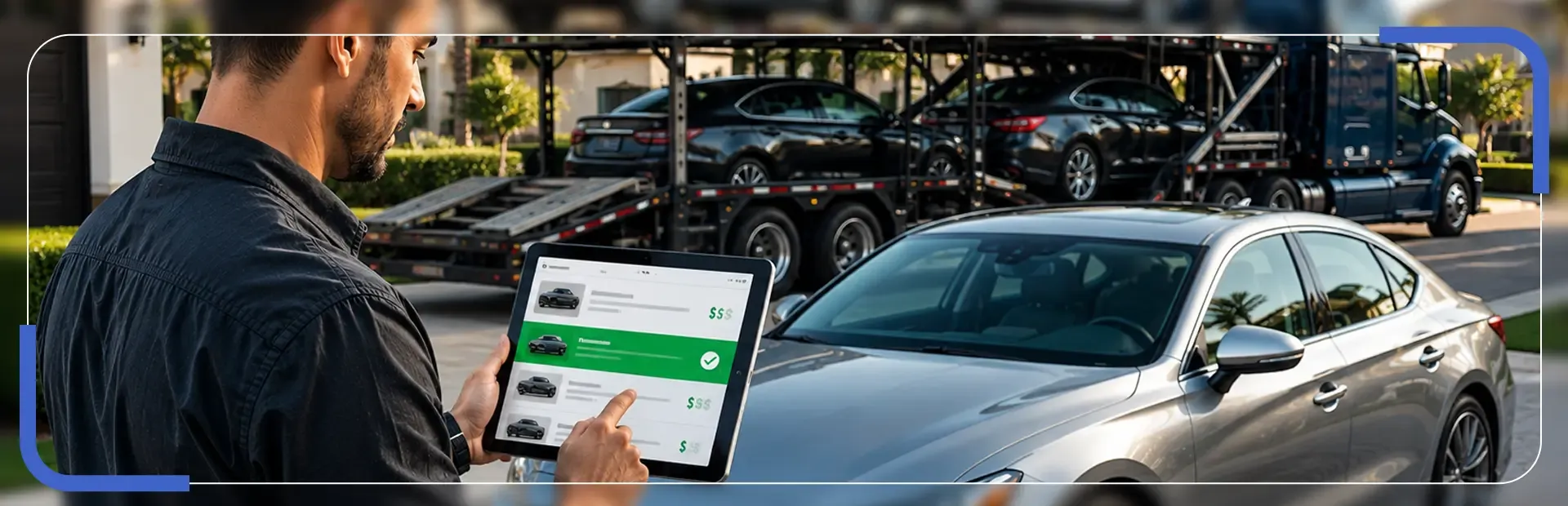
The simplest way to avoid double brokering is to work with a company that vets its carrier network directly, rather than outsourcing bookings to unknown third parties. Ask directly how a company selects carriers and whether they confirm insurance before assignment.
Quick Reference: Verification Checklist
Running through these checks before pickup takes only a few minutes but can save you from a much longer headache later. Use this table as a simple, step-by-step reference the next time you book a shipment.
Step | What to Check | Where to Check It |
|---|---|---|
1 | Carrier's DOT/MC number | FMCSA SAFER system |
2 | Active operating authority | FMCSA SAFER system |
3 | Company name on Bill of Lading | Compare to the original booking confirmation |
4 | Driver and truck details | Cross-check with dispatch email/text |
5 | Insurance coverage confirmation | Ask the broker directly before pickup |
What Should You Do If You Suspect Double Brokering?
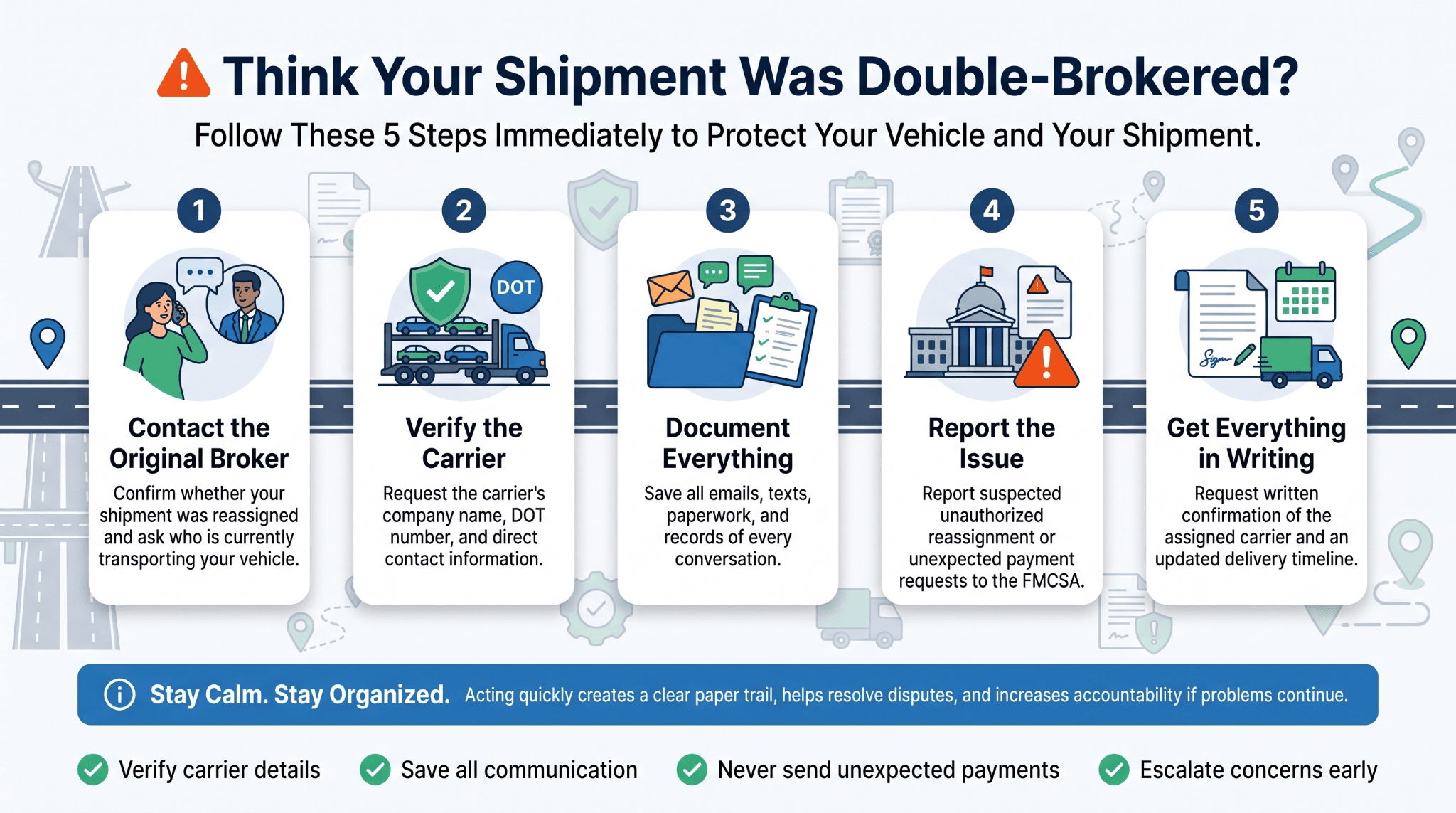
If something feels off during your shipment, a few steps can help you regain control of the situation:
Contact the original booking company immediately. Ask directly whether the load has been reassigned and to whom.
Request written confirmation of the assigned carrier, including their DOT number and contact information.
Document all communication, including emails, texts, and the names of anyone you speak with. This record matters if a dispute arises later.
Report suspected fraud to the FMCSA if it appears your shipment was reassigned without consent or if you're asked for an unexpected payment.
Ask for a revised timeline in writing once the situation is clarified, so you have a clear reference point if delays continue or further discrepancies come up.
Acting quickly rarely resolves everything instantly, but it does create a paper trail and puts pressure on the responsible party to explain what happened. Staying calm and organized throughout the process also makes it easier to escalate the issue effectively if the company fails to respond.
Common Questions About Double Brokering in Car Shipping
Every shipper eventually runs into the same handful of questions once they start researching how car transport actually works. Below are the ones that come up most often, answered directly so you know exactly what to expect before you book.
Is double brokering illegal?
Federal law requires brokers and carriers to register with the FMCSA, and unauthorized re-brokering generally violates existing authority requirements. Booking with a provider that keeps its carrier vetting transparent is the simplest way to avoid this issue.
Is double brokering the same as a broker using a carrier partner?
No. A broker working with a vetted partner is a normal, disclosed arrangement and a sign of a well-run operation. Double brokering means your shipment changes hands without your knowledge or consent.
Does double brokering affect delivery time?
Often, yes. Extra handoffs mean more coordination and more room for delay. A provider with its own in-house carrier network cuts out that layer and keeps shipments on schedule.
Can I refuse a double-brokered load after booking?
Yes. If your shipment is reassigned without consent, you can ask questions, request a change, or cancel, depending on your contract. A confident provider won't hesitate to show you who's handling your vehicle.
How can I confirm my shipment hasn't been double-brokered before pickup?
Ask for the carrier's DOT and MC numbers in writing, then verify them on the FMCSA's SAFER system. Providers who share this readily are usually the ones worth booking with.
Booking With a Transparent Carrier Network Protects Your Shipment
Most of the risk in double brokering comes down to one thing: visibility. When you can see exactly who is handling your vehicle, confirm their credentials, and reach them directly, the vast majority of these problems simply don't have room to occur.
Choosing a transport company that manages its own vetted carrier network, rather than one that quietly outsources bookings, removes the guesswork from the process. It means fewer unknowns, clearer communication, and a shipment you can actually track from pickup to delivery.
Get Your Free Quote from Safeeds Transport and work with a broker that shows you exactly who's shipping your vehicle.