To choose the best car shipping company, confirm its USDOT and MC numbers show active authority on the FMCSA website, ask for a cargo insurance certificate, and get a written price lock. Avoid large upfront deposits, check review volume across several platforms, and read the complaint history before you book.
Here’s something most people learn the hard way: a car shipping booking can look perfect on Monday and fall apart by Friday. The price goes up after you book, the pickup date keeps slipping, the insurance turns out to be missing, or a deposit disappears when no driver ever shows up. Since most of us ship a car only once or twice in our lives, and every company seems to promise the same thing, it’s tough to know who to trust.
That’s why we put together this guide on how to choose a car shipping company, with nine simple checks you can run yourself (most take less than five minutes), so you can find the best car shipping company for your move before you pay a cent. Get a free, price-locked quote from Safeeds Transport and test it against this checklist.
Key Takeaways
The best car shipping company will share its USDOT and MC numbers, and you can confirm its active authority for free on the FMCSA Company Snapshot in about two minutes.
Your car is protected by the carrier's cargo insurance, not the broker's surety bond, so always ask for a current cargo insurance certificate that names the carrier assigned to your vehicle.
A written price lock, often for seven days, protects you from lowball quotes that rise after booking or leave your car waiting for a carrier.
Avoid paying a non-refundable deposit before a carrier is assigned, because that payment structure puts all of the financial risk on you.
A 4.7 rating from 1,600 reviews is more reliable than a 5.0 rating from 15 reviews, so check review volume on at least three platforms before you book.
The Nine Criteria That Actually Matter

When people compare car shipping companies, they usually look at two things first: price and star rating. The problem is that both can fool you. A super low quote is often just a placeholder that no driver will accept. And a perfect 5.0 rating might come from only a handful of reviews.
The good news? The best car shipping companies earn your trust in ways you can actually check. But first, there’s one thing you need to know.
Brokers and carriers aren’t the same thing.
A carrier owns the trucks and physically moves your car.
A broker organizes your shipment and assigns it to a carrier from its network.
Most companies you’ll find online are brokers, and that’s completely normal. It just means you’ll want to check both the broker and the carrier it picks for you.
Here’s a quick look at all nine checks:
# | What to check | What good looks like | Red flag |
1 | Authority | Active USDOT and MC status on FMCSA | Numbers missing, mismatched, or inactive |
2 | Cargo insurance | A current cargo insurance certificate | “You’re fully covered” with no document |
3 | Quote | A written price lock | A quote way below everyone else’s |
4 | Payment | A clear deposit policy | Non-refundable deposit before a carrier is assigned |
5 | Carrier vetting | A real screening process | “We use whoever’s available” |
6 | Reviews | Strong review volume on 3+ platforms | A high score from very few reviews |
7 | Communication | Dispatch updates and tracking | Slow replies before you even pay |
8 | Damage claims | A clear bill of lading process | No inspection at pickup |
9 | BBB | Accreditation and a clean complaint history | Repeated, unanswered complaints |
The best auto transport companies pass all nine, not just the easy ones. Let’s walk through each one.
1. Verifiable USDOT and MC Authority
Any company that moves cars across state lines, or arranges for someone else to, must be registered with the Federal Motor Carrier Safety Administration (FMCSA).
That registration gives the company two important numbers:
A USDOT number, which identifies the company.
An MC number, which shows it has permission (called “operating authority”) to do interstate work.
A legitimate company will share both numbers right away. You’ll often find them on its website, quote, and contract.
How do you check active authority on an FMCSA snapshot?
It takes about two minutes. Here’s how:
Ask the company for its USDOT or MC number.
Go to the free FMCSA Company Snapshot tool and search for it.
Make sure the legal name matches the company you’re talking to.
Look at the operating authority status. It should say the company is authorized. That’s its active authority.
Check the authority type. Brokers should have broker authority, and carriers should have carrier authority.
Brokers also have to keep a $75,000 surety bond (or trust fund) on file with the FMCSA. Think of it as a safety net that protects customers and carriers if the broker doesn’t pay or deliver on its promises. Under an FMCSA rule that took effect on January 16, 2026, a broker whose bond drops below that amount can have its authority suspended.
Pro tip: If a company dodges your request, gives you numbers that belong to a different business, or shows an inactive status, walk away. No exceptions.
2. Cargo Insurance You Can Confirm
Here’s a detail a lot of people miss: your car is protected by the carrier’s cargo insurance, not the broker’s surety bond. The bond covers money problems. The cargo insurance covers damage to your car.
Like any insurance, cargo coverage has limits:
It usually doesn’t cover personal items left inside the car.
It rarely pays for damage that wasn’t recorded at pickup.
Car haulers commonly carry $100,000 to $250,000 per load, and that amount is shared by every car on the trailer.
So if a company tells you “you’re fully covered” but can’t show you any paperwork, be careful. A promise isn’t proof.
What should a cargo insurance certificate show?
Ask for the cargo insurance certificate of the carrier assigned to your car. Then check these four things:
Carrier name: It matches the carrier on your dispatch details.
Coverage limit: It’s high enough to cover your car’s value.
Deductible: The amount is clearly listed, along with who pays it.
Expiry date: The policy is active on your shipping dates.
Want to dig deeper? Our car shipping insurance guide, Safeeds car shipping insurance article, breaks down what’s covered and what’s not.
3. Quote Integrity and Price Locks

Lowball quotes are one of the most common car shipping traps. Here’s how they usually play out:
A company gives you a price that’s well below the going rate.
Your order gets posted for carriers at that low price.
No carrier takes the job, because it doesn’t cover their fuel and time.
You’re asked to pay more, or your pickup date keeps getting pushed back.
That’s where a price lock comes in. It’s a written promise that your quoted price won’t change for a set period, often seven days. It gives you breathing room to compare options and check out the company without feeling rushed.
It also helps to know what a fair price looks like. On the Safeeds Transport website in October 2026, most quotes fell between about $850 and $2,000. Here are a few sample open transport routes:
Los Angeles to Phoenix: $417 to $652, 1 to 2 days
New York to Miami: $1,100 to $1,950, 3 to 5 days
New York to Los Angeles: $1,275 to $1,500, 7 to 10 days
Pro tip: If one quote is hundreds of dollars lower than the rest, treat it as a warning sign, not a bargain. Our car shipping cost guide Safeeds car shipping cost guide explains what affects these prices.
4. Payment Structure and Deposits
Car shipping companies usually handle payment in one of three ways:
Big upfront deposit: You pay a large amount when you book, before a carrier is even assigned.
Small booking fee: You pay a little at booking and the rest later.
Pay at pickup or delivery: You don’t pay anything meaningful until a carrier is confirmed and your car is on its way.
The real risk is timing. If you hand over a large amount before a carrier is assigned, your money is stuck, even if no one ever shows up.
Before booking, read the company’s deposit policy and find answers to these three questions:
When exactly will I be charged?
Will I get my money back if no carrier is assigned by my date?
How do I cancel, and will it cost me anything?
It’s also smart to pay with a credit card. Card companies offer a dispute process if you pay for a service you never receive.
Red flag: A non-refundable deposit taken before a carrier is assigned. That setup puts all the risk on you.
5. Carrier Vetting Standards

When you book with a broker, the broker decides which carrier moves your car. You never see this step, but it’s one of the most important parts of the whole process.
The best car transport companies check every carrier before each job, not just once when the carrier signs up. To find out how a company handles carrier vetting, ask:
Do you confirm the carrier’s active authority before every assignment?
Do you check that the carrier’s cargo insurance is current?
Do you look at the carrier’s safety record on its FMCSA snapshot?
Will you tell me which carrier is assigned before pickup?
Why does this matter so much? Weak vetting can lead to double brokering. That’s when a carrier accepts your car and secretly hands it off to another carrier no one has checked. You can learn how to spot it in our double brokering guide.
Clear, specific answers are a good sign. Vague ones, like “we only work with good carriers,” are not.
6. Review Volume vs Review Score
A high star rating doesn’t mean much if only a few people left reviews. That’s why review volume matters just as much as the score.
Let’s say you’re comparing two companies:
Company A has a 5.0 rating from 15 reviews.
Company B has a 4.7 rating from 1,600 reviews.
Company B has been tested by more than 100 times as many customers. Its score is much more reliable, and a few honest complaints are normal at that size.
Here’s how to read reviews like a pro:
Check at least three platforms, like Google, Trustpilot, and the BBB.
Read the 1 to 3 star reviews first. They show how a company handles problems.
Look at how the company replies. Calm, helpful answers are a good sign.
Compare new reviews with older ones to see if service is getting better or worse.
Pro tip: Watch for fake reviews. Warning signs include lots of reviews posted on the same few days, or vague praise that never mentions a route, car, or driver. The best car shipping companies have reviews full of real details from real trips.
7. Communication and Tracking
Good communication is how you know your car is in good hands. A reliable company should give you:
A dispatch confirmation once a carrier is assigned
The carrier’s name and contact details
A pickup window, then a confirmed pickup date
Updates while your car is on the road
A heads-up before delivery
Many companies also have an online tracking page that shows your order status, like “dispatched,” “picked up,” or “delivered.” Being able to reach the driver directly is different, and it’s helpful for checking timing and planning the handoff. Ideally, you’ll have both.
Here’s a simple test: notice how fast the company replies while you’re still getting a quote. If they take days to answer before you’ve paid, it probably won’t get better after you book.
8. Damage Claim Process
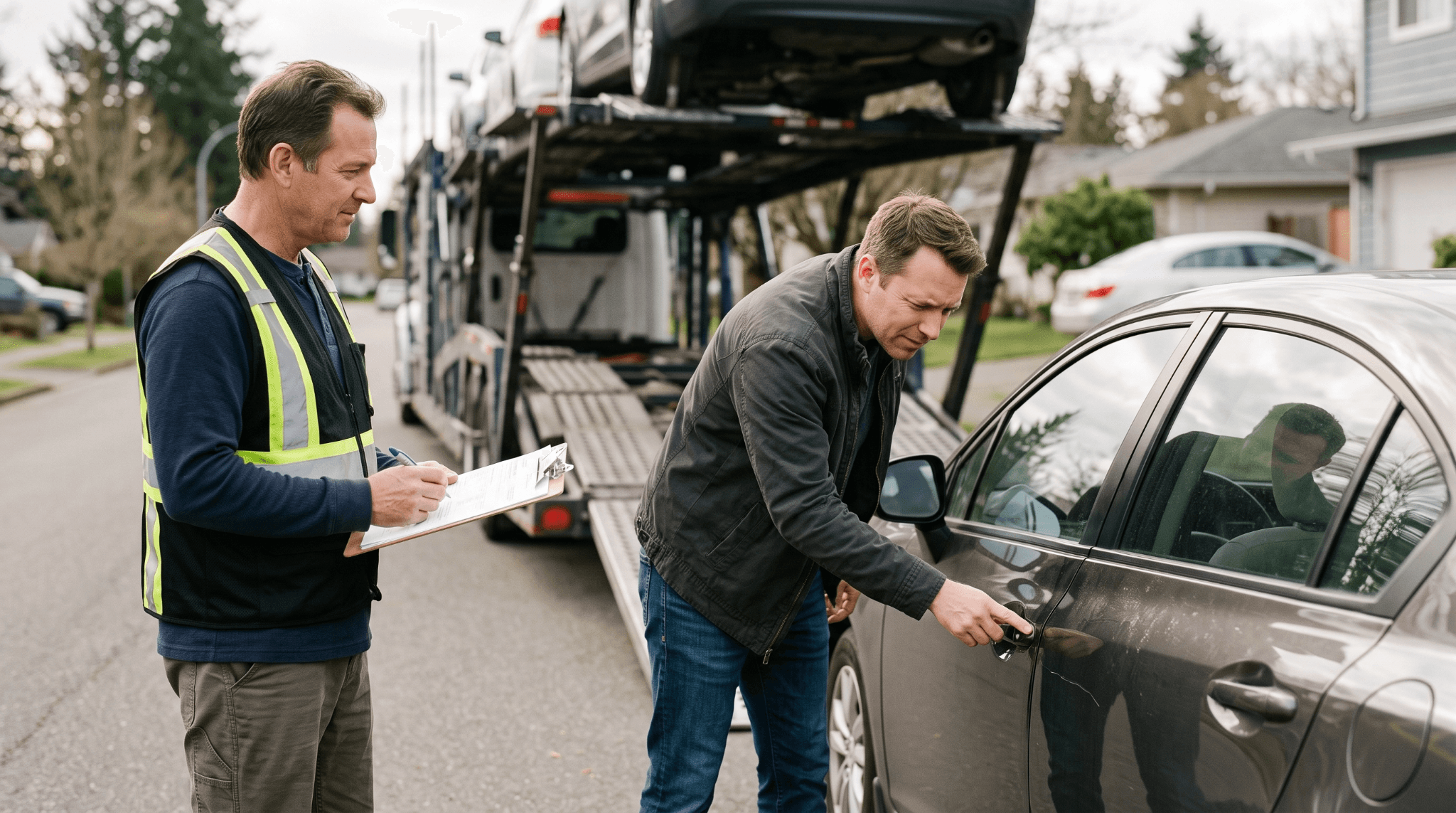
Most cars arrive without a scratch. Still, it’s smart to know how claims work before pickup, just in case. Here’s what to do if your car is damaged:
Inspect your car at delivery before the driver leaves.
Take photos of any new damage from different angles.
Write the damage on the delivery paperwork before you sign.
Tell the broker and the carrier right away.
File a claim with the carrier’s insurance company before the deadline in your contract.
A good broker will help you through the claim by sharing the carrier’s insurance details and following up with the insurer. Ask about this before you book, not after something goes wrong.
Why does the bill of lading matter for a claim?
The bill of lading is an inspection report that you and the driver both sign at pickup and again at delivery. It records your car’s condition at each step.
This document is your main proof. If new damage isn’t written on it at delivery, the insurance company can argue the damage happened later, and your claim could be denied.
Pro tip: Take dated photos of your car at pickup. They give you extra proof if you ever need it. Learn more in our bill of lading guide.
9. BBB Accreditation
BBB accreditation means a business has applied to the Better Business Bureau, agreed to follow the BBB Standards for Trust, and pays a fee to stay accredited. These standards include things like honest advertising and responding to customer complaints.
Keep in mind that accreditation is different from:
The BBB letter rating, which goes from A+ to F. A company can have a rating without being accredited.
Star reviews, which come directly from customers.
BBB is a useful signal, but it works best alongside your FMCSA and review checks.
How do you read a company’s complaint history?
You’ll find a company’s complaint history on its BBB profile. Look for four things:
Volume vs size: Bigger companies naturally get more complaints than small ones.
Common themes: Repeated complaints about surprise fees or missed pickups point to a real problem.
Resolution: Check whether the company answered and fixed the issues.
Recency: A bunch of complaints in recent months matters more than one complaint from years ago.
You can also search the FMCSA National Consumer Complaint Database to see complaints filed with federal regulators.
How Safeeds Transport Measures Up
A checklist is only useful if a company can actually pass it. So here’s how Safeeds Transport, a licensed and bonded auto transport broker based in Columbus, Ohio, stacks up against all nine checks.
Check | Safeeds Transport |
1. Authority | FMCSA-licensed broker, USDOT [insert number] and MC [insert number], with a surety bond on file |
2. Cargo insurance | Every shipment covered by the assigned carrier’s cargo insurance from pickup to delivery |
3. Quote | 7-day price lock on every quote |
4. Payment | No upfront payment, just a $1 card verification hold; balance due at pickup or delivery |
5. Carrier vetting | Carriers checked for licensing and insurance through an approval process before assignment |
6. Reviews | Google 4.8 (3,715 reviews), Trustpilot 4.7 (1,600+), TransportReviews 5.0 (413), BBB 4.08 (160) |
7. Communication | Online order tracking and 24/7 support by phone, chat, and email |
8. Damage claims | Bill of lading inspections at pickup and delivery; claims filed through the carrier’s cargo insurer |
9. BBB | BBB accredited, with a public complaint history on its BBB profile |
You’ll notice the scores aren’t the same on every platform, and that’s normal. The BBB average is a bit lower, which is common because many people go to the BBB specifically to report problems.
Whichever company you’re considering, including Safeeds Transport, hold it to the same nine checks. The best car shipping company for you is the one whose claims hold up on paper, not just on its website.
What People Also Ask Before Hiring the Best Car Shipping Company?
Still have questions before you book? Here are quick, straight answers to the ones car owners ask most when comparing shipping companies.
How do I know if a car shipping company is legitimate?
Run three quick checks. First, look up the company’s USDOT or MC number on the FMCSA snapshot and confirm active authority. Next, ask for the assigned carrier’s cargo insurance certificate. Then, read reviews on at least three platforms. Knowing how to choose a car shipping company starts with these basics, and a legitimate company will pass all three easily.
Should I pay a deposit to book car shipping?
You shouldn’t have to pay a big deposit before a carrier is assigned. A small, refundable booking fee or a card verification hold is fine. Before you pay anything, ask: “If no carrier is assigned by my pickup date, will I get my money back?” If the answer is unclear or no, keep looking.
What is a good rating for a car shipping company?
A rating of 4.5 stars or higher is a good benchmark, but only if there are enough reviews behind it. Look for at least a few hundred reviews across major platforms. A 4.6 rating from 900 reviews means more than a perfect 5.0 from 20. Also check whether the company responds to negative reviews.
Is it better to use a broker or go direct to a carrier?
Both can work. A broker connects you with a large network of carriers, which usually means faster pickup and more route options. Going straight to a carrier gives you one point of contact, but most carriers only run certain routes on set schedules. If you use a broker, make sure it checks every carrier it assigns.
How do I verify a company’s insurance?
Ask for the cargo insurance certificate of the carrier assigned to your car. Then look up the insurance company’s phone number yourself, instead of using the number printed on the certificate. Call to confirm the policy is active and the coverage amount is correct. This quick call proves the document is real and up to date.
What if a company pressures me to book today?
Take it as a warning sign. Lines like “this price expires in an hour” are meant to stop you from checking the company out. A trustworthy company gives you a written price lock, often for seven days, so you have time to compare. If a company won’t hold its price, keep shopping.
How many quotes should I get before booking?
Three to four quotes is usually enough. That gives you a good sense of the going rate for your route without spending hours on research. Put them side by side. If one quote is much lower than the rest, it’s probably a lowball price that will go up later or leave your car waiting.
Does BBB accreditation actually mean anything?
Yes, but it doesn’t prove quality on its own. Accreditation shows a company agreed to BBB standards and pays to stay accredited. It’s most helpful when you also review the company’s complaint history and confirm its authority on the FMCSA snapshot. Think of it as one helpful signal among several.
What questions should I ask before booking?
Ask for the company’s USDOT and MC numbers, whether your price is locked and for how long, when you’ll be charged and whether it’s refundable, how carriers are chosen and checked, and how damage claims work. The best auto transport companies will answer all five clearly and put their answers in writing.
How do I check a company’s complaint history?
Start with three places. Search the FMCSA National Consumer Complaint Database for complaints filed with regulators. Check the complaint history on the company’s BBB profile. Then read its 1 and 2 star reviews on Google and Trustpilot. Look for repeated issues, like surprise fees or missed pickups, and see whether the company responded.
Choosing the Best Car Shipping Company With Confidence
At the end of the day, choosing well isn’t about finding the lowest price or the highest rating. It’s about finding a company whose claims hold up when you check them. The best car shipping company for your move will show active authority on its FMCSA snapshot, share a cargo insurance certificate without hesitation, lock your price in writing, and keep your money safe until a carrier is confirmed.
Running all nine checks takes about 20 minutes. That’s a small amount of time to protect a car worth thousands of dollars. The best car transport companies welcome your questions, because clear answers are how they earn your trust. If a company pushes back or avoids them, that tells you everything you need to know.
When you’re ready to put this checklist to work, get a free quote from Safeeds Transport. Your price is locked for seven days, there’s no upfront payment, and you can verify every claim in this guide before you commit.