Nine things move your car shipping cost: distance, vehicle size and weight, whether the car runs, open versus enclosed transport, season, route popularity, pickup and delivery access, how flexible your dates are, and current diesel prices. Distance is the largest, but flexibility is the one you control most easily.
This what affects car shipping cost guide gives real weight to each factor, including two that get skipped over in most cost breakdowns: whether your car runs, and how flexible you're willing to be on timing.
Knowing all nine before you request a quote makes it far easier to spot a fair number from an inflated one. Get your free, price-locked quote today and see exactly how these factors apply to your shipment.
What Affects Car Shipping Cost the Most?
Distance affects car shipping cost more than any other single factor, followed by vehicle size, whether the vehicle runs, and transport type. All nine factors combine to set your final number, and each one adds or saves a specific, real amount.
Here are all nine, with what each typically adds or saves:
Distance: It is the largest factor. Per-mile rates run $0.90 to $1.90 on short routes and drop to $0.40 to $0.65 on cross-country moves.
Vehicle size and weight: adds $100 to $400 over a standard sedan on the same route, covered in detail below.
Whether the car runs: adds $150 to $300 for a non-running vehicle, covered in detail below.
Open versus enclosed transport: enclosed typically costs 40 to 60 percent more than open, reflecting the smaller vehicle capacity per trailer.
Season: peak months (summer and snowbird corridors) add roughly 15 to 30 percent versus off-peak pricing.
Route popularity: a high-traffic corridor prices lower than a similar-distance route through less-traveled territory, since carriers can fill trailers more efficiently on busy lanes.
Pickup and delivery access: a rural or hard-to-reach address typically adds $75 to $300, since the carrier has to detour off its main route.
Date flexibility: saves 10 to 20 percent compared to a fixed pickup date, covered in detail below.
Diesel prices: carriers apply a fuel surcharge, typically 8 to 15 percent, that moves with national diesel pricing.
The three factors covered in dedicated sections below- vehicle size, running condition, and flexibility- tend to swing a quote the most in dollar terms and are also the ones you have the clearest ability to plan around. Understanding what affects car shipping cost requirements behind each factor helps you spot which parts of your quote are fixed and which parts you actually have room to influence.
This is what affects car shipping cost process stays consistent across brokers, even though the exact dollar figures vary.
How Much Does Vehicle Size Change the Price?
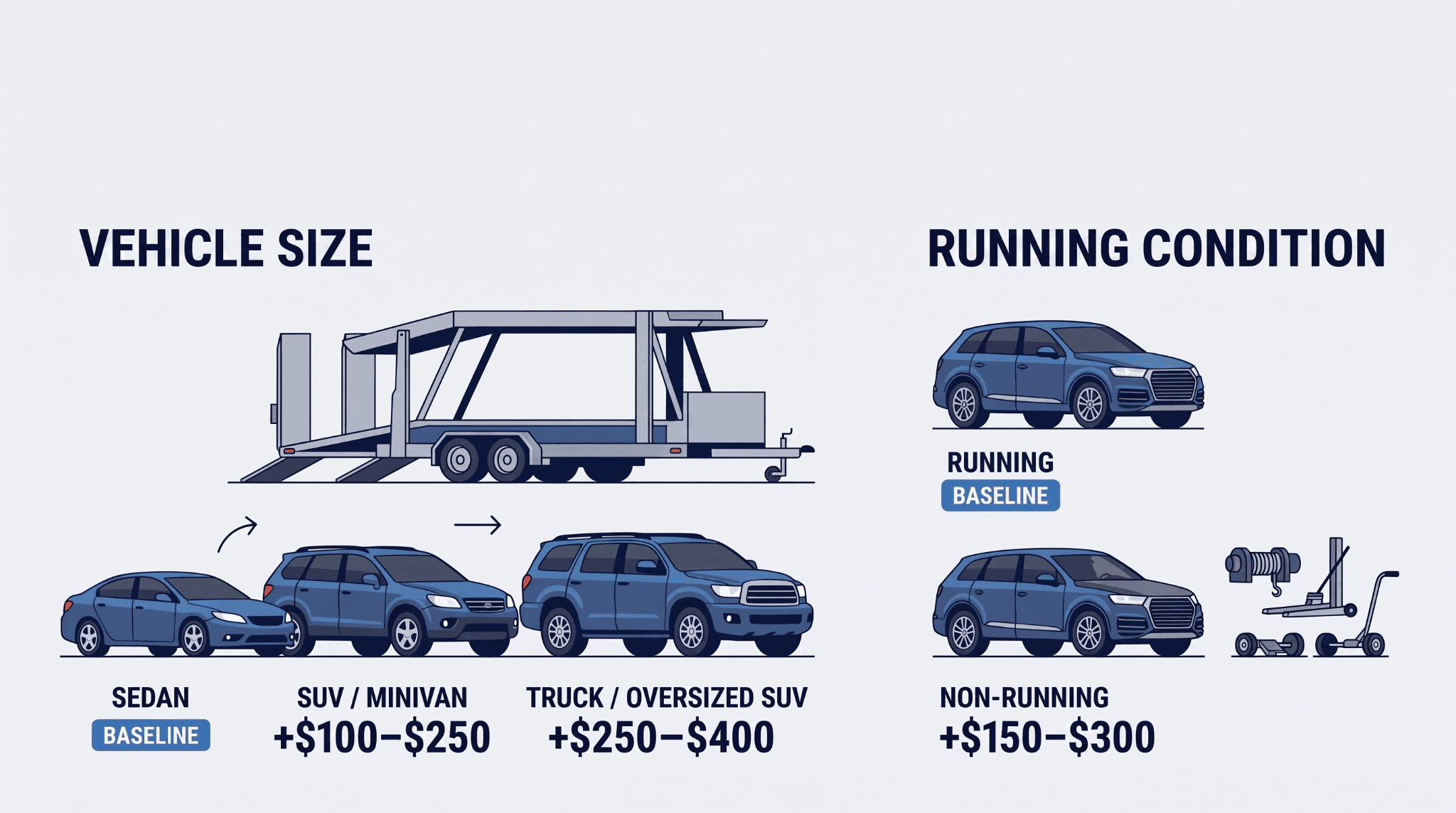
Vehicle size changes the price by $100 to $400 over a standard sedan on the same route, since larger vehicles take up more trailer space and add fuel weight. This premium applies whether you're comparing a midsize SUV or a full-size truck.
This isn't an arbitrary markup; it reflects a real physical constraint: every trailer has a fixed number of vehicle slots, and a larger vehicle simply takes up more of that limited space.
A rough breakdown for a typical 1,000-mile route:
Compact or midsize sedan: baseline cost, minimal trailer space used.
SUV or minivan: $100 to $250 above the sedan baseline.
Full-size truck or oversized SUV: $250 to $400 above baseline, sometimes requiring specialized equipment.
The car shipping cost prices between vehicle sizes hold fairly steady across most distance bands.
What affects car shipping cost rates for larger vehicles reflects real capacity constraints on the trailer, not an arbitrary markup.
Does a Non-Running Car Cost More?
Yes, a non-running car typically costs $150 to $300 more than the same vehicle in working condition, since it requires a winch-equipped trailer and extra loading time instead of driving on and off under its own power. The exact premium depends on how the vehicle is disabled.
Carriers generally sort non-running vehicles into two categories:
Roll and steer: the car can be pushed and steered normally even though the engine won't start. This is the more common, less expensive case.
Non-rolling: the wheels are seized, or the steering doesn't turn, requiring dollies or a forklift. This adds further cost and narrows which carriers can take the job.
So how much what affects car shipping cost changes once a vehicle can't run comes down almost entirely to which of these two categories applies. Disclosing this honestly at quote time, rather than at pickup, is what keeps the number accurate rather than triggering a surprise surcharge on the day.
If you're searching for a what affects car shipping cost near me resource assuming local carriers handle non-runners differently, know that winch-equipped trailers and the pricing logic around them operate nationally, not regionally.
Real differences do exist among what affects car shipping cost companies in how transparently they price this surcharge.
A well-run what affects car shipping cost company will ask about running condition at quote time, not discover it at pickup.
How Much Does Date Flexibility Save?
Date flexibility can save 10 to 20 percent compared to a fixed pickup date, since it gives your carrier more routing options and lets them slot your vehicle into a trip they're already running. This is one of the few cost factors entirely within your control.
A few ways this plays out in practice:
A 3 to 5 day pickup window typically prices lower than insisting on one specific date.
Booking 2 to 3 weeks ahead generally produces better rates than booking with only a few days' notice.
Guaranteed-date or expedited shipping, the opposite of flexibility, carries its own separate premium.
A genuine what affects car shipping cost service will explain this tradeoff clearly, since flexibility is one of the easiest ways to lower a quote without giving up anything you actually need.
Understanding how much what affects car shipping cost you personally control, versus what's fixed by your route and vehicle, is really the core value of breaking these nine factors apart individually.
Which Factors Can You Actually Control?

You can control transport type, pickup flexibility, and how far ahead you book, but you cannot control distance, season, or current fuel prices. Focusing your attention on the controllable factors is the most effective way to influence your final quote.
A few practical moves:
Stick with open transport unless your vehicle genuinely needs enclosed protection.
Offer a flexible pickup window instead of a single fixed date.
Book with enough lead time that your carrier can plan an efficient route around your shipment.
Request a what affects car shipping cost quote that breaks down which of these nine factors apply to your specific move.
Comparing what affects car shipping cost quotes from two or three providers, using the same vehicle details each time, helps confirm you're seeing a fair number.
An online what affects car shipping cost calculator can offer a rough starting estimate, though a live quote will always reflect your specific situation more accurately.
What Shippers Want to Know First
Cost questions come up on nearly every call we take. Here are direct answers to the ones we hear most.
What affects the cost of shipping a car?
Nine factors combine to set the price: distance, vehicle size, running condition, transport type, season, route popularity, access, date flexibility, and fuel prices. Distance carries the most weight overall. The best what affects car shipping cost breakdown covers all nine, not just the obvious ones.
Does vehicle weight change the price?
Yes. Heavier vehicles add fuel consumption and take up more trailer space, typically adding $100 to $400 over a standard sedan on the same route.
How much does flexibility save me?
Typically 10 to 20 percent compared to a fixed pickup date, since it gives your carrier more routing options to work with. Reading what affects car shipping cost reviews from other shippers can confirm whether a specific broker actually passes this savings along.
Why is my route more expensive than average?
Rural addresses, low-traffic corridors, and peak-season timing can all push a specific route above the general average, even for a common distance. A few practical tips that affect car shipping cost help here: ask directly which of these applies to your route.
Does diesel price affect my quote?
Yes, through a fuel surcharge that carriers apply when diesel prices rise. This surcharge shifts with national fuel trends rather than any single carrier's choice, and asking how long what affects car shipping cost quotes stay locked can protect you from a mid-transit surcharge increase.
Use These Nine Factors to Read Any Quote
A cheap what affects car shipping cost quote that skips explaining these nine factors is rarely the outcome you actually want once the real invoice arrives. The best approach knows which factors are fixed and which you control, turning a confusing quote into something you can evaluate with confidence.
Most disputes over a final bill trace back to one of these nine factors never being disclosed clearly at quote time, not to bad luck during transit. Asking a broker to walk through all nine before you book removes nearly all of that risk upfront.
This same framework is expected to hold for what affects car shipping cost 2026 bookings just as it has in prior years, since these nine factors are structural to the industry rather than tied to any single year. Get your free, price-locked quote today and see exactly which of these nine factors apply to your shipment.