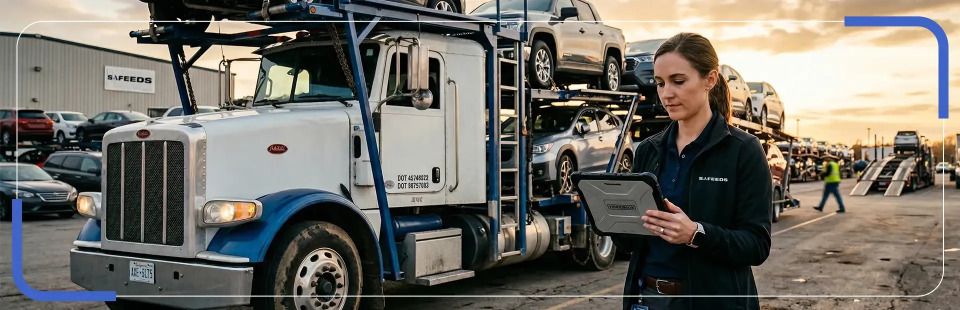
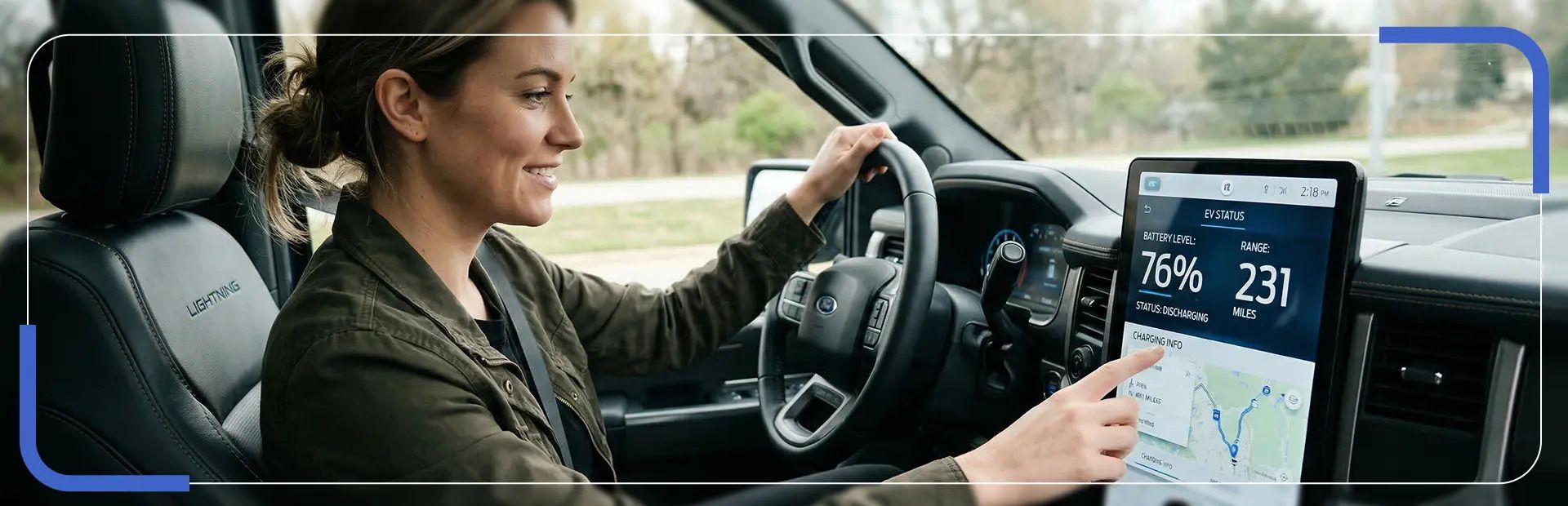
Vehicle and cargo theft is a growing concern for anyone transporting high-value assets, from luxury cars to critical shipments. Every year, thousands of vehicles and valuable cargo are targeted, and relying on traditional locks or alarms is often not enough to stay ahead of thieves. That’s where AI-driven technology comes in, helping transport companies monitor shipments in real time, predict high-risk scenarios, and prevent theft before it happens. From smart surveillance systems to predictive analytics and fleet tracking, these tools make vehicle theft prevention smarter, faster, and more reliable than ever.
Understanding how AI enhances security allows vehicle owners and logistics managers to protect their investments throughout every step of the transport process. Safeeds Transport Inc. uses these cutting-edge solutions to ensure safe, worry-free shipping. Get a quote today and move your vehicles and cargo with confidence.
The Growing Threat of Vehicle and Cargo Theft
The security of modern transportation is currently under siege by a new wave of organized crime. According to recent cargo theft statistics, the industry has witnessed a staggering double-digit increase in incidents over the last twenty-four months. This trend was catalyzed by the widely reported cargo theft surge in 2025 news, which highlighted a shift from opportunistic "smash-and-grab" tactics to highly coordinated strategic thefts involving fraudulent pickups and identity theft.
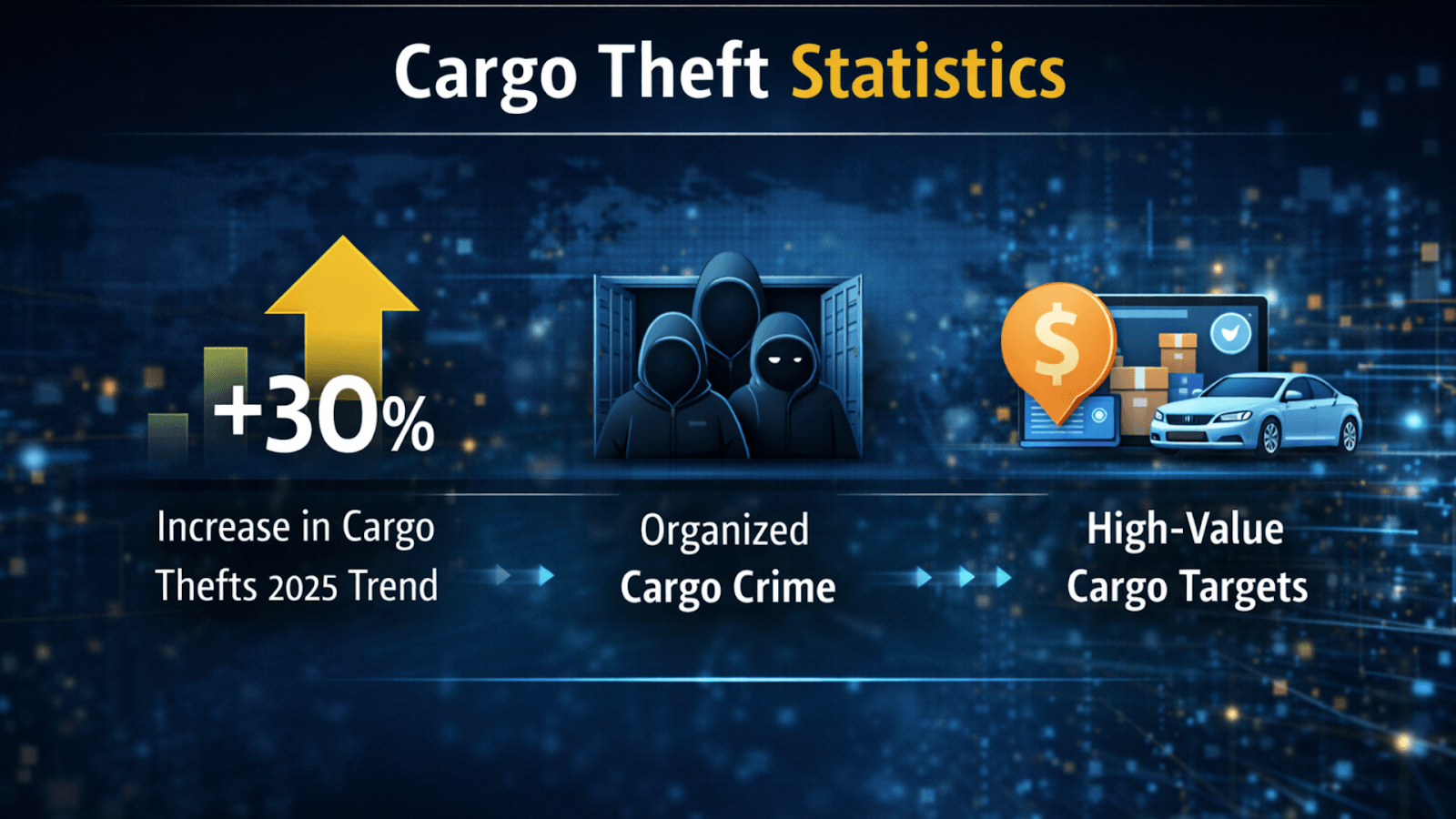
Cargo theft does not merely impact the bottom line of logistics firms; it destabilizes the availability of essential goods and increases insurance premiums across the board. Criminal organizations are now targeting not just the vehicles themselves, but the high-value commodities within, such as electronics, pharmaceuticals, and luxury vehicles.
Understanding that the risk profile for both individual owners and commercial fleets has fundamentally changed is the first step in implementing a robust vehicle theft prevention strategy. As we analyze the data from 2025 and early 2026, it is clear that traditional barriers are no longer sufficient to deter professional thieves who utilize GPS jammers and signal spoofing to bypass standard security measures.
Common Vulnerabilities in Vehicles and Cargo Transport
Despite the advancement of security technology, many thefts occur due to predictable vulnerabilities in the transportation process. Identifying these weak points, ranging from physical locks to digital signals, is essential for any organization looking to prevent theft from vehicle operations effectively.
The most frequent risk factors include:
Unattended and Unmonitored Parking: Vehicles left in poorly lit or unmonitored staging areas remain the primary targets for quick interception and theft.
Unsecured Cargo and Human Error: A lack of secondary locking mechanisms often provides a window of opportunity for "curtain cutting" and unauthorized offloading.
Outdated Security Hardware: Many owners still rely on an older anti-theft security system in cars that can be bypassed through relay attacks, where thieves intercept the signal from a keyless entry fob.
Regional Theft Patterns: Carriers often fail to account for specific "car thefts in my area" data, leading to routes that inadvertently pass through high-risk zones.
Lack of Situational Awareness: The absence of real-time visibility and predictive data creates a perfect environment for organized criminal groups to operate undetected.
Traditional Vehicle Theft Prevention Methods
Before the advent of predictive algorithms, security relied heavily on physical deterrents and reactive recovery tools. The standard anti-theft security system in cars typically includes audible alarms and basic engine immobilizers. While these are effective against joyriders, professional cargo thieves often find ways to neutralize these systems in seconds.
To prevent theft from vehicle losses, owners have traditionally turned to:
Steering Wheel Locks and Kill Switches: Physical barriers that provide a visual deterrent.
Standard GPS Trackers: Tools that allow for recovery after the theft has occurred, though they are often defeated by signal jammers.
Basic Hygiene: Locking doors, parking in high-traffic areas, and ensuring no valuables are visible.
A common question for individual owners is: Does renters' insurance cover theft of a car? While personal property stolen from the interior is often covered by renters' or homeowners' insurance, the vehicle itself and commercial cargo typically require specific comprehensive or inland marine policies. While these traditional methods provide a baseline of security, their reactive nature is a significant limitation. They focus on making the theft "difficult" rather than making it "predictable" or "preventable."
How AI Is Transforming Vehicle Theft Prevention
Artificial Intelligence is revolutionizing the industry by shifting the focus from recovery to proactive prevention. Unlike traditional systems that only alert you once a window is broken, AI surveillance systems utilize "computer vision" to identify suspicious behavior before a crime is committed. For instance, AI tools for quality assurance are now used to scan vehicle perimeters and identify loitering or the presence of unauthorized scanning devices.
The most significant shift lies in predictive analytics. By processing vast amounts of data, including weather, time of day, and historical cargo theft statistics, AI can identify high-risk areas in real time. This allows fleet managers to reroute drivers before they ever enter a danger zone. Furthermore, AI monitoring for cargo shipments utilizes sensors that detect minute changes in light, temperature, or vibration within a container, instantly alerting a central command center if a seal is compromised. By integrating AI, vehicle theft prevention becomes an active, 24/7 digital sentry that is far more difficult to deceive than a human guard or a simple mechanical lock.
Comparison: Traditional vs. AI-Driven Security
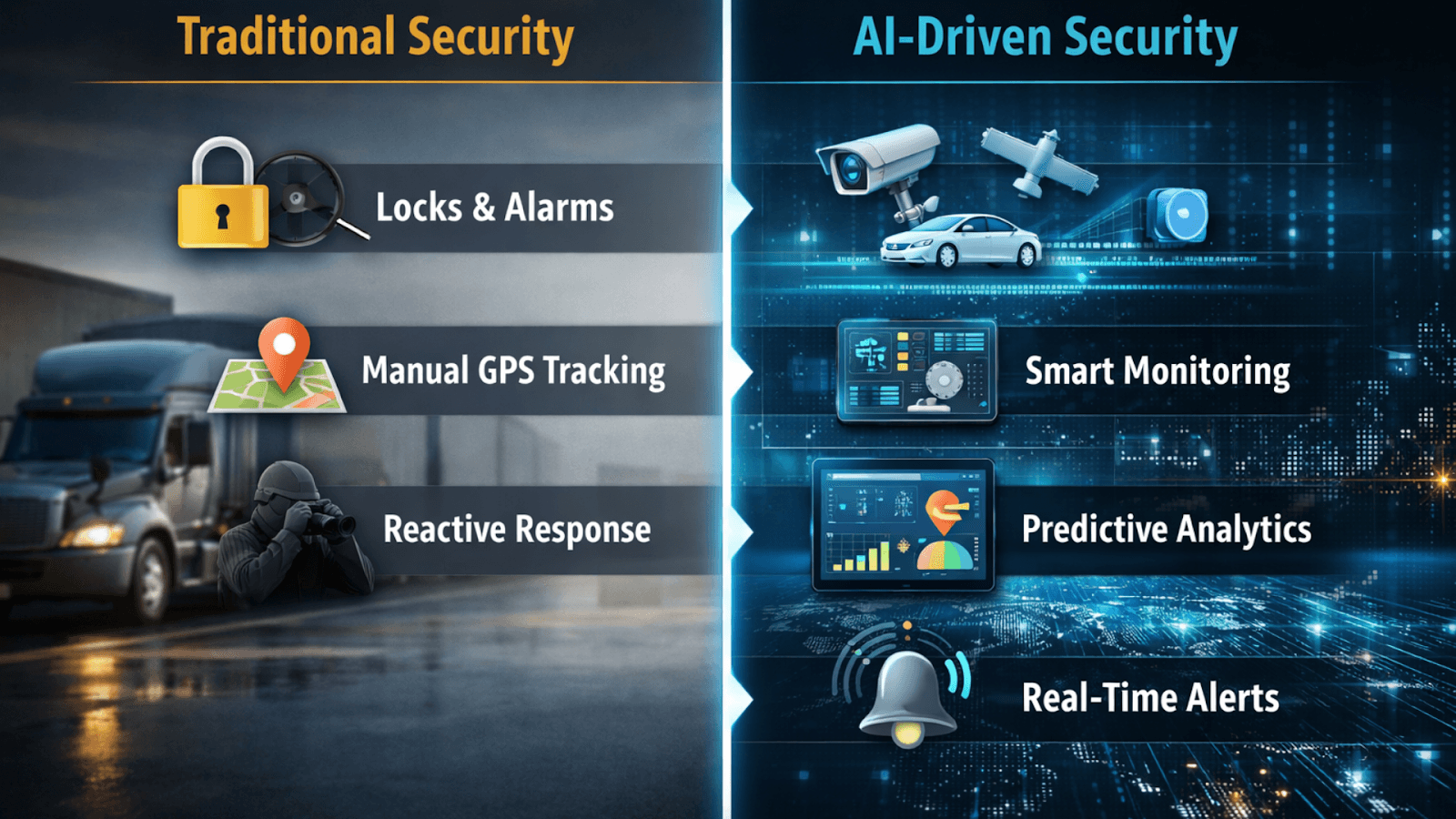
To help you visualize the shift in the industry, the following breakdown compares legacy methods with modern technological standards. This comparison highlights why top-tier providers are moving away from reactive measures toward a more intelligent, proactive defense strategy.
Feature | Traditional Security | AI-Driven Prevention |
Detection Timing | Reactive (After the event) | Proactive (During or before) |
Visibility | Limited to GPS pings | AI tools for online visibility |
Human Error | High (Forgotten locks/alarms) | Low (Automated monitoring) |
Analysis | None | Predictive risk modeling |
Cargo Protection | Door locks only | Internal sensor fusion & AI alerts |
AI-Powered Tools for Cargo Theft Detection and Tracking
The logistics industry has moved beyond simple GPS pings to a sophisticated ecosystem of "intelligent visibility." In the professional sector, the best AI overviews tracking tools for fleets do more than just show a dot on a map; they analyze the "context" of a journey. These platforms integrate telematics with behavioral AI to ensure that the driver and the vehicle are behaving exactly as expected.
For professional fleets, these systems now utilize edge computing, allowing the device to process data locally for instantaneous response times. For example, if an AI-powered tracker detects a vehicle moving at an unusual hour without the ignition being engaged, it identifies a "tow-away" theft in progress and can automatically immobilize the engine or trigger a high-priority security response.
Furthermore, AI tools for online visibility are being deployed to monitor the "digital blind spots" of transport. New hybrid tracking systems combine standard cellular networks with Satellite IoT (Internet of Things) to ensure zero-blind-spot connectivity, even in remote regions where traditional signals fail. This level of oversight allows stakeholders to:
Detect "Fictitious Pickups": AI verifies digital documentation and bills of lading to flag "spoofed" identities, a leading cause of the cargo theft surge in 2025 news, before the cargo ever leaves the warehouse.
Monitor Digital Seals: When paired with AI tools for quality assurance, these systems verify the integrity of a container’s seal at every waypoint, ensuring any tampering is flagged immediately.
Maintain Chain of Custody: By using AI to verify every step of the journey, companies ensure the chain of custody remains unbroken from origin to destination.
This combination of real-time physical monitoring and digital verification ensures that high-value cargo containers are never truly offline or unprotected.
Practical Vehicle Theft Prevention Tips Using AI Insights
Modern vehicle theft prevention tips have evolved beyond physical hardware; today, safety is about leveraging the data and predictive power that AI provides. By integrating these advanced insights into daily operations, both commercial carriers and individual owners can significantly lower their risk profile and stop criminals before they execute a plan.
For Commercial Fleets and Logistics
To effectively prevent theft from vehicle operations at scale, industry leaders recommend:
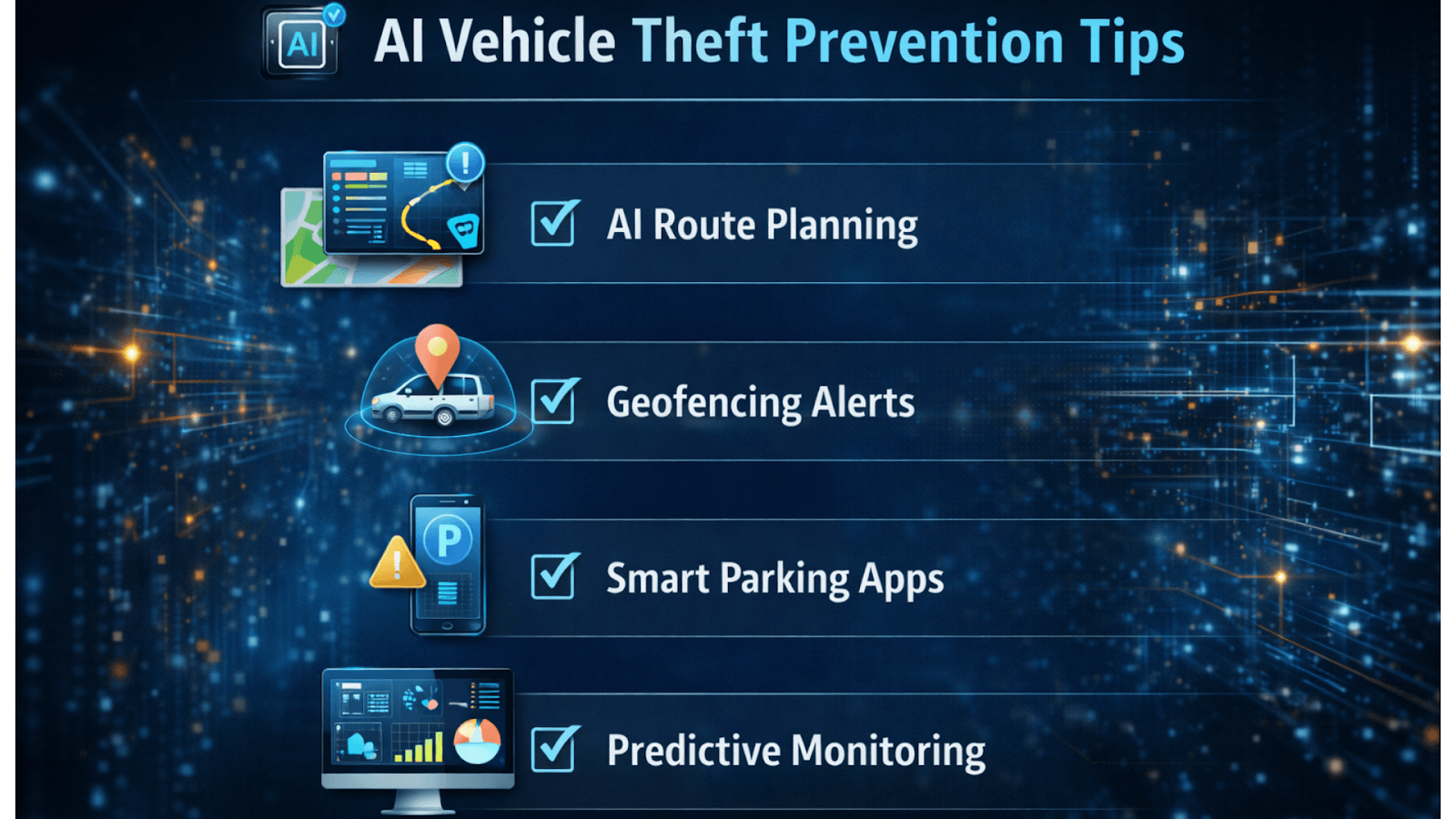
Dynamic Route Planning: Use AI to avoid "hot zones" identified by current cargo theft statistics. Platforms can now suggest safer paths in real-time if a specific corridor shows a sudden spike in suspicious activity.
Geofence and Power-Disconnect Alerts: Set up automated notifications that trigger the moment a tracking device loses power or an asset leaves a pre-defined "safe zone," such as a loading yard.
Intelligent Loitering Alerts: Integrate AI surveillance with your anti-theft security system in cars. This allows cameras to distinguish between a driver performing a routine check and an unauthorized individual lingering with a signal-jamming device.
For Individual Owners and Small Operators
Even for personal vehicles, AI offers actionable how-to prevent vehicle theft strategies that create a multi-layered defense:
Smart Parking Selection: Use AI-enabled apps to aggregate real-time crime data, helping you choose the safest parking or loading zones in unfamiliar cities.
AI-Enhanced Integrated Monitoring: Ensure your security cameras or dashcams use AI to recognize human forms. This reduces false alarms from animals or shadows, ensuring you only receive an alert when a genuine threat is detected.
Behavioral and Predictive Alerts: Enable systems that notify you if your vehicle moves outside of its typical operating hours or if its "digital signature" is being scanned by an external device.
By combining these high-tech insights with traditional habits, such as verifying the identity of your transport driver, you shift from a reactive stance to a proactive defense that is significantly more difficult for thieves to penetrate.
Real-World Impact and Future Trends in AI Theft Prevention
The measurable impact of AI is best seen in its ability to reduce operational costs and prevent catastrophic losses. For example, a leading European construction materials supplier recently deployed AI-powered perimeter and access control solutions across its logistics network. By using AI to classify vehicles and detect "forced entry" postures in real-time, the company reported a 30% reduction in operational security costs and a significant acceleration in incident response times.
Another compelling case involves a North American fleet that integrated predictive diagnostic alerts; by using AI to monitor "ping-on-demand" location updates and sensor-based movement detection, the fleet achieved a nearly 30% reduction in safety-related vehicle failures and unauthorized movements. These real-world applications prove that AI tools for quality assurance and tracking are delivering a decisive advantage to those serious about vehicle theft prevention.
To maintain this advantage, carriers are now leveraging AI to navigate high-risk areas and anticipate future criminal tactics:
Data-Driven Regional Strategy: According to the latest cargo theft statistics, regions like New Jersey and Indiana have seen theft increases of 30% to 50%. AI insights allow carriers to combat these "theft-prone zones" by scheduling deliveries to avoid peak risk periods and choosing routes with historically lower incidents of "fictitious pickups."
Proactive Cargo Monitoring: In high-risk zones, AI monitoring for cargo shipments can detect if a truck is being followed by a "suspicious" lead car or if a trailer has been detached in an unauthorized area, providing drivers with instant in-cab safety alerts.
Autonomous Security Systems: As we move through 2026, the industry is entering the age of "Predictive Uptime," where AI prevents theft through autonomous monitoring rather than just reporting it after the fact.
Next-Generation Authentication: Future anti-theft security systems in cars will likely include biometric authentication and blockchain-based vehicle identity verification, making it nearly impossible for unauthorized users to spoof a vehicle’s credentials.
Smart City Integration: The expansion of "Smart Cities" will allow vehicles to communicate directly with urban infrastructure to flag stolen assets automatically.
Advanced Fleet Oversight: AI tools for online visibility are evolving into "Generative AI Copilots" for fleet managers, allowing them to use natural language to identify "weak signals" of risk and stay steps ahead of the criminal underground.
Essential Information on Vehicle and Cargo Safety
Securing high-value assets requires a strategic blend of physical vigilance and advanced technology. In today's landscape, vehicle theft prevention is no longer just about locks; it is about proactive risk management. By combining AI-driven oversight with professional transport protocols, you can ensure your property remains protected throughout its journey.
How can I verify if a transport company uses AI for vehicle theft prevention?
A top-tier provider won't just claim security, they’ll prove it. At Safeeds Auto Transport, we utilize cutting-edge AI tools for online visibility and real-time telematics. When you choose us, your vehicle isn't just "in transit"; it’s under the constant watch of a 24/7 digital sentry that detects and neutralizes threats before they manifest.
What are the best vehicle theft prevention tips for high-risk zones?
In dangerous corridors, data is your best defense. Beyond a standard anti-theft security system in cars, we recommend choosing a partner that employs AI-driven risk modeling to avoid theft-prone areas. We use geofencing and real-time alerts to ensure your vehicle stays on the safest possible path, effectively making theft a statistical impossibility.
Does the cargo theft surge in 2025 news affect individual vehicle owners?
Absolutely. The sophisticated techniques used in commercial cargo theft, like signal jamming and relay attacks, are now being used against private vehicles. That’s why we treat every shipment with the same elite security protocols we use for million-dollar fleets, shielding your personal vehicle from the latest criminal trends.
Are traditional anti-theft security systems in cars still effective?
Physical deterrents are only the first layer. To truly prevent theft from vehicle losses, hardware must be backed by intelligence. We complement traditional security with AI-powered monitoring that can detect electronic tampering, providing a level of protection that steering locks and basic alarms simply cannot match.
How do AI tools for quality assurance improve cargo safety?
Safety is about more than just preventing theft; it’s about arriving in pristine condition. By utilizing AI tools for quality assurance, Safeeds Transport monitors the environment and stability of your cargo throughout the trip. We don’t just deliver your vehicle; we guarantee its integrity from pickup to delivery.
Protect High-Value Vehicles With Expert Transport Solutions
In an environment where the cargo theft surge in 2025 remains a constant reality, the most effective way to secure an asset is to work with professional logistics experts who prioritize technology. Choosing an AI-enabled transport company ensures that your vehicle is not just being moved, but is being actively shielded by a multi-layered digital and physical security stack.
By combining the latest anti-theft security system in cars with a partner that understands the nuances of AI-driven tracking, you can transport high-value cargo with total confidence. The future of safe transportation is here; it is intelligent, it is proactive, and it is powered by AI. Get a free transport quote from Safeeds Transport Inc. and protect your investment with our AI-enhanced shipping solutions.