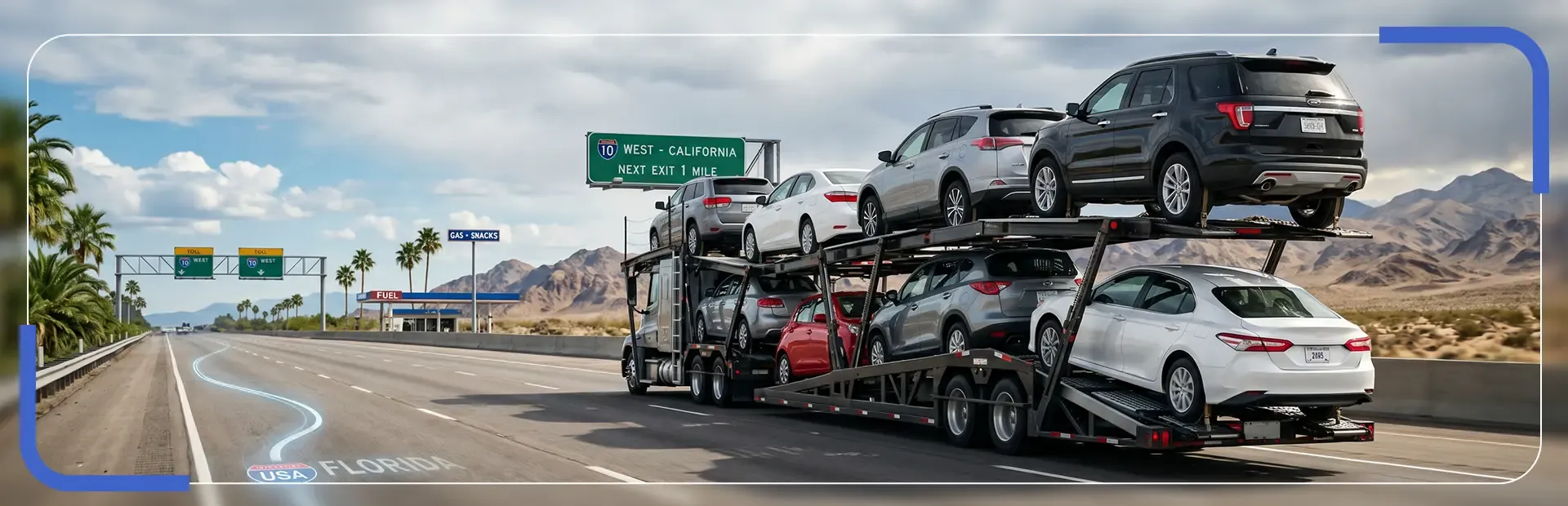
Car shipping cost per mile drops sharply as distance grows. In 2026, expect roughly $1.90 per mile under 500 miles, $1.00 per mile at 1,000 miles, $0.75 at 1,500 miles, and around $0.58 per mile on coast-to-coast routes. Enclosed transport runs 40 to 60 percent above these figures.
Understanding this curve before you request a quote makes it far easier to tell a fair price from an inflated one, regardless of how far your vehicle is traveling. Get your free, price-locked quote today and see exactly where your route falls on this scale.
What Is the Average Car Shipping Cost Per Mile?
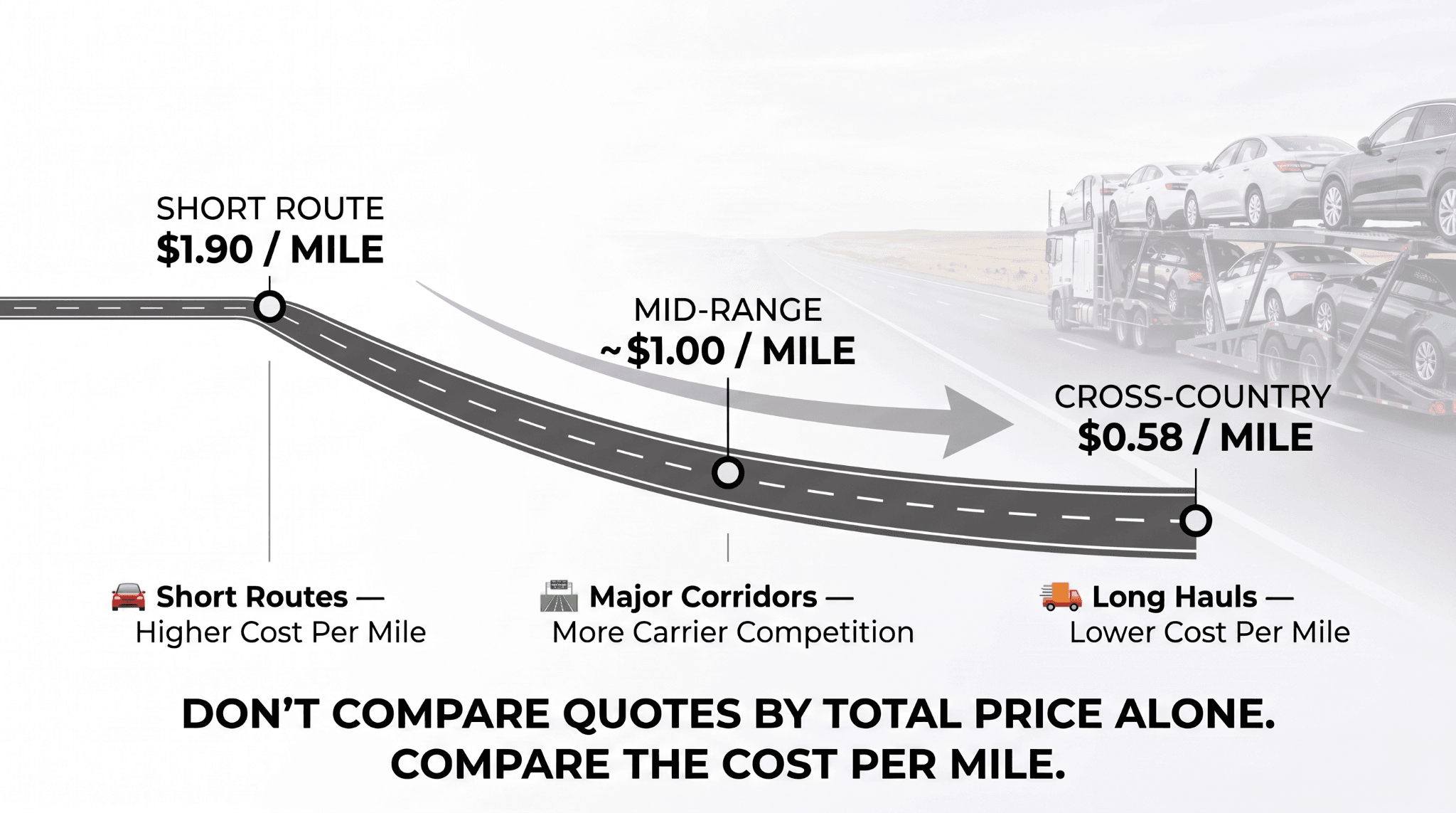
The average car shipping cost per mile in 2026 ranges from about $1.90 on short routes down to $0.58 on the longest cross-country hauls, with most standard sedan shipments landing somewhere in between depending on distance and transport type.
This range holds fairly steady nationwide, though the average car shipping cost per mile in the US 2026 figure shifts slightly by region depending on carrier density and route popularity. High-traffic corridors between major metro areas tend to price closer to the lower end of each band, while rural or less-traveled routes trend higher.
This distance-based curve is not unique to any single carrier or broker. It reflects how the entire industry prices transport, since the same fixed costs, fuel, dispatch, and loading time apply to every shipment regardless of who is doing the hauling.
Car shipping cost per mile 2026 is the clearest way to compare two very different quotes side by side, since it strips out distance and shows what you're actually paying for the service itself rather than just the total invoice.
Why Does the Per-Mile Rate Fall With Distance?
The per-mile rate falls with distance because every shipment carries the same fixed costs, like dispatch time and loading, regardless of how far the vehicle travels. Spreading those costs over more miles brings the per-mile number down.
Think of it like a taxi meter versus a flat airport fare. A taxi charges by the mile because time and fuel scale directly with trip length. A flat fare only makes sense on a short, predictable, frequently repeated route.
Auto shipping rates per mile follow the same underlying logic, and average car shipping rates per mile 2026 data confirms this pattern holds true across nearly every carrier in the industry:
Short trips absorb the fixed cost fast, since it gets divided across very few miles.
Long trips spread that same fixed cost thin, pulling the per-mile rate down even as the total price rises.
Long-haul corridors run more efficiently, since carriers can fill multiple vehicle slots along one continuous route.
This is why auto transport cost per mile 2026 estimates published for short regional routes look so different from the numbers quoted for a coast-to-coast move, even when the underlying carrier and equipment are the same. Current car shipping rates per mile 2026 reflect this same logic no matter which specific corridor you're pricing out.
What Are the Rates at Each Distance Band?
Rates span from roughly $1.90 per mile on the shortest routes down to $0.35 per mile on the longest cross-country hauls, spread across five clear 500-mile distance bands for a standard sedan on open transport.
Distance Band | Cost Per Mile (2026) | Typical Total |
0-500 miles | $0.90-$1.90 | $450-$950 |
501-1,000 miles | $0.75-$1.20 | $650-$1,050 |
1,001-1,500 miles | $0.65-$1.00 | $850-$1,150 |
1,501-2,000 miles | $0.55-$0.90 | $1,050-$1,500 |
2,000+ miles | $0.35-$0.65 | $1,200-$1,800 |
These car shipping rates per mile 2026 figures reflect open-transport pricing for a standard sedan, which is how most vehicles move across the country.
Rates shift within each band based on a few factors: vehicle size, transport type, and how flexible your pickup window is. Comparing your quote against the table above gives you a quick sanity check before committing to any single provider.
To put real numbers behind the pattern, a 400-mile shipment might run close to $1.20 per mile, while a 2,200-mile shipment on the same open-carrier service can fall to around $0.45 per mile. The total invoice for the longer trip is still larger, but the actual per-mile cost is less than half.
This same downward curve shows up consistently across the industry, regardless of which broker or carrier is doing the pricing.
How Much More Is Enclosed Per Mile?
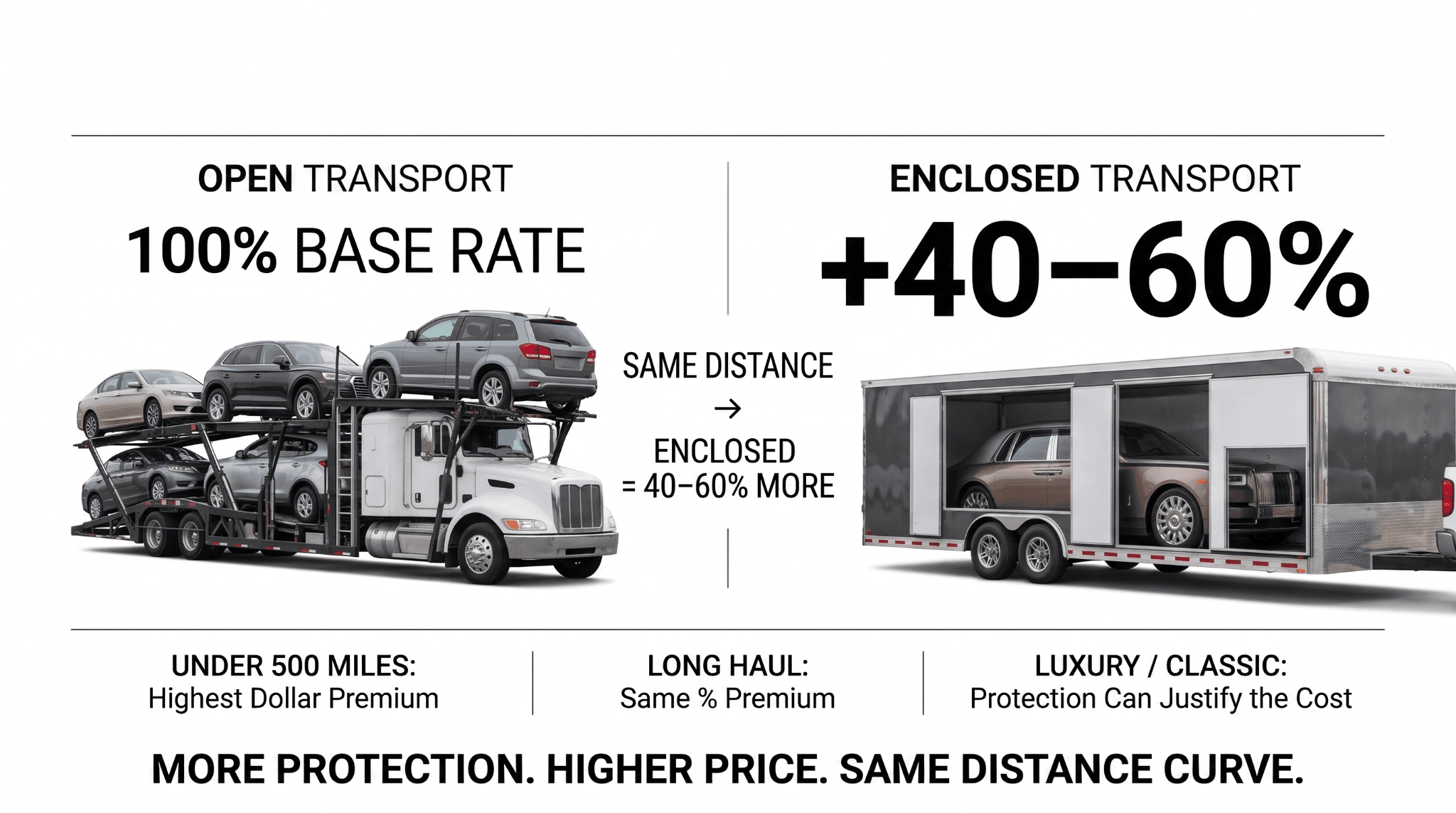
Enclosed transport typically runs 40 to 60 percent above open transport rates at every distance band, reflecting the smaller vehicle capacity per trailer and the added weather and debris protection.
The enclosed car transport cost per mile follows the same distance curve as open transport, just shifted higher across the board:
Short routes under 500 miles see the steepest enclosed premium in dollar terms.
Long-haul routes still benefit from the same fixed-cost-spreading effect, keeping the percentage premium consistent even as both numbers drop.
This consistency matters when comparing quotes, since a legitimate enclosed rate should track roughly 40 to 60 percent above the open rate for the same distance band, no matter which carrier is quoting it. A number well outside that range, in either direction, is worth a second look. Checking your quote against typical car shipping rates per mile in the USA 2026 for both open and enclosed transport is a quick way to confirm you're being priced fairly.
Enclosed car shipping cost per mile 2026 estimates are worth requesting, specifically if you're shipping a luxury, classic, or high-value vehicle, since the added protection against road debris and weather exposure is usually worth the premium for these vehicle types. For everyday sedans and SUVs, open transport remains the standard, cost-effective choice.
How Do You Estimate Your Own Route?

Estimate your own route in three steps: find your total mileage, match it to the closest 500-mile band, then multiply by that band's per-mile range to get a cost window.
Find your route's total mileage using a mapping tool or a carrier's online quote form.
Match your mileage to the closest 500-mile band shown in the table above.
Multiply your mileage by the per-mile range for that band to get an estimated total cost.
For example, a 1,200-mile route falls into the 1,001-1,500 mile band, priced at roughly $0.65 to $1.00 per mile, putting the estimate between $780 and $1,200.
This gives a reasonable starting point, though an instant quote will always be more precise since it accounts for your specific vehicle and timing. The average cost to ship a car per mile from any online calculator should be treated as a baseline, not a final answer.
Car hauling rates per mile can also vary by a specific carrier's current capacity, so cross-checking your estimate against more than one source is worth the extra few minutes. Auto transport rates per mile 2026 figures published by different brokers can vary slightly even for the same route, which is exactly why a real quote beats a generic average.
What Shippers Ask Most About Per-Mile Pricing
Pricing questions come up on nearly every call we take, so here are direct answers to the ones asked most often.
What is the cost per mile to ship a car?
It ranges from about $1.90 per mile on routes under 500 miles down to $0.58 per mile on coast-to-coast hauls. The average car shipping cost per mile in 2025 or 2026 has stayed within this same range, since the underlying distance-based pricing logic hasn't changed year to year.
Why do short trips cost more per mile?
Every shipment carries the same fixed costs, like dispatch and loading, which get divided across fewer miles on a short trip. That pushes the per-mile rate up even though the total price is lower.
How do I calculate my shipping cost?
Find your total mileage, match it to the closest 500-mile band, and multiply by that band's per-mile range. This gives a reasonable estimate before requesting a real quote.
Is the per-mile rate the same for SUVs?
No. SUVs and trucks typically add $100 to $400 over a standard sedan at the same distance, since they take up more trailer space and increase fuel use.
Does the rate include fuel surcharge?
It depends on the provider. Always confirm whether your quote already includes fuel surcharges or bills them separately, since this can meaningfully change your final total. Checking current car transport rates per mile in 2026 against your specific quote is a useful way to spot whether a surcharge has been folded in or not.
Get a Rate Built On Your Actual Route
Distance sets the general range for car shipping cost per mile, and the 500-mile bands above give a solid frame of reference, but your final price always depends on details only a direct quote can capture. Average car shipping cost per mile open transport 2026 figures are useful for budgeting, but they were never built around your specific vehicle and timeline.
Checking current car shipping rates per mile in the US 2026 against the bands above is a useful sanity check, but averages are still just a starting point for planning a budget, not a substitute for a real number tied to your exact vehicle, transport type, and route. The bands and examples covered here should narrow your expectations considerably before you ever request a quote, which makes it much easier to spot a number that seems unusually high or suspiciously low. This holds true whether you're comparing average car shipping rates per mile in the US 2026 data or a single live quote from one provider.
Get your free, price-locked quote today and see an accurate, distance-based rate for your exact route, locked in for 7 days with no upfront payment required.